In May 2026, Narendra Modi stood in Oslo alongside the Norwegian Prime Minister and a journalist asked him a question. Not a hostile question. Not a trick. A simple, direct question from Helle Lyng of the Norwegian newspaper Dagsavisen: why does he not take questions from the world's freest press? Modi did not respond. He walked away from the podium. The moment went viral because it touched something that twelve years of carefully managed messaging had been built to avoid. The export version of India under Prime Minister Modi cannot survive unscripted contact with the international community he tries to impress.
What followed was more revealing than the walk away. BJP IT Cell chief Amit Malviya called Lyng a 'delinquent journalist'. BJP supporters labelled her a foreign plant, a spy and a Chinese proxy. Her X account had been verified only days before Oslo, which the BJP's online apparatus used to question her motives. Her Instagram and Facebook accounts were subsequently suspended after the coordinated trolling campaign. She had to publicly clarify she was not a foreign spy of any sort. The Indian Embassy in Norway invited her to a separate briefing where the MEA Secretary responded to her questions with a lecture on India's civilisational heritage, yoga, chess and vaccine diplomacy. She briefly walked out of that briefing on camera.
NDTV anchor Gaurie Dwivedi then invited Lyng for an interview and asked her what she knew about India. Lyng said yoga and curry. The clip went viral in India, celebrated as a demolition. This is Indian mainstream media in the Modi era — not a check on power but its most reliable international defender.
Modi has not held a single solo press conference on Indian soil since taking office in May 2014. The one televised appearance alongside Home Minister Amit Shah produced his signature pattern: every substantive question deflected to Shah, every difficult moment managed by proximity to someone else. When elections approach, he grants access to anchors whose questions, the opposition has consistently alleged, are agreed in advance. In 2024 he gave 80 such interviews to national channels and regional newspapers — averaging more than one daily during the campaign period — choreographed appearances in which one anchor asked him how he managed to work so hard at his age. Between elections he communicates through Mann Ki Baat, a radio monologue broadcast to millions in which no one can ask anything.
Abroad, the story is no different. The one joint press conference he attended — alongside Joe Biden at the White House in June 2023 — produced one of the most revealing moments of his career. A Wall Street Journal reporter, Sabrina Siddiqui, asked what steps his government would take to improve the rights of Muslims and other minorities. Modi replied through a translator that India lives democracy as laid out by its constitution, that there is absolutely no space for discrimination. He said he was surprised by the question. His supporters launched an immediate harassment campaign against Siddiqui, questioning her religion and her motives. The White House condemned it. Modi said nothing.
At the international podium, Modi sells India's civilisational values — democracy, the ancient wisdom of non-violence and peaceful coexistence, the universal brotherhood of Vasudhaiva Kutumbakam. India, he says, is not merely the world's largest democracy. It is the mother of democracy. But when the Wall Street Journal's Sabrina Siddiqui asked what democracy means for Muslims and minorities in India, what she heard back from India was a lynch mob. The mob back home is not a contradiction Modi manages. It is a system he has built. Internationally, he has no choice but to hard sell the values India is known for — whether or not they are available at home.
The India Being Built at Home
India's domestic reality is not something New Delhi will be proud of showing to an international audience. Since the BJP came to power in 2014, mob lynchings under the pretext of cow protection have risen steadily. The victims are overwhelmingly Muslim. Eight vigilantes convicted of lynching a 45-year-old Muslim meat trader were garlanded by a Union Minister in Modi's cabinet. A cow vigilante received an election ticket from the BJP in Karnataka. The BJP government at the centre told parliament in 2022 that it does not maintain data on mob lynchings. If you do not count the bodies, the bodies do not exist.
The pattern of intimidation goes beyond the mob. During Hindu religious processions across India, hate-filled songs calling for violence against Muslims are blared from loudspeakers as marchers pass through Muslim neighbourhoods and outside mosques. The processions have repeatedly turned violent. Muslim homes and mosques have been torched. Most mob attacks against Muslims follow this pattern — a large procession, provocative music, and then the violence that follows. The central government has declined to address it as a systemic issue.
The love jihad laws — enacted across multiple states — criminalise interfaith relationships under the guise of preventing forced conversion. The theory behind them, promoted by Hindu nationalists and BJP leaders, is that Muslim men systematically lure Hindu women into marriage to convert them to Islam. An independent 2024 assessment found that love jihad accusations were the second most common motivator for communal violence targeting Muslims, accounting for 18 per cent of such incidents from mid-2019 to mid-2024. Since 2020, when Uttar Pradesh enacted its anti-conversion law, 835 cases have been registered and 1,682 arrests made. As of mid-2024, not one case had produced a conviction while hundreds of Muslim men spent months or years in pretrial detention.
The BJP frames the Citizenship Amendment Act of 2019 as a humanitarian gesture — protection for persecuted religious minorities fleeing Afghanistan, Bangladesh and Pakistan. The Act offers that protection to Hindus, Sikhs, Buddhists, Jains, Parsis and Christians. It excludes Muslims. India's minorities law has no room for India's most persecuted minority. The United Nations High Commissioner for Human Rights called it fundamentally discriminatory. India's government dismissed the observation.
The bulldozer has become the BJP's signature instrument. State governments led by the party have used demolition orders to raze the homes and properties of Muslims accused of crimes, in some cases before any trial, in others after protests that the government found inconvenient. The Supreme Court eventually issued guidelines limiting the practice. Several BJP governments continued it anyway.
India's press freedom ranking was 140th of 180 countries when Modi took office in 2014. By 2026 it had fallen to 157th, placing India in the very serious category according to Reporters Without Borders. The country that in May 2026 asked the question Modi refused to answer — Norway — ranks first. The distance between those two numbers is the distance between what India claims to be in the world and what it is.
'India' Made for Export
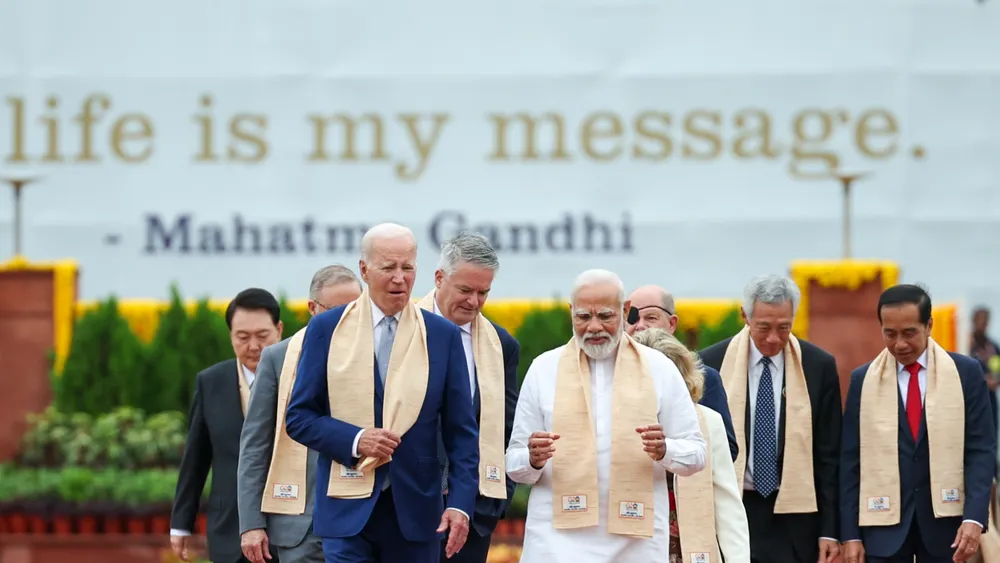
At the 2023 G20 summit in New Delhi, whose motto was Vasudhaiva Kutumbakam — the world is one family — Modi presented India to the world as the voice of the Global South, the civilisational bridge between East and West, the teacher whose ancient wisdom the fractured modern world requires. The same philosophy invoked at his first address to the United Nations General Assembly in 2014. The same framing deployed at every multilateral gathering since. One Earth, One Family, One Future.
This export version of India works because the inheritance is genuine. Vasudhaiva Kutumbakam is not a BJP invention. It comes from the Maha Upanishad, composed centuries before the RSS existed. The Non-Aligned Movement, the Panchsheel principles, the constitutional commitment to secularism and equal citizenship — these are Nehruvian achievements that the BJP has spent twelve years quietly dismantling at home while loudly deploying abroad. The ideals have survived not because of the BJP but despite it. Modi is spending down an inheritance he did not build and is not replenishing.
The India Modi preached and the India he practised were not the same country. Principled foreign policy costs something precisely because it is principled. Under Modi, foreign policy has a transactional logic. State visits create relationships. Relationships create contracts. Nehru went abroad to build a world order. Modi goes abroad to build a balance sheet.
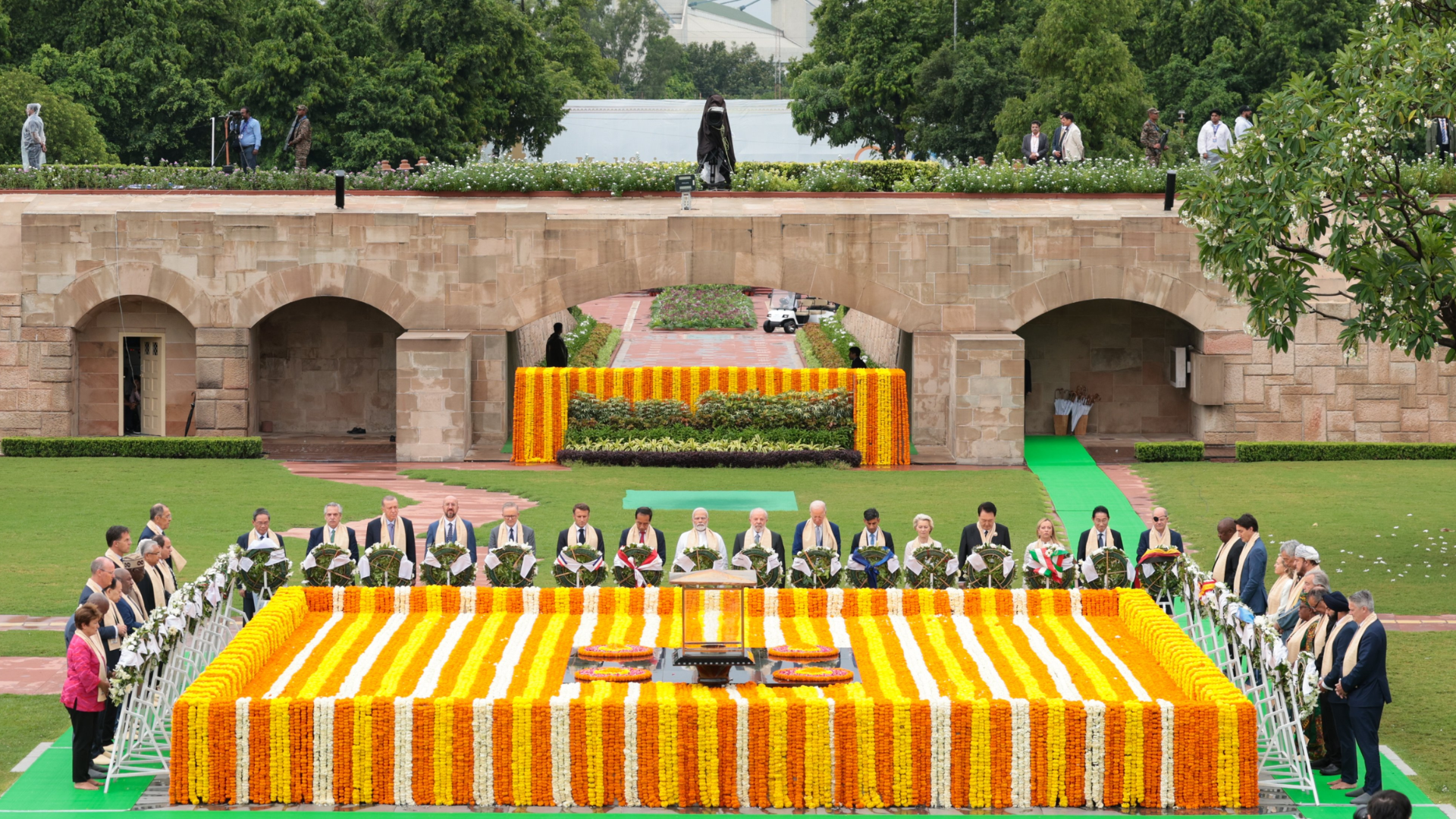
Abroad, Modi lays wreaths at Gandhi's statue because Gandhi is the only Indian the world recognises as a moral authority. At home, BJP members of parliament have called Gandhi's assassin a patriot — in parliament, on record, without lasting consequence. The BJP has spent over a decade trying to erase Nehru from India's story. It has renamed roads, revised textbooks and built an alternative nationalist pantheon. But the erasure is selective and the irony is structural. The BJP abhors the India that Nehru and Gandhi built. It has simply not found a replacement the world will listen to. So it borrows their language, lays their wreaths and speaks their values at every international podium — because these are the only words that open doors abroad. Gandhi and Nehru are the export version's most essential props. The BJP's contempt for them is strictly for domestic consumption.
The Geometry of the Contradiction
This is where the BJP diverges from every comparable hard right movement in the world. Viktor Orbán does not moderate his message for Brussels. He exports the illiberalism as the product, openly and proudly. Marine Le Pen, Giorgia Meloni, the AfD — all of them present broadly the same ideological face at home and abroad. The nativist, the exclusionary, the anti-Muslim: this is what they sell everywhere.
Modi cannot do this. The Hindutva project — Hindu nationalism, Muslim othering, the conversion of citizenship into a Hindu entitlement — cannot survive being the export version because it would destroy the international legitimacy that insulates the domestic project from external pressure. The moment the world sees the bulldozers alongside the Sanskrit, the brand collapses. So there are two versions. One for the base. One for the world. And a press conference is the room where both versions would have to exist simultaneously, which is why there is no press conference.
The domestic and international versions of BJP India are not in tension. They are in symbiosis. The Hindutva consolidation at home creates the stable political base that gives Modi the authority to project international ambition. The international legitimacy and the Vishwaguru brand insulate the domestic project from external interference. Each makes the other possible. The man who presides over the lynchings and the demolitions needs the G20 podium. And the G20 podium needs the man who has consolidated enough domestic power to claim he speaks for 1.4 billion people.
What holds this architecture together is control of the image. Mann Ki Baat instead of press conferences. A media pool composed of government-aligned outlets who have agreed their terms of access, not independent journalists who might ask an unscripted question. Friendly anchors in carefully arranged studios. And when a journalist in Washington or Oslo asks the question that the export version cannot answer — the question about Muslims, about press freedom, about the gap between the constitution Modi invokes and the India his government is building — the answer is a long-winded assertion about democracy being in India's DNA, then silence, then a walk away from the podium.
In 2007, when Modi was still Chief Minister of Gujarat, journalist Karan Thapar sat down with him for an interview and began asking about the 2002 Gujarat riots, in which over a thousand people, mostly Muslims, were killed. Modi ended the interview within minutes. He removed his microphone. He said, in Hindi, dosti bani rahe — let friendship remain. And he walked away. Nineteen years later, in Oslo, the microphone comes off at a different podium, the language is silence rather than Hindi, and the friendship being maintained is with a world that has not yet decided to look at what is being built behind the export version.
Jawaharlal Nehru visited Norway in June 1957. The Norwegian president introduced him to the press as a leading statesman of the world and urged journalists to avail of the rare opportunity of asking questions to such an acclaimed personality. Nehru told the Norwegian press: I shall leave myself in your hands to be dealt with, I hope, gently and kindly. Sixty-nine years later, his successor walked away from a Norwegian journalist who asked a single question. The distance between those two moments is not the distance between two prime ministers. It is the distance between two ideas of what India is.
What the Inheritance Costs
India's democratic and civilisational traditions are deep enough to survive twelve years of a government systematically working against them. The Constitution has been tested. The Supreme Court has sometimes held. The opposition exists. The press, diminished and pressured, has not been extinguished. The India before Modi was not a perfect democracy. But it was a serious one, with institutions that took their own principles seriously.
What the BJP has done is not destroy those institutions. It has hollowed them out while using their language. The courts still sit. The elections still happen. The Constitution is still invoked. But the content has been slowly replaced. The secular state speaks the language of Hindu civilisation. The world's largest democracy has a prime minister who has not faced a press conference in twelve years. The government that calls itself the voice of the Global South refuses to count its own lynching victims.
The export version is still working. The world still buys it. The G20 chair, the BRICS convener, the voice of the Global South, the Vishwaguru of Vasudhaiva Kutumbakam — all of it still lands at international podiums with the weight of genuine civilisational depth behind it, because the inheritance is real even when the inheritor is not.
But inheritances are not infinite. Every lynching that goes uncounted, every journalist who loses accreditation, every Muslim man held in pretrial detention on a love jihad charge that will never produce a conviction, every family watching its home fall to a bulldozer on a charge never tested in court — these are withdrawals from the account. The balance is still positive. The brand still travels. Modi still walks away from the podium and the world still invites him back.
The question is not whether India's democratic inheritance can survive this government. It probably can. The question is what it will look like when this is over, and whether the export version will still have something genuine behind it, or whether it will have already become what it is becoming — a performance increasingly disconnected from the reality it claims to represent.
This Analysis is part of India Examined — DiploPolis's ongoing analysis of Indian foreign policy since 2014. What India claims to be in the world. What it actually is. And what the gap between those two things costs.
Previously in this series: The Vishwaguru the World Never Knew
This Analysis piece is free to read. Future Analysis pieces will be available to registered DiploPolis members first. Free registration takes 30 seconds. No credit card required.