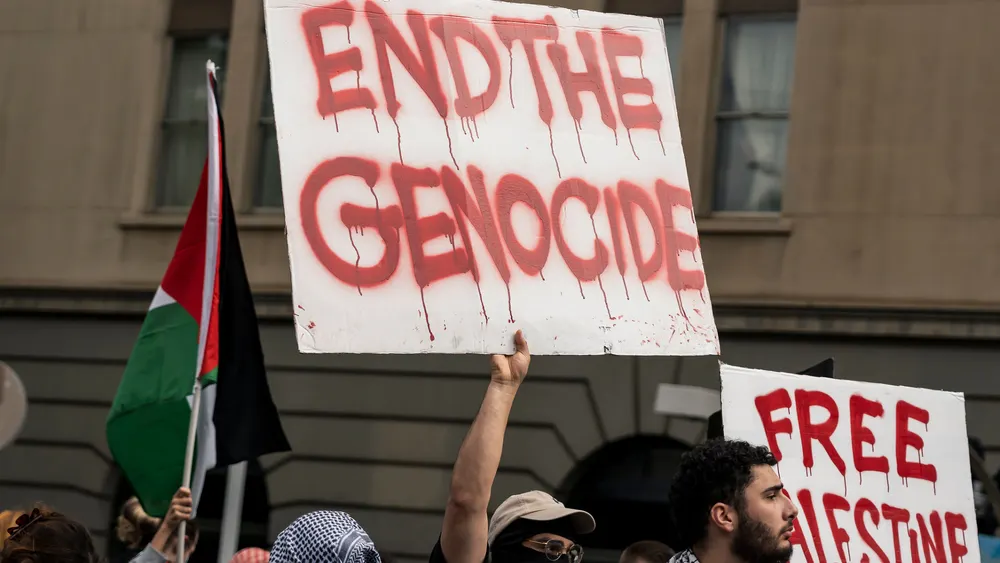
On January 26, 2024, Justice Dalveer Bhandari of India sat among seventeen judges in the Peace Palace in The Hague and voted to apply the Convention on the Prevention and Punishment of the Crime of Genocide to the situation in Gaza. The vote was 15 to two. The two who voted against were Judge Julia Sebutinde, appointed by Uganda, whose government subsequently issued a statement repudiating her position, and Judge ad hoc Aharon Barak, appointed by Israel as its own representative on the bench. The fifteen who voted in favour came from across the court's membership: Germany, France, Lebanon, China, Suriname, Jamaica, Japan, Morocco, Slovakia, Australia and Brazil among them. And India. A judge from a country that was not in the room when Raphael Lemkin built the instrument being applied was now part of the majority applying it.
Lemkin died 65 years before that vote, on August 28, 1959, having collapsed in midtown Manhattan. He was 59 years old, penniless, and alone. He left behind a bare rented room, some clothes, and an unsorted pile of papers. Seven people attended his funeral. The New York Times editor A.M. Rosenthal, who had been his friend, later wrote that Lemkin 'had no money, no office, no assistants.' He had, Rosenthal said, only himself, a briefcase, and a conviction. The conviction was that the world needed a word, and then a law, and then a court that could apply the law. He got all three. He did not live to see what the law, in the hands of the court, could and could not do.
The Word and What It Cost Him
Lemkin coined 'genocide' in November 1944 in a book called Axis Rule in Occupied Europe, published by the Carnegie Endowment for International Peace. The word came from the Greek genos, meaning race or tribe, and the Latin cide, meaning killing. Its construction was precise. Lemkin was a lawyer and a linguist, he spoke nine languages, and he chose the roots deliberately: he wanted a word that was clinical enough for a courtroom and resonant enough to force governments to reckon with what it described. 'New conceptions require new terms,' he wrote.
He had been trying to get there since 1933, when as a young Polish lawyer he had proposed an international convention against 'barbarity' at a League of Nations conference in Madrid. He was rebuffed. By the time Axis Rule was published, the reason he had spent a decade trying to build an international legal category for the destruction of peoples had become unignorable. Forty-nine members of his family, including his parents, had been killed in the Holocaust, his mother and father gassed at Treblinka in 1943. He learned of their deaths while working at the Nuremberg trials, where he was serving as an advisor to the chief US prosecutor, Justice Robert Jackson.
He got the word 'genocide' into the Nuremberg indictment, but it was not yet a legal crime with its own standing. The Nuremberg verdicts covered crimes committed in conjunction with an aggressive war. What Lemkin wanted was something that reached further: a convention that criminalised the destruction of groups as such, in peacetime as well as war, by any government against any people. He spent the next five years lobbying every delegation at the newly formed United Nations, drafting statements for thirty different ambassadors, persuading Cuba, India and Panama to co-sponsor the initial resolution. His unpublished autobiography, which he called Totally Unofficial Man, documents the cost: 'Poverty and starvation. My health deteriorates. Living in hotels and furnished rooms. Destruction of my clothes. Increased number of ratifications... The labors of Sisyphus.'
On December 9, 1948, the United Nations General Assembly adopted the Convention on the Prevention and Punishment of the Crime of Genocide by a vote of 55 to zero. It was the first legally binding human rights treaty in UN history. Lemkin was in the gallery. He wept. He then spent the remaining eleven years of his life lobbying countries to ratify a convention they had already unanimously voted to adopt, because he understood what unanimous votes without ratification were worth. By the time he collapsed in midtown Manhattan, sixty countries had ratified it. The United States had not. It would not for another twenty-nine years.
The Convention Lemkin built defined genocide as acts committed with intent to destroy a national, ethnical, racial or religious group, in whole or in part. The acts enumerated were specific: killing members of the group; causing serious bodily or mental harm; deliberately inflicting conditions of life calculated to bring about the group's physical destruction; imposing measures to prevent births; forcibly transferring children. The definition was tight and the drafting was deliberate. But the requirement of intent, that the acts be committed with the intent to destroy, was the Convention's sharpest edge and its most contested one. To prove genocide, you must prove not just that people were killed or starved or displaced, but that they were killed or starved or displaced with the specific purpose of destroying the group as such. States accepted that definition partly because Lemkin insisted on precision and partly because they knew the intent threshold would be difficult to meet. A law that is hard to apply is easier to sign.
What the Court Saw and What It Could Not Do
South Africa filed its application against Israel at the International Court of Justice on December 29, 2023. In an 84-page document, it alleged that Israel's actions in Gaza were genocidal in character, intended to bring about the destruction of a substantial part of the Palestinian national, racial and ethnical group. It invoked the Genocide Convention and asked the court to issue provisional measures, binding interim orders requiring Israel to halt the conduct alleged while the case proceeded. Both South Africa and Israel are parties to the Convention, giving the court jurisdiction.
The court heard arguments on January 11 and 12, 2024, and issued its order fifteen days later. The 15-2 majority found that South Africa had standing and that Palestinian rights under the Genocide Convention were plausible, not proven, but plausible enough to warrant provisional protection. The court ordered Israel to take all measures within its power to prevent acts falling under Article II of the Convention in relation to Palestinians in Gaza; to ensure its military did not commit such acts; to prevent and punish incitement to genocide; to allow humanitarian assistance; and to preserve evidence. It required Israel to file a compliance report within one month.
The court did not order a suspension of military operations. It did not find that genocide had occurred. What it found was that the situation was serious enough, and the rights asserted plausible enough, that Israel was legally bound to take steps to prevent the worst outcome while the full case was argued. Justice Bhandari wrote in his declaration that 'the widespread nature of the military campaign in Gaza, as well as the loss of life, injury, destruction and humanitarian needs following from it, much of which is a matter of public record, are by themselves capable of supporting a plausibility finding with respect to rights under Article II.' He condemned the October 7 attacks. He voted for the measures.
Israel filed its compliance report on February 26, 2024. The court did not release it to the public. Within weeks, the UN Special Rapporteur Francesca Albanese reported that Israel appeared to be in breach of the provisional measures, citing the killing of more than 1,755 Palestinians since the order was issued and the continued restriction of humanitarian aid. Amnesty International said Israel had failed to take the 'bare minimum' steps to comply. Human Rights Watch stated it was not complying with at least one measure. The court reaffirmed its orders in March and again in May 2024. The measures remained in place. The compliance remained contested. The court had no enforcement mechanism. It could order. It could not compel.
What He Would Have Built
This is the question the ICJ's provisional measures place before Lemkin's legacy. The instrument worked: a court applied it to one of the most scrutinised conflicts of the contemporary era and found the threshold for provisional measures met. The law was precise enough to reach the situation. What it could not do was change the situation, because precision in law does not produce enforcement, and enforcement requires power, and power was on the other side.
Lemkin knew this. His autobiography documents not just his poverty but his clarity, the 'labors of Sisyphus' is not an accidental metaphor. He understood that the Convention's survival depended on ratification by states that had every incentive to ratify and limited incentive to apply. He lobbied for ratification regardless, because he understood something about the architecture of accountability that the ICJ proceedings in The Hague have now confirmed: naming is the precondition for accountability, even when accountability is deferred.
The Convention did not fail at The Hague. It performed exactly the function Lemkin designed it to perform. The ICJ found that South Africa's case was plausible under the Convention's terms. It applied the law to the facts before it and issued orders accordingly. What it could not do, what no legal instrument can do, is compel a state backed by a Security Council veto to comply. That is not a failure of drafting. It is the political architecture within which the drafting had to operate, and which Lemkin understood before he died in midtown Manhattan with seven people at his funeral.
The question of whether he would have built it differently assumes that a different design was available. It was not. The Convention's intent threshold was the price of the signatures. The enforcement gap was the price of state sovereignty. The limitations were not oversights. They were the conditions under which the thing could be built at all. A Genocide Convention that states would not ratify was no Genocide Convention. Lemkin took what was achievable and made it as precise as possible within that constraint, because he understood that a flawed instrument that names the thing correctly is more valuable than silence: not because it stops the thing, but because it outlasts the political conditions that prevent anyone from stopping it.
Justice Bhandari's vote on January 26, 2024 is what Lemkin was building toward. A judge from a country that had itself been colonised, whose independence had been extracted from the same imperial system that produced the Holocaust's legal impunity, applying the Convention to a situation that the states which built the post-war legal order were protecting from scrutiny. The Global South judge voted for the instrument the Global South was not asked to design. That is not a vindication of the system. It is proof that the instrument, flawed as it is, reached further than the system intended.
Lemkin did not die defeated. He died having done the one thing that could not be undone. He gave the world a word, and a court that, seventy-six years later, would find that the word applied.
This Analysis piece is free to read. Future Analysis pieces will be available to registered DiploPolis members first. Free registration takes 30 seconds. No credit card required.
Find this piece interesting?
Dispatches by DiploPolis delivers sharp analysis and pointed commentary on power, politics, diplomacy, and world affairs — directly to your inbox.
No neutrality. No noise. Just argument.