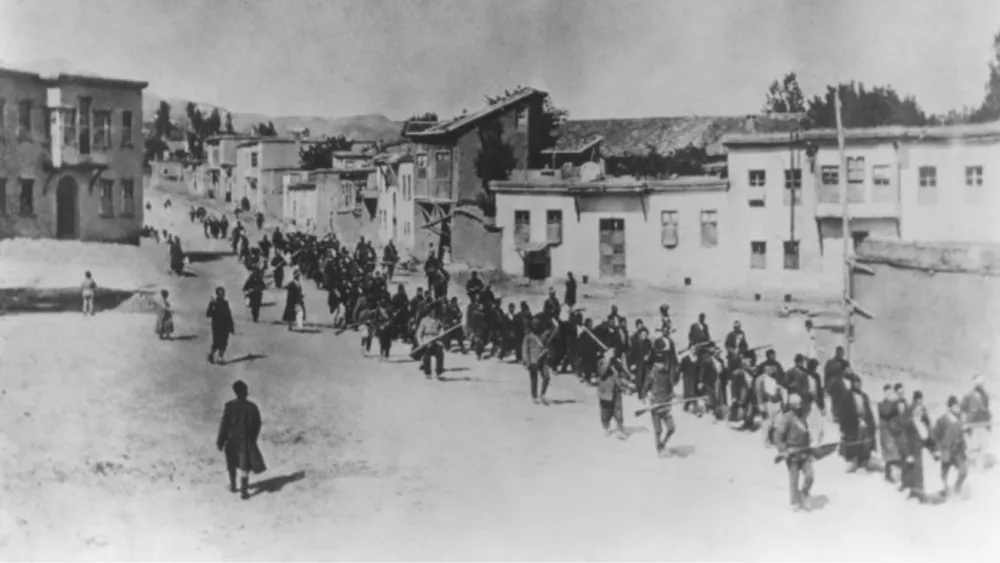
On June 28, Israel's Cabinet unanimously recognised the Ottoman massacre of Armenians during the First World War as genocide. Foreign Minister Gideon Sa'ar called it a moral obligation. Prime Minister Netanyahu said he certainly supported it. The decision still requires parliamentary ratification. The statement from Jerusalem described the Armenian Genocide as the subject of 'an institutionalised campaign of denial and minimisation, including a manipulative rewriting of history.' Israel, Sa'ar said, must stand against the erasure of historical truth.
On January 26, 2024, the International Court of Justice found it plausible that Israel's acts in Gaza could amount to genocide. The court issued binding provisional measures ordering Israel to take all steps within its power to prevent genocidal acts, to ensure humanitarian aid reached Palestinians under siege, and to preserve evidence of crimes committed. The case, brought by South Africa, is ongoing. A final judgment will take years. The provisional measures have not been complied with in any meaningful sense. More than 73,000 Palestinians have been killed in Gaza. Over 1,000 have been killed under an active ceasefire. The ICJ has issued three separate rounds of emergency orders. Israel has continued its operations, expanded its territorial control and, last week, told the residents of two Lebanese cities to evacuate.
Turkey said Israel's recognition was politically motivated — 'a malicious attempt' to cover up Israel's own crimes. 'The Israeli government, which systematically persecutes the Palestinian people in full view of the world and is being tried at the International Court of Justice for genocide against the people of Gaza, aims to cover up its own crimes,' the Turkish Foreign Ministry said. Turkey has a specific interest in preventing genocide recognition — Ankara has campaigned for decades to ensure the Armenian massacres are not designated as such, making the accusation of bad faith from the country doing the denying particularly layered. But Turkey's cynicism does not make the observation wrong. The timing of Israel's recognition is not a moral coincidence. The Cabinet did not vote on this in a neutral week. It voted in the same month that the UN independent experts it hosted accused Israel of deliberately shooting children in Gaza.
The word genocide was coined by Raphael Lemkin, a Polish-Jewish lawyer, in 1944 — a direct response to the Holocaust and, specifically, to the Armenian massacres. Lemkin had been documenting the Ottoman campaign against the Armenians since the 1930s. He argued, long before the Holocaust was completed, that the systematic destruction of a group of people required a name, a legal category and a mechanism of prevention. Israel was founded, in part, in the shadow of that catastrophe. Its founding generation understood what it meant to be the target of systematic destruction. The state that emerged from that history has now formally deployed the word genocide against the Ottomans, while simultaneously contesting its application to its own conduct before the world's highest court.
This is not a new kind of argument. States have always used the vocabulary of atrocity selectively. Powerful countries recognise the genocides of others while insisting their own acts are different — more complex, more contextual, more legally ambiguous. The Armenians know this. They have been waiting for recognition from most of the world for over a century and have received it, when it came, primarily when it served someone else's diplomatic interests. That Israel has now added its recognition to the list is not meaningless. The Armenian Genocide happened. Recognising it is correct. The 1.5 million who died deserved a reckoning that took too long to arrive.
What the CBS News report noted — that this was 'driven by deteriorating relations with Turkey' — makes plain is that the recognition arrived when it was useful, not when it was only right. Sa'ar described it as a moral obligation. A moral obligation does not wait for the right diplomatic moment. It does not arrive simultaneously with an ICJ genocide case and the need to rebuke Ankara. This one did.
The Armenian people have a right to see their history named for what it was. They have been fighting for that right for more than a hundred years and should not have to feel ambivalent about any country's recognition, whenever it arrives and for whatever reason. The recognition is right. The timing is Israel's own statement about how it understands the word.
Lemkin spent his life arguing that genocide required a name because naming it was the first condition of preventing it. He died in 1959, largely unrecognised, having given international law its most important and most contested concept. He understood, better than most, that the word could be weaponised as easily as it could be honoured. He saw that too, in his time.