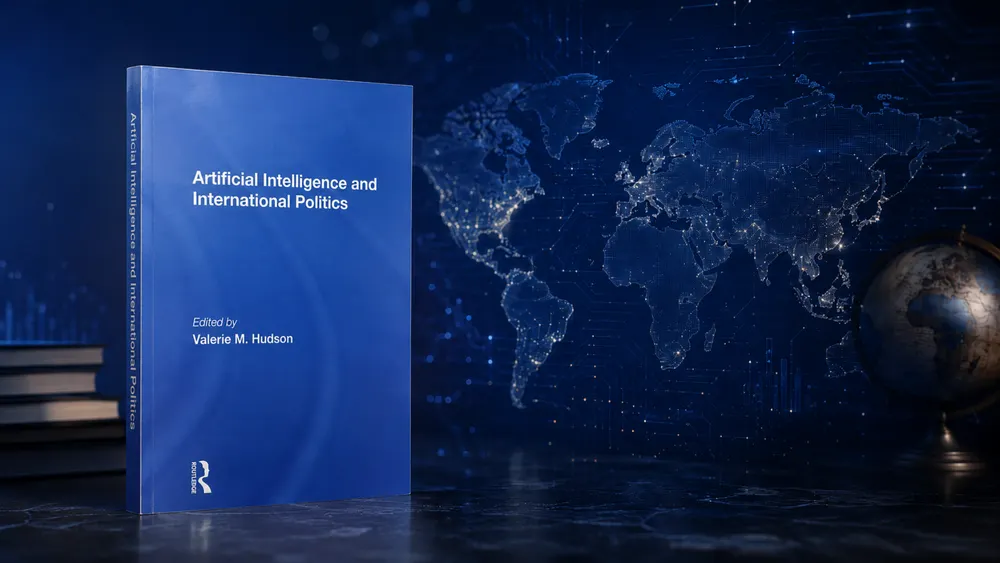
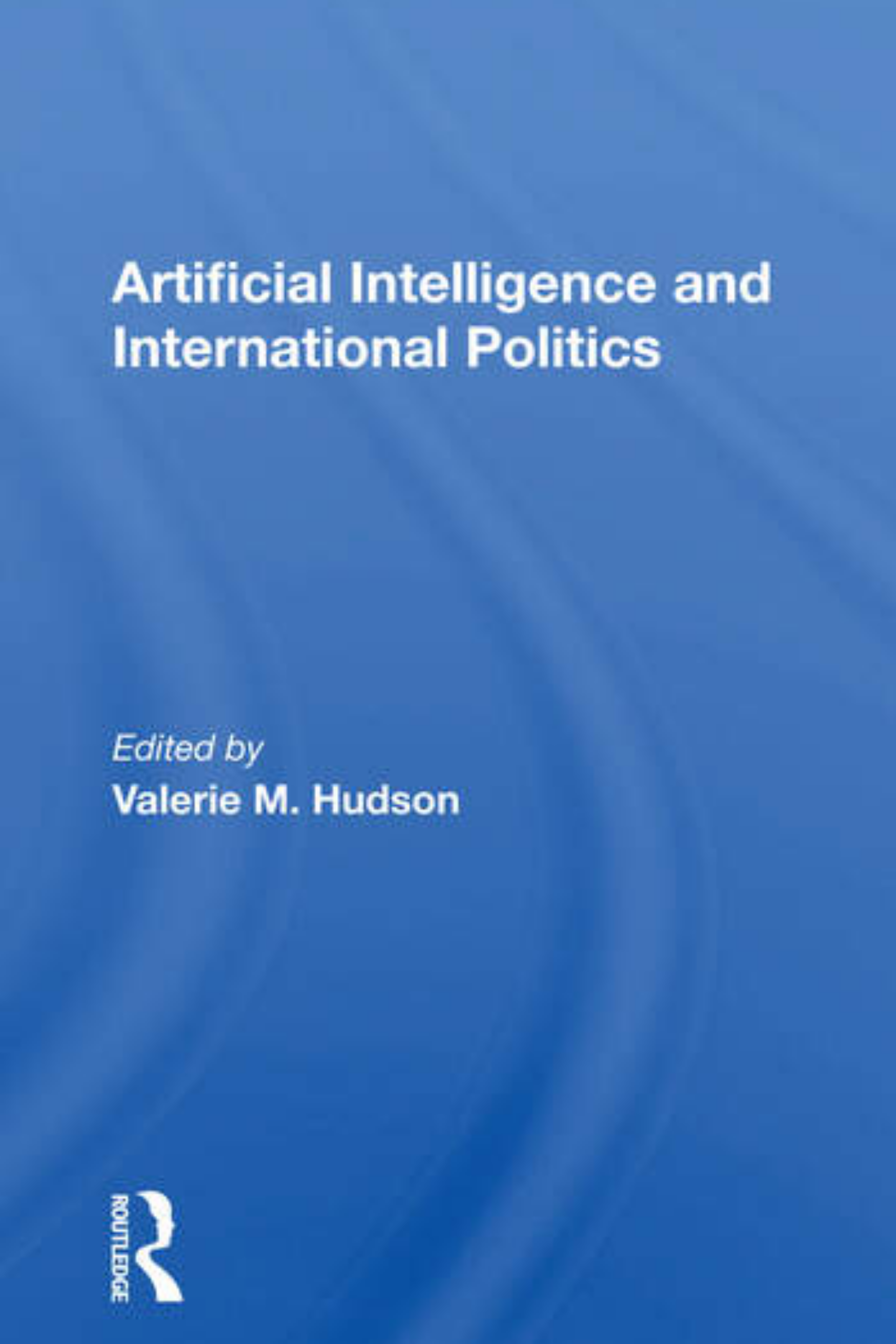
There is a particular kind of intellectual pathos in reading a book about the future written just before the future arrived in a form nobody anticipated. Artificial Intelligence and International Politics, published in 1991 and edited by Valerie M. Hudson, then at Brigham Young University and now Professor and George H.W. Bush Chair at Texas A&M, belongs to that category. Published to capture a field's best thinking about what artificial intelligence would mean for international relations, it records something valuable and something unexpected in equal measure. It is valuable as an account of how IR scholars once believed AI would work. It is unexpected because the AI that actually arrived bore so little resemblance to what those scholars imagined that the book now reads less as a guide to the present than as a map of a country that no longer exists.
That is not a dismissal. It is, if anything, a more interesting critical claim. Hudson's volume is a time capsule, and time capsules reveal not only the past they preserve but the distance between that past and where the reader stands. Reading it from 2026, with generative AI embedded in intelligence workflows, synthetic media reshaping information environments, autonomous systems being tested in conflict zones and language models sitting inside the everyday reasoning of diplomats, analysts and ordinary citizens, is to understand something important about what the field got right, what it got wrong and why the gap between the two matters for how we think about AI and international politics today.
The volume belongs to an earlier intellectual moment when artificial intelligence in IR meant something narrower and more orderly than it means now. It meant expert systems, decision rules, formalised reasoning, computational models and the attempt to make political judgement legible to machines. In that world, the strongest version of the claim was not that AI could predict international politics, but that modelling could expose the assumptions behind a theory. That is the part worth rescuing. A formal model forces the scholar to specify what the actor knows, what it wants, what options it sees, what rules it follows and what outcome counts as success. Even when the model fails, it can fail usefully. It reveals what the theorist smuggled in.
Hudson's volume mostly understands this distinction, but does not always resist the seduction of prediction. The computational elegance of formalised systems tempts the reader toward a stronger claim: that if the rules are sufficiently refined, the future becomes more legible. That is where the review should press. The volume is most valuable when it treats AI as a mirror held up to IR theory, forcing scholars to make their assumptions explicit. It is weakest when it hints that politics can be made machine-readable in any deep predictive sense. International politics can be modelled. It cannot be domesticated.
The deepest methodological limit of the computational approach is not one the volume fully reckons with, and it is worth naming. The approach can model choices once preferences are given. But in politics, the formation of preference is often the real story. Why does a state choose escalation when restraint would be materially wiser? Why does a leader prefer symbolic victory to practical gain? Why does a population accept economic pain for national dignity? The answer to these questions often involves something that formal modelling cannot adequately handle: humiliation.
Humiliation is the most absent element in Hudson's volume and in the computational IR tradition it represents. Fear appears. Misperception can be modelled, awkwardly. Ideology can be coded, with difficulty. Hierarchy appears in structure, though too abstractly. But humiliation is harder because it is not simply a preference, a perception or a material constraint. It is memory with a wound inside it. States do not only pursue interests. They pursue status, revenge, dignity, recognition and escape from shame. They remember defeats. They narrate insults. They convert past injury into present policy in ways that rational choice models find inexplicable.
For DiploPolis readers, this is not an abstract methodological point. South Asia cannot be understood without humiliation as a political category. Partition, the 1971 liberation of Bangladesh, the Sino-Indian war of 1962, Pakistan's structural insecurity, India's status anxiety, the desire to be recognised as Vishwaguru, the Sanskrit term for teacher of the world: none of this fits comfortably inside a model of rational choice under formalised constraints. The politics of humiliation does not replace material analysis. It explains why material analysis so often fails to predict what states actually do. A computational model can assign value to prestige or reputation. That is not the same as understanding why a wounded state will accept enormous costs to recover a symbolic position it has lost.
Looking from 2026, the field's most significant mistake was assuming that AI would enter international politics primarily as a specialised reasoning system sitting near the analyst. That was understandable at the time. The imagined AI was orderly, expert, domain-specific, legible. What arrived was more unruly: generative models embedded in public culture, synthetic media reshaping electoral environments, autonomous agents operating in conflict zones, algorithmic systems making bureaucratic decisions whose logic is invisible to the people subject to them, and language models sitting inside the everyday reasoning of governments, journalists and citizens who may not know they are being shaped.
IR scholars built formal models of how AI might reason about international politics. Then AI arrived as a force that changed the information environment in which everyone reasons about politics. The field expected AI to sit inside the analysis. It did not anticipate AI sitting inside the feed — inside the translation layer, the intelligence workflow, the propaganda network and the classified file.
And yet the field deserves credit for one important insight it articulated early and correctly: AI is not simply a technology of speed. It is a technology of formalised judgement. When judgement is encoded, automated, delegated or hidden inside a technical system, questions of accountability, bias, transparency and power do not disappear. They become harder to answer. Today's AI systems are ontologically different from the expert systems Hudson's volume represents, but that old question has not lost its force. What happens when human judgement is replaced by machine inference? Who is responsible? Who can challenge it? Who even knows it happened?
The question was right. The imagined machinery was wrong.
Artificial Intelligence and International Politics is not a guide to the AI politics of 2026. It is something more interesting: a record of the moment before the explosion, when the field still believed artificial intelligence would make international politics more formally intelligible. Read it for the methodological honesty of its best chapters, which show that modelling exposes assumptions without necessarily predicting outcomes. Read it for the humility it generates retrospectively, when you realise how much the field's imagination was constrained by the technology available to it. Read it, above all, as a reminder that the hardest questions about AI and power were being asked long before the technology became capable of answering them in ways nobody wanted. Then ask the question the book cannot answer, because it could not have known to ask it: what happens to international order when AI does not make the world more legible, but more saturated, more synthetic and harder to know?
This Book Review is free to read. Future Book Reviews will be available to registered DiploPolis members first. Free registration takes 30 seconds. No credit card required.
Find this piece interesting?
Dispatches by DiploPolis delivers sharp analysis and pointed commentary on power, politics, diplomacy, and world affairs — directly to your inbox.
No neutrality. No noise. Just argument.