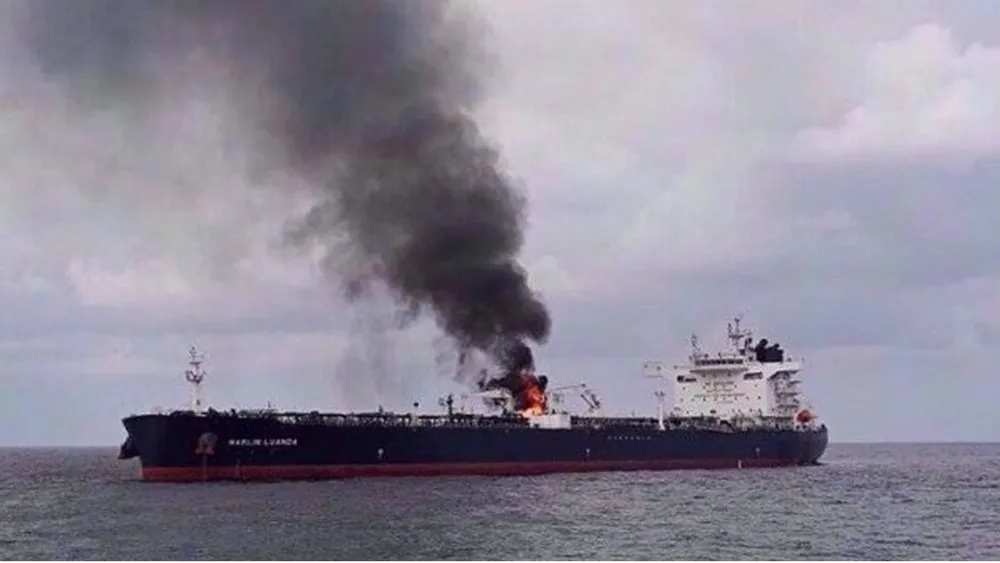
Sometime in the early hours of November 4 — while American votes were still being counted and before it was clear that Democrats would take both chambers of Congress — Iran's Islamic Revolutionary Guard Corps announced that four oil tankers had been destroyed after hitting naval mines south of the Strait of Hormuz. Two other vessels had been seized. A drone had been shot down over the strait. The IRGC said the tankers had tried to use a passage it had declared prohibited. They were 'rogue' and 'non-compliant.' They were still burning.
The timing is striking whether you read it as deliberate or not. Iran has maintained its blockade of the strait since the onset of the conflict with the United States and Israel in February. It has been the central economic pressure point in the entire war, a constraint that has pushed global oil prices higher and reduced Middle East crude exports by millions of barrels per day. By October, Middle East crude and fuel exports had fallen to 17.1 million barrels per day, down from 18.9 million in September. Each tanker attack makes the route more expensive to insure, which makes it more expensive to use, which raises prices for everyone who relies on what moves through the strait.
What is different about November 4 is not that four tankers were hit. It is what was happening simultaneously on the other side of the world.
Trump told the Financial Times in the days before the election that there would be no strikes on Iran before November 4. He did not rule out action after. His deputy Vance had sent a letter to Iranian security chief Mohsen Rezaei in the preceding week, reportedly at Trump's direction, to explore a framework for negotiations. Iran's Foreign Minister Abbas Araghchi described the outreach as 'a positive step.' Qatari mediators were active. Iran's president Masoud Pezeshkian said the supreme leader had given his government additional negotiating powers. The language of diplomacy was in circulation for the first time in months.
The tanker attack on election night does not contradict that diplomacy. It runs alongside it. Inside Tehran, there are competing centres of power and competing assessments of what the American election means for Iran's strategic position. Parliament Speaker Ghalibaf, who had been conducting negotiations as chief interlocutor, described the midterm result as a rejection of war. He warned Washington against ignoring its own voters. Araghchi suggested the strait could reopen within two days of an agreement, with nuclear issues addressed in a second phase. That framework has not been accepted by the United States.
The hardliners are reading the moment differently. State television commentators argued after the election that a symbolic strike of the kind that ended the initial 12-day exchange would no longer suffice, because the Strait of Hormuz remains unresolved. Iran's deputy foreign minister said Iran was legally and factually still in a state of war. Hardline lawmakers have been pressing the supreme leader to revise the religious ruling against nuclear weapons. Security chief Rezaei acknowledged that discussions about Iran's nuclear doctrine were underway, though he said no decision had been taken.
What exists now is this: a Democratic Congress that will push hard to end a war it opposed from the start; a president who said on Wednesday that he would launch the same war again; a strait that remains closed, mined, and under Iranian control; and a country that destroyed four tankers on the night its principal adversary voted against the conflict. These facts do not resolve into a single conclusion. They point in several directions at once, which is the condition of a war that neither side has decided to end.
Iran has made clear that its control of the Strait of Hormuz is not a bargaining chip it has forgotten it holds. The mines on election night were a reminder addressed not only to the ships that struck them but to the government in Washington, the new Congress convening in January, and every allied navy that has been escorting tankers through the strait since February. The question of who blinks first has not been answered. The mines suggest Iran is not planning to blink soon.