The Wall Street Journal reported last week that the Trump administration is pushing Viktor Orban for the position of UN Secretary-General, with backing from Russia and China. The story produced predictable reactions: Poland's foreign minister said Orban would not receive Warsaw's support; Ukraine's foreign minister said Orban would bring 'masterful veto and blackmail skills' to the position; Russia's deputy foreign minister said, technically and irrelevantly, that the five permanent Security Council members do not nominate candidates. The focus, in most of the coverage, was on Orban himself — his record in Hungary, his defeat in Hungary's April election, his proximity to Trump and Putin, his posture toward Brussels.
That focus is the wrong one. Orban may or may not become Secretary-General. He is not on the official straw-poll roster that the Security Council has been working through since August. His advisers are said to be telling the press that he will not formally enter unless he is confident of winning. The midterm elections on November 3 may or may not produce the political conditions under which Washington decides to spend capital on a campaign for him. Rebeca Grynspan, the Costa Rican head of UNCTAD, still leads the straw polls — all seven candidates in the official roster have received a 'discourage' vote from at least one permanent member, which means the contest is genuinely open.
The Orban question is uncertain. The consensus question is not. The United States, Russia and China have together backed virtually nothing in the Security Council since February 2022. They have agreed, according to the Wall Street Journal, on Viktor Orban. What is worth examining is not what that agreement says about Orban. It is what it says about the three governments that arrived at it — and about what they want from the institution whose leadership they are now jointly attempting to determine.
What Three Governments Have Found in Common
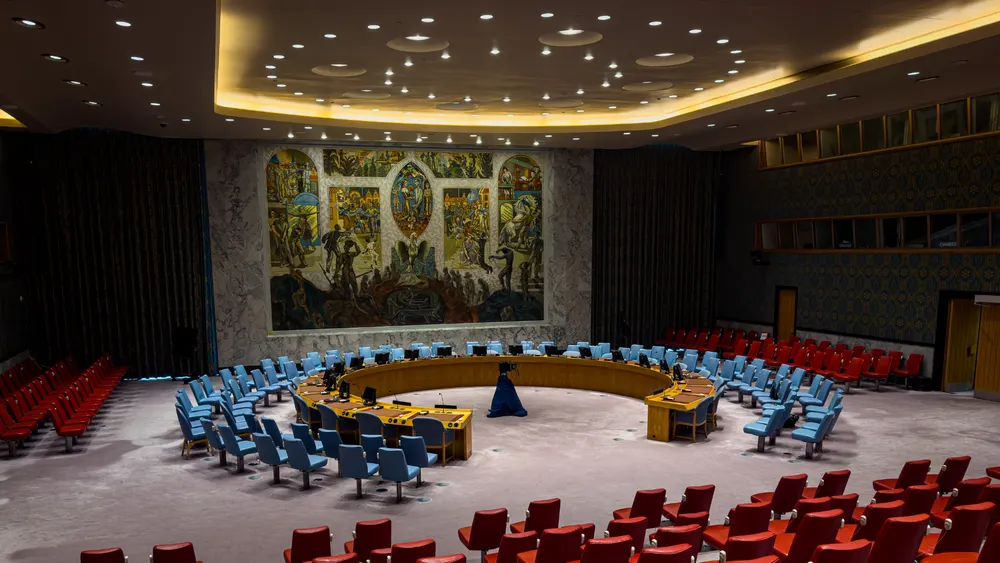
The post-2022 Security Council is a body defined by its inability to act. The Iran war has produced no Security Council resolution. The Syria reconstruction question has produced vetoes. The Sudan famine produced blocked referrals. The Council's Yemen resolutions have been either empty or contested. Since Russia's full-scale invasion of Ukraine in February 2022, the United States and Russia have not voted the same way on a substantive political resolution on any topic of active geopolitical significance. China, managing its relationship with both Washington and Moscow, has largely abstained on Russia-related matters while voting with Russia on most others.
This is not an institution these three governments agree on. It is an institution they each tolerate because each holds a veto, and because the veto means the institution cannot be used effectively against them. The UN is useful to all three precisely because it cannot be used against the permanent members' core interests. What it can be used for — by smaller states, by non-permanent members, by the Secretary-General in his personal capacity — is something more limited: framing, moral pressure, the creation of diplomatic records, the activation of humanitarian mechanisms, the provision of neutral ground for conversations that cannot happen bilaterally.
That residual function — the UN as a space for states without vetoes to do things the major powers could not prevent — is the function that the three governments have found common ground in wanting to constrain. A State Department official described Orban as a 'dream candidate for MAGA conservatives.' That description is accurate as far as it goes, but it understates the breadth of the consensus. Orban is not merely a dream candidate for MAGA conservatives. He appears to be a satisfactory candidate for the Russian and Chinese governments as well. The question is why.
What the Secretary-General Actually Does
The Secretary-General has no formal power to overrule the Security Council. The veto remains. P5 decisions cannot be blocked by the Secretary-General's preference. The Secretary-General cannot compel investigations, cannot force access, cannot order peacekeepers into a conflict without Council authorisation. On the formal powers, Orban would be as constrained as Guterres has been.
What Guterres has done, and what past Secretaries-General have done, is use the office's informal power: the public statement, the appeal to conscience, the invocation of the UN Charter's human rights provisions, the 'good offices' function that gives the Secretary-General standing to speak in conflicts where no party has requested his presence. Guterres invoked Article 99 of the UN Charter in November 2023 — a rarely-used provision that allows the Secretary-General to bring a matter to the Security Council's attention — in relation to Gaza. That invocation did not change the outcome. But it created a diplomatic record, shifted the moral framing, and forced the Council to formally consider the matter again.
Orban's record in Hungary is one of systematic removal of exactly these kinds of independent institutional voices. Courts, media, civil society organisations: when Orban has controlled institutions, he has subordinated them to his government's preferences. There is no reason to expect that he would exercise the Secretary-General's informal powers in ways that inconvenience the three governments that put him there.
This is not the conspiracy theory version of the Orban appointment. It is the straightforward reading of what the governments backing him want and what their candidate's record suggests he would deliver. They want a Secretary-General who does not use the office's moral authority against them. Orban would not. That is the nature of the consensus.
The Blocking Power They Have Already Used
Russia's deputy foreign minister's point — that P5 members do not nominate candidates — is technically accurate and practically beside the point. The formal UN process is that the Security Council recommends a candidate to the General Assembly, which then votes. But the Council's recommendation requires no P5 veto, which means all three governments backing Orban need to do is not veto him while ensuring he receives sufficient non-permanent member votes to be recommended. The WSJ reported that approximately eight of the fifteen Council members would 'easily' back Orban, potentially rising to ten.
The straw poll results — where all seven official candidates have received a 'discourage' vote — demonstrate what the blocking power already looks like in practice. Every government that has entered the official process on behalf of a credible reformist candidate has discovered that at least one permanent member will discourage them. The P5 has not yet agreed on a candidate. What it has already achieved is the elimination of candidates that any one of its members found too independent.
Grynspan's persistence at the top of the polls despite receiving a 'discourage' from one P5 member suggests that candidate is not yet finished, and the midterm elections and their effect on Washington's commitment level will matter. But the straw poll picture is not evidence that the normal process is working. It is evidence that the blocking mechanism is working precisely as the permanent members use it: to eliminate candidates they find threatening before the formal vote, without having to use the formal veto.
What This Means for Everyone Else
The argument against the Orban bid, as made by Poland and Ukraine, focuses on Orban's personal failings — his corruption, his record in Hungary, his relationship with Moscow. That argument may be tactically useful and is factually grounded. It is not the argument that should most concern governments in the Global South.
The more important argument concerns what the P3 consensus reveals about the shared vision for the institution. The UN is used most actively not by the countries that write its largest cheques but by the countries that most need what it provides: dispute resolution mechanisms, humanitarian access frameworks, human rights recording functions, peacekeeping deployments, development financing, the political cover that a General Assembly resolution or a Secretary-General statement provides to a smaller state attempting to navigate between larger powers.
Sudan's neighbours used UN mediation frameworks to try to manage the displacement crisis from the ongoing civil war. Myanmar's military government has been the subject of General Assembly resolutions and Human Rights Council reports that, while not binding, created the diplomatic record that constrained its external partners' freedom to operate. The Palestinian observer status process, the Yemen humanitarian resolutions, the Libya stabilisation mechanism — each of these represents the UN's function as a space for states that lack the bilateral leverage to exercise these functions on their own.
A Secretary-General selected by consensus of Washington, Moscow and Beijing because he will not exercise the office's independent moral authority against any of the three is not merely a MAGA appointment or a Russian preference or a Chinese convenience. It is the institutionalisation of the principle that the UN should serve the permanent members' interests without inconveniencing any of them. That principle already describes the Security Council, where the veto has always ensured this. The Orban bid extends it to the Secretary-General's office, which has been, by design, the part of the institution with some independence from the P3.
The candidates being managed out of contention through the straw poll process — Grynspan, Nusseibeh of the UAE, Bachelet before she withdrew — represent a different vision of what the Secretary-General's office is for. Guterres, who used Article 99, who accused Israel and the United States directly, who spoke at the General Assembly in terms that made permanent members uncomfortable, was the last Secretary-General selected without a functional P3 consensus on institutional capture. His successor will not be selected in those conditions.
That is the significance of the Orban bid. Whether Orban wins is a secondary question — one that the next six weeks and a midterm election and the straw poll arithmetic will answer. The primary question has already been answered: the three governments that have agreed on almost nothing since 2022 have found what they agree on. They agree on a Secretary-General who will not use the UN against them. That consensus was the news. The candidate was the vehicle.
This Analysis piece is free to read. Future Analysis pieces will be available to registered DiploPolis members first. Free registration takes 30 seconds. No credit card required.
Find this piece interesting?
Dispatches by DiploPolis delivers sharp analysis and pointed commentary on power, politics, diplomacy, and world affairs — directly to your inbox.
No neutrality. No noise. Just argument.