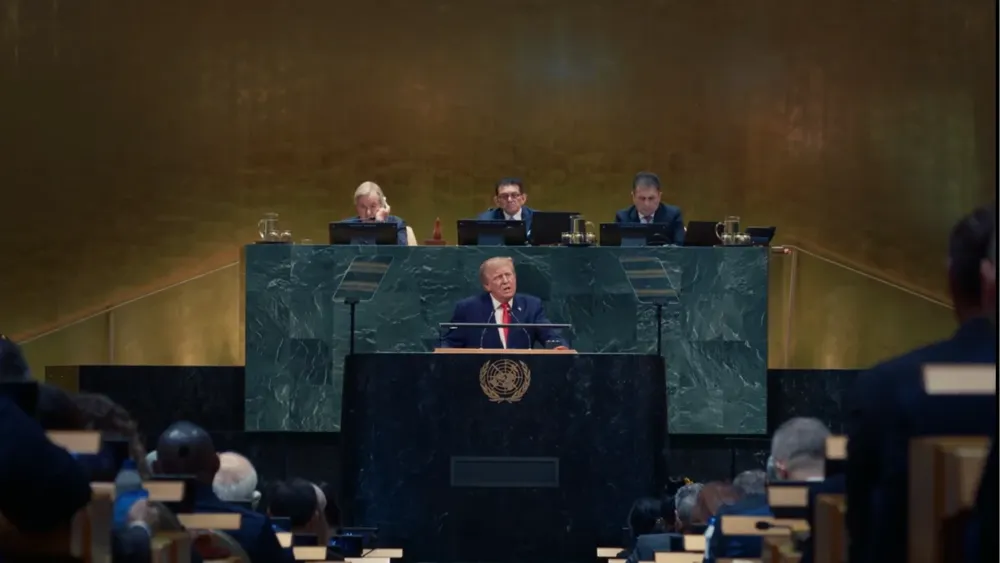
On the morning of September 22, 2026, the President of the United States stood at the green marble dais of the United Nations General Assembly and asked the assembled representatives of 193 member states whether he should annihilate one of them. 'Do I annihilate the Islamic Republic and do it quickly, never giving them a chance to kill and destroy people and countries again?' Trump posed. 'Do I drive them into hell with no chance of survival and no hope of future greatness or generations?'
He then offered Iran the alternative: make a deal 'that lets them rebuild' after the US midterm elections. 'I believe we'll make a deal right after the election because it doesn't make sense for them not to,' he said. 'They're waiting to see how I do in the midterm election.' Later the same day, Trump confirmed that Jared Kushner and Steve Witkoff had spent three hours in indirect talks with Iranian officials through mediators on the UNGA sidelines.
The words were delivered from the forum that exists, according to its own founding Charter, to prevent precisely this: the threat of force against a member state, issued from the institution built to replace force with law. The United Nations Charter's Article 2(4) states that all member states 'shall refrain in their international relations from the threat or use of force against the territorial integrity or political independence of any state.' The US helped write that sentence. It signed the Charter. It holds a permanent seat on the Security Council — the body whose primary function is to enforce the peace the Charter mandates. On September 22, its president stood at the institution's principal deliberative forum and asked the assembled world whether to drive a fellow member state into hell.
Iran's Ambassador to the United Nations, Amir Saeid Iravani, had written to the Security Council ahead of UNGA describing earlier American threats as 'a flagrant violation of international law and the founding United Nations Charter.' The Security Council did not act on that letter. It cannot act on it. The mechanism for enforcing the Charter against a state that threatens force is the Security Council. The state that threatened force is a permanent member of the Security Council. It holds the veto that would prevent any resolution from passing. The architecture produced an institution that can receive the complaint and cannot answer it.
The Charter's Author and the Charter's Rule
Article 2(4) is the foundational commitment of the United Nations system. It is the sentence that makes the UN something other than the League of Nations — the League's failure to prevent force being exercised by powerful states was the specific institutional failure that the UN's architects set out to address. The prohibition on threats of force is not incidental to the Charter. It is the Charter's core operational rule. Sovereignty is meaningful only if the threat to destroy a sovereign state is prohibited. Without Article 2(4), the UN is a forum in which powerful states may announce their intentions to destroy weaker ones in the presence of the weaker ones' allies.
The United States participated in drafting the UN Charter at San Francisco in 1945. American diplomats, specifically Secretary of State Edward Stettinius, co-chaired the conference. The American delegation pushed for the inclusion of specific prohibitions on force as the central mechanism for maintaining peace. The prohibition was understood to be universal — it applied to the United States as much as to any other member. The permanent Security Council seat the US holds was designed to give major powers a stake in the collective security system, not to exempt them from it.
Foreign Policy reported that experts have argued Trump's annihilation threat 'could be considered war crimes' under international law. The legal debate about whether the threat alone — without an act — constitutes a violation is genuine. What is not in dispute is that the language 'no chance of survival and no hope of future greatness or generations' describes the destruction of a people, not the defeat of a military. Iran has a population of 90 million people. 'No hope for future generations' is not a military objective. It is the language of annihilation in the sense that international law has historically defined.
Trump also called in the same speech for an ICC boycott — a position that followed his administration's campaign of sanctions against ICC judges who had issued arrest warrants against Israeli officials. The same president who was threatening to annihilate a UN member state was also calling for the abolition of the court whose core function is prosecuting acts that threaten civilian populations. The annihilation threat and the ICC boycott were delivered in the same speech, at the same podium, to the same audience.
The Midterm That Governs the Annihilation
The specific content of Trump's UNGA statement reveals its primary intended audience. He told the assembled world that Iran was 'waiting to see how I do in the midterm election' before doing a deal. He predicted a deal 'right after the election.' He framed the annihilation option as the alternative to the post-election reconstruction deal. The temporal frame of the entire geopolitical decision — annihilate or rebuild — is the American electoral calendar.
This is not unusual as political logic. Every American administration conducts foreign policy with one eye on domestic political conditions. What is unusual is stating it explicitly, from the United Nations podium, in front of the representatives of every country whose energy markets, supply chains and regional security the Iran war has affected. The assembled delegates of the countries whose oil transit is disrupted, whose bases have been struck, whose currencies have absorbed the energy price shock and whose citizens are paying higher fuel costs were told, from the green dais, that the president's decision about annihilation was contingent on how he performs in November.
The people of Iran were told that the window between continued bombardment and reconstruction was determined by an American election they cannot vote in. The 90 million people whose 'future generations' Trump raised as the object of the annihilation question received their geopolitical status — destroyed or rebuilt, hell or reconstruction — as a function of the midterm outcome in states like Arizona and Georgia.
The irony that a statement about annihilating 90 million people was also a domestic political communication is specific to this administration and this war. But the underlying dynamic — that the UN's most powerful member uses the General Assembly as a global stage for domestic political messaging — is not new. What is new is the register: the open framing of mass destruction as a policy option contingent on electoral outcomes, delivered from inside the institution whose founding purpose was to prevent that framing from governing international relations.
What the Institution Produced
The chamber's response to Trump's annihilation question was, according to reporting, largely silence. The only moment of applause was for 'Iran will never have a nuclear weapon' — a statement about Iranian capability rather than American restraint. The representatives of 193 states, including the members of the Global South who have watched six months of war disrupt their energy markets and trade routes, sat in a room in which the President of the United States asked whether he should drive a fellow member into hell and did not produce a collective response.
The Britannica chronicle of the Iran war notes that the war has cost the US an estimated $43.6 billion in military expenditure. The American economy is absorbing record gas prices. Senate Republicans are registering their doubts at the ballot box of internal party votes. The political coalition that sustained the war's first phase is developing visible cracks, as the DiploPolis Phase One Is Done piece documented last week.
Into that context, Trump's UNGA statement is both a threat and a promise: the threat of annihilation for Iran if no deal, the promise of reconstruction for Iran after the midterms. Both the threat and the promise serve the same political purpose: they tell the American domestic audience that the president is in control of the outcome, that the war's end is within his grasp, that the decision is his to make. The UN General Assembly was the global stage on which that domestic message was broadcast. Iran has 90 million people. The message was for an audience considerably smaller.
The United Nations has received Iran's formal complaint about threats to its existence. The Security Council cannot act on it. The General Assembly has no binding enforcement mechanism. The International Court of Justice can adjudicate disputes between states but cannot issue emergency rulings from a podium speech. The International Criminal Court is the subject of a boycott campaign led by the same government that made the threat. Every institutional mechanism that exists to respond to 'do I drive them into hell' is either blocked, inaccessible or under active assault by the state that asked the question.
That is the specific condition in which the UN General Assembly of September 22, 2026, took place. The institution founded to prevent the threat of annihilation heard the threat of annihilation from the podium of its most powerful member. It produced no response. The question is in the permanent record of the 81st General Assembly. The institution's silence is also in the record.
This Analysis piece is free to read. Future Analysis pieces will be available to registered DiploPolis members first. Free registration takes 30 seconds. No credit card required.
Find this piece interesting?
Dispatches by DiploPolis delivers sharp analysis and pointed commentary on power, politics, diplomacy, and world affairs — directly to your inbox.
No neutrality. No noise. Just argument.