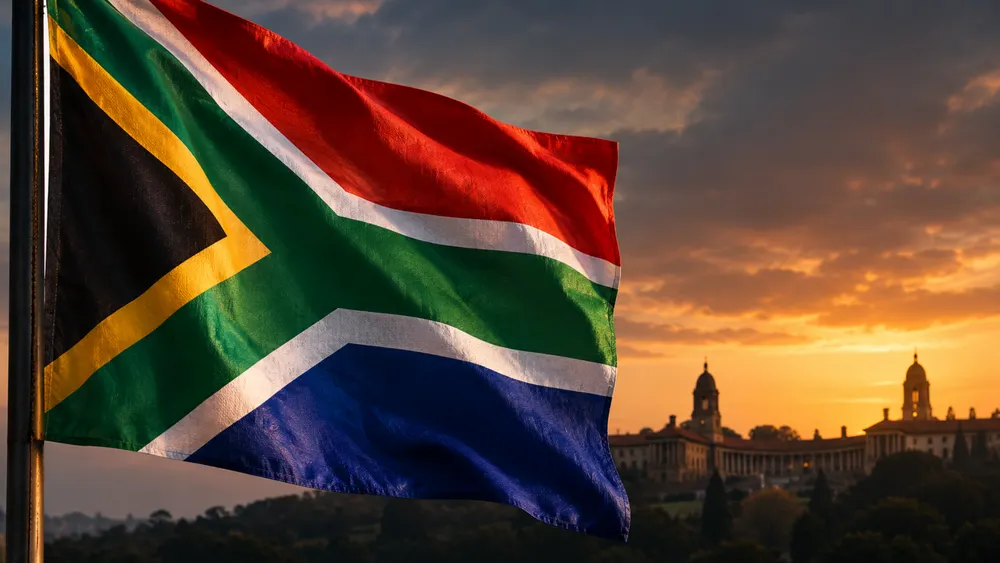
The African National Congress won 32.5 per cent of the vote in South Africa's local elections on 8 November, its worst result since the first post-apartheid election in 1994. The domestic implications, fractured metros, 14 days to form coalitions, the DA leading in Johannesburg, are being covered extensively. What is being covered less is the question that matters more for anyone watching from outside South Africa: what does the collapse of the ANC's domestic mandate do to the foreign policy that the ANC built, and that South Africa has been deploying on the world stage at precisely the moment when it is most consequential?
The answer is that it complicates everything. South Africa brought the genocide case against Israel to the International Court of Justice in December 2023. It abstained twice on UN resolutions condemning Russia's invasion of Ukraine. It hosted Chinese and Russian warships for joint military exercises in February 2023. It held the BRICS summit in Johannesburg in 2023 and championed the bloc's expansion. It has consistently positioned itself as a voice of non-alignment in a world being pushed toward binary choices. All of that is ANC foreign policy. It reflects a specific ideological tradition, rooted in the liberation struggle, that has defined South Africa's international identity for 30 years.
The Democratic Alliance, which finished second nationally at 22.9 per cent and leads in Johannesburg, holds a sharply different position on most of these questions. It opposed the ICJ case. It has pushed for South Africa to align more closely with Western multilateral institutions. It has criticised the government's Russia policy. If coalition arithmetic hands the DA a larger governing role at municipal level, and the DA's national trajectory continues, the question of whether South Africa's non-aligned posture survives the ANC's decline is not a theoretical one. It is a question about the next national election in 2029 and whether the party that defined South Africa's international identity can still win enough votes to set it.
The timing is not incidental. South Africa currently chairs the G20. It has been pressing for a reform of the international financial architecture, specifically to give developing countries more equitable access to climate finance and to restructure the debt obligations that prevent African governments from spending on adaptation. These are positions the ANC has held consistently. They are positions that require a government with a credible domestic mandate to press with any force at the international level. A government that cannot hold a third of its own voters, negotiating frantically to form coalitions in eight major cities, does not carry that mandate.
There is a broader pattern here that South Africa's result brings into focus. The Congress Party in India, SWAPO in Namibia, ZANU-PF in Zimbabwe, the MPLA in Angola: post-liberation governing parties across the Global South are losing the dominance they once treated as permanent. What differs in each case is what fills the space. In South Africa the fragmentation is genuine; uMkhonto weSizwe, Jacob Zuma's breakaway party, finished third nationally, drawing heavily from the same Black working-class base the ANC once held. The DA is leading in the economic capital. The EFF remains a factor in several metros. No single successor is emerging.
What that fragmentation means internationally is that South Africa's foreign policy voice, which has been coherent and identifiable precisely because one party held it for 30 years, is about to become contested in a way it has not been before. The ICJ case was supported by a broad cross-section of South African public opinion, which gives it some durability. The Russia position is more vulnerable, particularly if Western pressure increases and the DA gains leverage. The BRICS commitments depend on sustained executive will that a weakened ANC may not be able to sustain.
The election was held in South African cities and towns on 8 November. Its consequences will be felt in Geneva, in Pretoria's diplomatic corps, in the BRICS working groups and at the next UN General Assembly. The story is not about Johannesburg's coalition arithmetic. It is about what South Africa sounds like on the world stage when the party that gave it a foreign policy no longer has a majority.