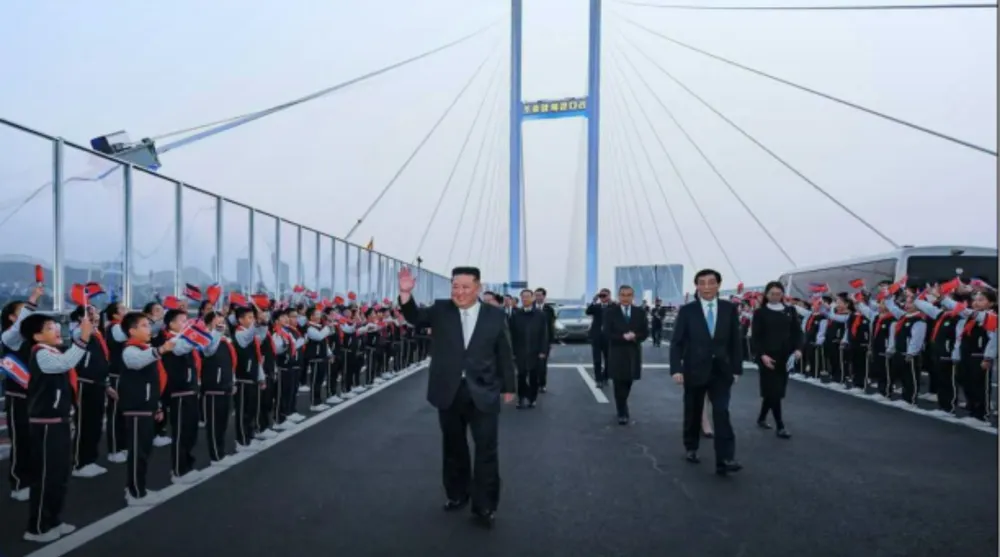
Kim Jong Un made a one-day trip to the Chinese border city of Dandong on Saturday, October 24, crossing the New Yalu River Bridge into China. He toured a Korean War memorial, where Chinese soldiers who died fighting alongside North Korean troops are commemorated, and visited a local automobile factory. Wang Huning, China's fourth-ranked official and a member of the Politburo Standing Committee, accompanied him throughout and passed on greetings from President Xi Jinping. Xi did not attend. North Korean state media reported that Kim described relations with Beijing as 'invincible.' Wang later saw Kim off at the bridge. The visit lasted one day. Kim has since returned to Pyongyang.
The bridge itself is the fact around which everything else turns. China completed the New Yalu River Bridge in 2014 at a cost of over $300 million. It sat unused for more than a decade because North Korea had not finished the roads and customs facilities on its side of the border. The four-lane, three-kilometre crossing officially opened about a week before Kim's visit, after Pyongyang finally completed its infrastructure. Experts describe it as the most significant land crossing between the two countries and expect it to move heavy equipment, raw materials and energy products. North Korea's international trade, of which China accounts for most of the official volume, had been constrained by a single older bridge and rail crossing. The new bridge removes what analysts call a major logistics bottleneck. China built it in 2014. North Korea made China wait until 2026 to open its end.
The timing of Kim's visit is not coincidental. China is preparing to host the APEC summit in Shenzhen next month. President Trump has said he wants to restart talks with North Korea before the end of the year. Kim met Wang Huning rather than Xi Jinping, which positions the trip below a summit but above a routine diplomatic call. Wang told Kim that China was 'ready to expand personnel exchanges and economic and trade cooperation.' Kim said North Korea stood ready to 'carry forward their historical friendship and expand practical cooperation.' Since Russia began providing North Korea with military technology in exchange for weapons and ammunition, China's leverage over Pyongyang has been under pressure. Beijing has been seeking to maintain influence over a neighbour that is increasingly aligned with Moscow on military matters. Kim's choice to cross the bridge in the week it opened is, among other things, a message to Beijing that the economic relationship is still worth maintaining on Pyongyang's own terms.
What the bridge makes possible matters beyond symbolism. The older crossing could not carry heavy cargo in both directions. The new one can. Russia and North Korea have been developing rail and energy links along the eastern border of the country. China's bridge is on the western border. Kim is constructing two supply routes simultaneously, one with each great power that backs him. That is not dependence. It is a supply architecture designed to give Pyongyang room to manoeuvre. North Korea can take Russian military technology and Chinese economic goods without having to subordinate itself fully to either. The bridge opening strengthens that geometry by removing the logistics constraint on the Chinese side.
China paid for the bridge over twelve years ago. North Korea made China wait to use it. Kim crossed it on October 24, called the friendship invincible at a memorial to a war 73 years ago, toured a bus factory, and went home. Wang Huning saw him off. Xi Jinping did not appear. Trump wants to talk before the year ends. The APEC summit is in Shenzhen next month. Kim crossed the bridge at a moment when every major power that deals with North Korea needs something from it. He appears to understand this. The bridge is now open. What he charges for using it, in political terms, remains to be seen.