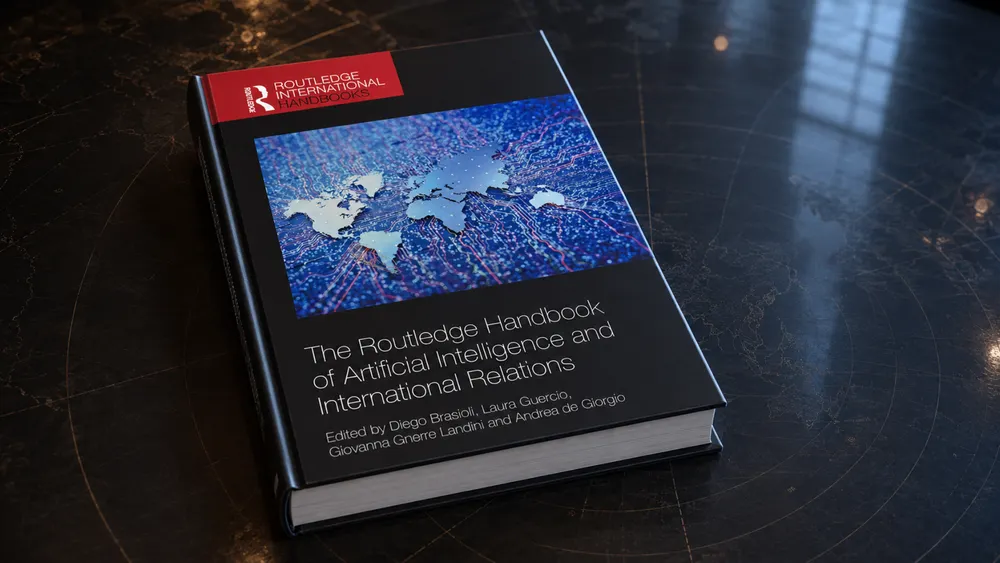
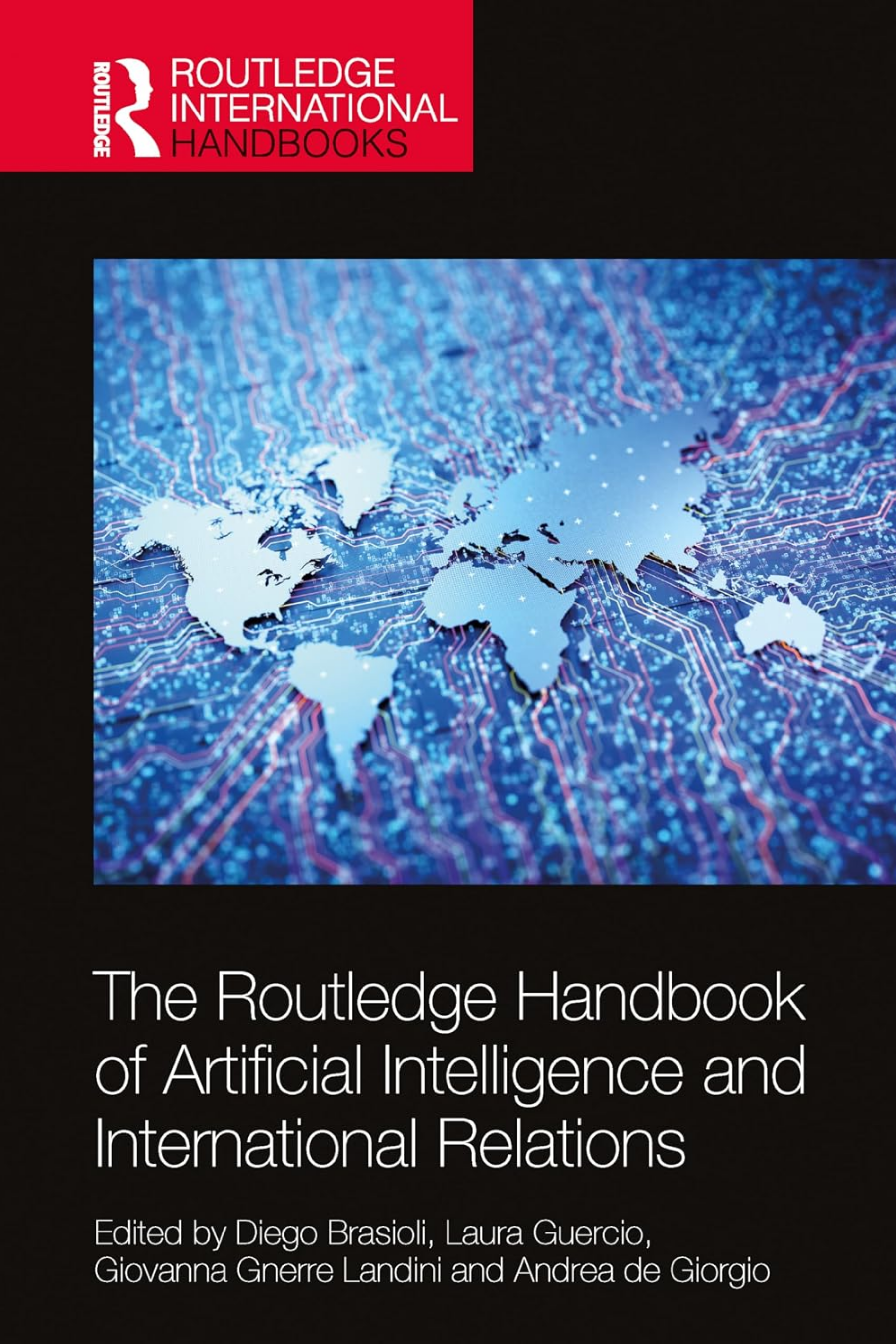
A handbook implies mastery. It implies that a field has accumulated enough knowledge, settled enough disputes and agreed enough on its methods that a group of scholars can usefully map the territory for those who come after. The Routledge Handbook of Artificial Intelligence and International Relations arrives at a moment when none of those conditions fully apply. The field it is trying to map is still moving. The disputes are not settled. The methods are contested. The terrain keeps changing shape. That is not the editors' fault. It is the condition of the subject. Artificial intelligence and international relations is a field defined by the speed of its object, and a handbook that waits for stability will always be late. The question is whether a handbook produced under these conditions can be genuinely useful rather than merely comprehensive.
The answer, in this case, is a qualified yes. Diego Brasioli — a career diplomat at Italy's Ministry of Foreign Affairs specialising in cybersecurity and AI — together with Laura Guercio, Giovanna Gnerre Landini and Andrea de Giorgio have assembled a genuinely broad volume covering war, diplomacy, governance, ethics, regulation, data, intelligence, autonomy and knowledge production. The breadth is not arbitrary. AI touches all of these domains simultaneously, and a handbook that tried to organise the field around a single argument would be dishonest about how scattered the conversation currently is. The scatter, in this sense, is honest. What it reveals is that AI and IR scholarship has not yet found a shared vocabulary strong enough to make its different strands argue with one another. The chapters map the field more than they disturb each other. That is the handbook's principal limitation, and it is worth dwelling on before praising its virtues.
The editorial apparatus does the expected handbook work. It organises the material, provides an introduction and divides the field into sections. What it does not do, at least from the evidence available, is force the contributors into a sustained debate. The result is genuine intellectual diversity under insufficient editorial pressure. The distinction matters. Genuine diversity acknowledges that ethics scholars, security scholars, diplomacy scholars and data governance scholars are all working on different parts of the same problem. Insufficient editorial pressure means that these scholars are not required to test their frameworks against each other. A handbook is most valuable when it produces collision, not just coverage. This one produces more of the latter than the former.
The review's organising question, and the most important question any AI and IR handbook must answer, is whether artificial intelligence is genuinely changing IR theory or whether IR scholars are mainly applying old categories to new machines. The honest answer, looking at the state of the field, is both; and the balance matters. Sovereignty still matters because states regulate, procure, surveil, censor and wage war using AI systems. Balance of power still matters because AI capability is radically unevenly distributed. Liberal institutionalism still matters because governance regimes, standards bodies and treaties are being actively contested. Constructivism still matters because AI reshapes identity, trust, legitimacy and threat perception in ways that material accounts cannot fully capture.
But those categories are no longer sufficient. AI forces new questions about agency that the existing framework cannot absorb. A state may decide, but the decision is now mediated by a platform, a model, a dataset, a recommender system or an autonomous weapon whose logic the state may not fully understand. Power is not only territorial, military or institutional. It is infrastructural, computational and epistemic. The unit of analysis cannot remain only the state, the institution or the individual. It must also include the model, the platform, the cloud provider, the data pipeline, the chip supply chain and the standards body. The most interesting chapters in a handbook like this one will be those that make the old categories feel inadequate. The least interesting will be those that simply affix 'AI' to existing debates and call that transformation. Both kinds of chapter exist here.
The Global South is where this limitation becomes most consequential. A handbook on AI and international relations that does not seriously reckon with who builds AI, who owns it, who controls the infrastructure, whose languages train the models, whose data is extracted and whose societies become governed populations is not a handbook on AI and international relations. It is a handbook on AI and the international relations of the powerful. This volume appears aware of the problem. It includes postcolonial and critical perspectives, and addresses China's strategies in Africa alongside questions of sustainable development. That awareness matters. It means the handbook is not entirely written from the control room of the powerful.
But awareness is not reorientation. There is a difference between including the Global South as a chapter or a case study and building the handbook's architecture around the recognition that the Global South is where the inequality of the AI order becomes most visible. India, Africa, Latin America and Southeast Asia are not merely adoption zones or markets for AI systems designed elsewhere. They are where dependency, aspiration, linguistic exclusion, data extraction, platform governance and state surveillance intersect at their most intense. Consider what linguistic exclusion means in practice: a model trained overwhelmingly on English-language data will classify, recommend, moderate and translate with assumptions baked into a fraction of the world's linguistic reality, then present its outputs as neutral inference to speakers of languages it barely knows. The countries least able to shape AI development will be most shaped by it. A handbook whose main story remains great powers, security, regulation and innovation, with Global South concerns appearing at the margins, describes AI and the international relations of the powerful while occasionally noticing everyone else.
That observation is not unique to this handbook. It describes the field. And the field's failure to centre these questions is itself an argument for why IR theory needs genuine renovation, not renovation-flavoured extension of existing frameworks.
There is a useful comparison to be made with an earlier edited volume on AI and international relations. Hudson's volume, produced at a moment when artificial intelligence in IR meant expert systems and computational modelling, reads today as a time capsule from before the explosion: a record of what the field believed AI would do before AI arrived as something unrecognisable. This handbook belongs to the moment after that explosion. Its virtue is that it knows the terrain has changed. It acknowledges generative AI, platform power, autonomous systems and the geopolitics of data infrastructure as genuine transformations rather than extensions of known problems. Its weakness is that it still sometimes reaches for the old compass. The categories of sovereignty, security dilemma, great power competition and international regime, adjusted for AI but not fundamentally renovated by it, still organise much of what appears here.
The Routledge Handbook of Artificial Intelligence and International Relations is a genuinely useful reference and a serious attempt to map a field that defies easy mapping. Read it as a record of where the conversation is, not where it needs to go. Read it for the chapters that make old frameworks feel inadequate, and approach the chapters that merely extend them with healthy scepticism. Then ask the question the handbook cannot quite answer: at what point does the accumulation of AI-adjusted IR arguments become a new theory, rather than the old theory with new examples? The renovation IR theory needs is not incremental. It is ontological. The field is not there yet. This handbook shows both how much progress has been made and how much ground remains.
This Book Review is free to read. Future Book Reviews will be available to registered DiploPolis members first. Free registration takes 30 seconds. No credit card required.
Find this piece interesting?
Dispatches by DiploPolis delivers sharp analysis and pointed commentary on power, politics, diplomacy, and world affairs — directly to your inbox.
No neutrality. No noise. Just argument.