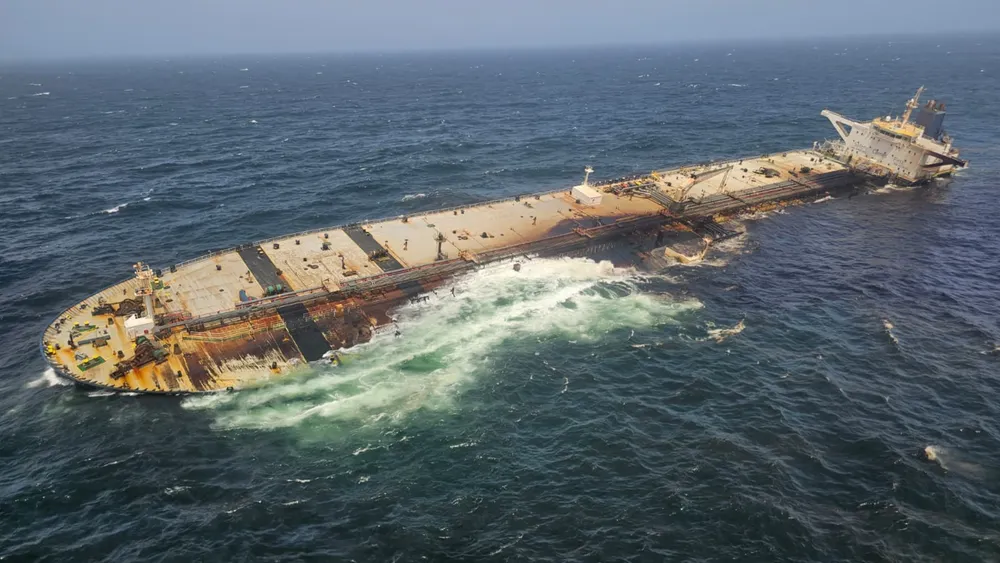
The Caroline Bezengi left Novorossiysk — the Russian Black Sea port Ukraine has been targeting since 2022 — carrying approximately 800,000 barrels of Russian crude oil. It travelled south, entering the waters off Yemen where the Houthis have been attacking ships since October 2023. In early June, still off the Yemeni coast, the vessel suffered what an operator described as unexplained explosions. It limped toward Oman. On June 30, it ran aground near Al-Qibliyyah Island — a protected marine nature reserve home to Arabian Sea humpback whales and Socotra cormorants. The tanker has been leaking ever since.
No party has claimed responsibility for the explosions. No responsible party has been officially identified. The vessel navigated from one war zone through another and ran aground in a third. Three conflicts contributed to its journey. None has answered for where it ended.
The spill grew with the monsoon. It covered 45 square kilometres at the end of July. By August 2 it had reached 150. By August 4 it had quadrupled to 600 square kilometres as storm conditions pushed the oil across the Arabian Sea. By August 12, satellite imagery showed it exceeding 2,000 square kilometres — roughly the size of Rhode Island — spreading across one of the world's most biodiverse maritime environments. By August 13, oil had reached the Omani mainland, fouling 40 kilometres of the Ras Madrakah coastline. The Omani government instructed residents to avoid fishing in affected areas and to report unusual odours.
A British maritime security firm, Ambrey, was engaged to salvage the vessel. The International Maritime Organisation said seasonal monsoon conditions had limited access and delayed operations. Environmental specialists at Greenpeace described the spill as fragmented across multiple areas rather than one continuous mass — which makes containment significantly more difficult and the affected zone larger than single-point measurements suggest.
This is not the only oil in the water. Two additional slicks appeared in Iranian waters — one near Qeshm Island reaching its mangrove forests and a second near Sirri Island further into the Gulf — both appearing linked to a strike on the Minoan Pioneer, a dry bulk ship hit by an unknown projectile in the Strait of Hormuz on August 3. Iran has claimed trillion-dollar pollution damage. The question of which party caused which spill in which waters under which legal framework has not been answered, partly because no functioning international legal mechanism is currently examining the Strait of Hormuz's environmental status.
Crude oil futures climbed above $90 a barrel after reports that Iran had seized a UAE-owned tanker. US petrol prices set a mid-August record with a national average of $4.06 a gallon. The war's energy costs — which DiploPolis has tracked since the WFP warned of six million people approaching food insecurity — are now denominated in gallons at American petrol stations as well as in food basket prices in Mogadishu and Colombo. The spill adds the cost of environmental destruction to both columns.
Iran's own environmental officials confirmed that oil reached Qeshm Island's beaches and its Hara mangrove forests — one of the most ecologically significant habitats in the Gulf region. They said cleanup operations had largely cleared the Qeshm slick by mid-week. The Caroline Bezengi's spill has not been cleared. It is still growing.
The war that began on February 28 has produced, among its other consequences, 800,000 barrels of Russian crude spreading across the Arabian Sea in a marine nature reserve. The tanker navigated three wars to reach this point. The war's first confirmed large-scale environmental disaster has no responsible party and no cleanup plan capable of addressing its current scale.