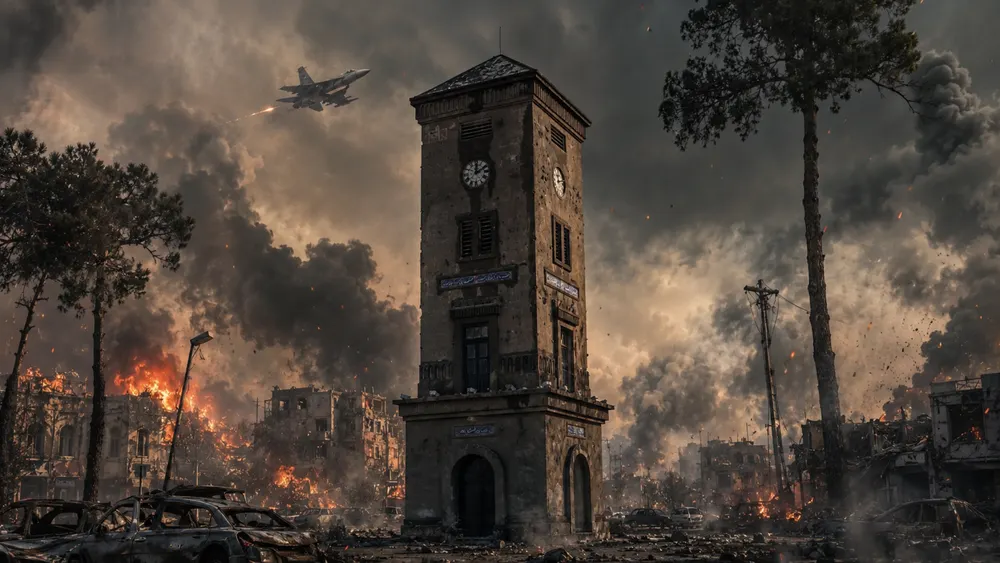
On June 17, 2026, Donald Trump signed the Islamabad Memorandum at Versailles. The ceremony was deliberate: the Palace of Versailles, where the post-war order was codified in 1919, was chosen as the location for a document the administration presented as the beginning of a new order for the Middle East. The MOU committed both sides to an 'immediate and permanent termination of military operations on all fronts,' pledged 60 days of nuclear negotiations, and included provisions for the reopening of the Strait of Hormuz. Trump called it historic. The G7 applauded.
On August 17, the 60-day clock expired. There is no nuclear deal. There is no durable Hormuz agreement. Lebanon remains under Israeli military occupation, as the MOU's first clause required but could not produce. Both Trump and Iranian leaders said in the days before the deadline that the deal had 'basically collapsed.' Iran called the 60-day period 'irrelevant.' Trump called for Iran's surrender.
What happened in the 60 days between Versailles and the collapse is the story the ceremony obscured. The Wall Street Journal reported on August 17, citing Iranian and Arab officials, that Iran's hardline leadership had treated the MOU as a 'tactical pause' — and possibly as a US-Israeli ploy to ease pressure on the global economy and buy time for a larger strike. Whether or not that suspicion was accurate, Iran's use of the 60 days is documented. The pause the MOU created did not de-escalate the conflict symmetrically. It ran, strategically, in Tehran's favour.
What Iran Did With the Pause
The Wall Street Journal's reporting, confirmed by a Congressional Research Service report published August 7, is specific about how Iran used the 60-day window. The Islamic Revolutionary Guard Corps was given greater authority over the country's regular military. Military officers with experience in the Iran-Iraq War and previous domestic crackdowns were appointed to key positions. Internal counterintelligence operations were expanded. Missile and drone production was accelerated. Iran took measures to strengthen its control over the Strait of Hormuz, including maritime vessel operations.
The IRGC also used the calm the MOU created to lay groundwork with allied militias in Iran, Yemen and Lebanon to step up attacks if needed, sending advisers and increasing coordination. The appointment of Mohsen Rezaei — former IRGC commander and consistent hardliner — as the new head of Iran's Supreme National Security Council is the clearest institutional signal of direction. Al Jazeera quoted analysts saying the appointment and other recent leadership changes 'show Iran believes it has the upper hand.'
Iran's foreign minister Abbas Araghchi, speaking on August 15, provided the legal framing Tehran is using for its position. What was in the Islamabad MOU was 'the end of the war, not a ceasefire,' Araghchi said. Since the US violated the MOU and continued attacks, 'there was no 60-day ceasefire that needed to be extended.' In Tehran's reading, the MOU was already dead before the deadline, killed by Washington's own conduct. A separate Iranian diplomatic statement described the MOU as being in a 'coma' from which it could be revived only if Washington abandoned its 'habit of breaching commitments.'
The US reading is different. Washington described mediation efforts involving Pakistan and Qatar as 'static.' Trump ruled out extending the ceasefire and called for Iran to 'put up the white flag of surrender.' He threatened to 'bomb the shit out of Oman' if it obstructed Hormuz reopening efforts. He posted a map on social media showing the Strait of Hormuz as US territory. Brigadier General Yadollah Javani, head of the IRGC political bureau, responded on Iranian state television that 'the enemy started the war and our efforts have been defensive, although they might take on an offensive aspect,' warning opponents to expect 'strategic surprises.'
The gap between 'put up the white flag' and 'strategic surprises' is the current state of US-Iran diplomacy.
What the 60 Days Were Supposed to Produce
The Islamabad Memorandum committed both parties to 60 days of nuclear negotiations. The three specific disputes the MOU was designed to resolve were Iran's nuclear programme, the status of billions in frozen Iranian financial assets and the security status of the Strait of Hormuz. On August 17, all three remain unresolved. Iran's enriched uranium stockpile — approximately 440 kilograms of material enriched to 60 per cent — remains in Iran. The frozen assets have not been released. The Hormuz negotiation with Oman continues but has produced no durable agreement.
DiploPolis identified the MOU's structural flaw in June: the document's first clause committed all parties to a Lebanon ceasefire, but Israel — whose military behaviour in Lebanon determines whether that ceasefire holds — did not sign it. That flaw did not disappear when the 60-day clock started. It compounded. Israeli operations in Lebanon continued throughout the MOU's lifespan, giving Iran both the legal justification and the political rationale to treat the document as void. The Lebanon trap was not resolved by the MOU. It was embedded in it.
The nuclear talks that were supposed to fill the 60 days encountered an unbridgeable gap that existed before February 28. Iran's president stated Iran would never back down from its right to enrich uranium. Trump stated Iran must surrender all enrichment. Those positions have not moved. A Congressional Research Service report published August 7 compared the current situation to the 1980s Tanker War, noting that the experience of that period 'may not be analogous in the context of US-Iran conflict in 2026.' The analogy does not hold because Iran in 2026 is not the Iran of 1988 — it has hardline leadership with a nuclear programme, a restructured IRGC and a strategic assessment that it has survived the most intensive American air campaign in decades without conceding its core positions.
The Pause and What It Was For
The Islamabad Memorandum's architects presented the 60-day clock as a countdown to a deal. The evidence of what Iran did during the countdown suggests it was experienced in Tehran as something different: an opportunity to consolidate strategic position before the next phase of a conflict whose trajectory Iran's hardline leadership believes is running in Iran's favour.
That assessment may be wrong. Iran has suffered enormous damage — its infrastructure, its civilian economy, its military capacity, its international standing. The war has been catastrophic for Iranian citizens. But the hardliners making strategic decisions are not measuring the war by its civilian costs. They are measuring it by whether Iran's nuclear programme survived, whether the IRGC survived, whether the proxy network survived and whether Iran's control of the Strait of Hormuz produced leverage. On all four measures, the 60-day MOU period ended with Iran in a stronger position than when it began.
Trump ended the MOU period by calling for surrender. Iran ended it by appointing a hardline IRGC commander to its top security body and promising strategic surprises. The clock that was supposed to be counting down to a nuclear deal has revealed itself to have been counting down to something else: the next phase of a conflict in which one side used the pause to prepare and the other used it to negotiate. The Islamabad Memorandum did not end the war. It gave Iran 60 days to get ready for it.
This Analysis piece is free to read. Future Analysis pieces will be available to registered DiploPolis members first. Free registration takes 30 seconds. No credit card required.
Find this piece interesting?
Dispatches by DiploPolis delivers sharp analysis and pointed commentary on power, politics, diplomacy, and world affairs — directly to your inbox.
No neutrality. No noise. Just argument.