On the night of February 26, 2020, the Indian government issued a transfer order for Justice Srinivasan Muralidhar at close to midnight. He was a judge of the Delhi High Court. His bench had spent that day questioning the Delhi Police over its failure to register first information reports against three BJP leaders whose alleged hate speeches had preceded communal violence spreading through northeast Delhi, in what would become known as the 2020 Delhi riots. The notification came close to midnight. He was transferred to the Punjab and Haryana High Court. His colleagues, the legal community and the press widely interpreted the timing as punitive. Muralidhar gave a farewell address in which he described the sequence of events precisely and without accusation. He did not need to name it as retaliation. Everyone who read it understood.
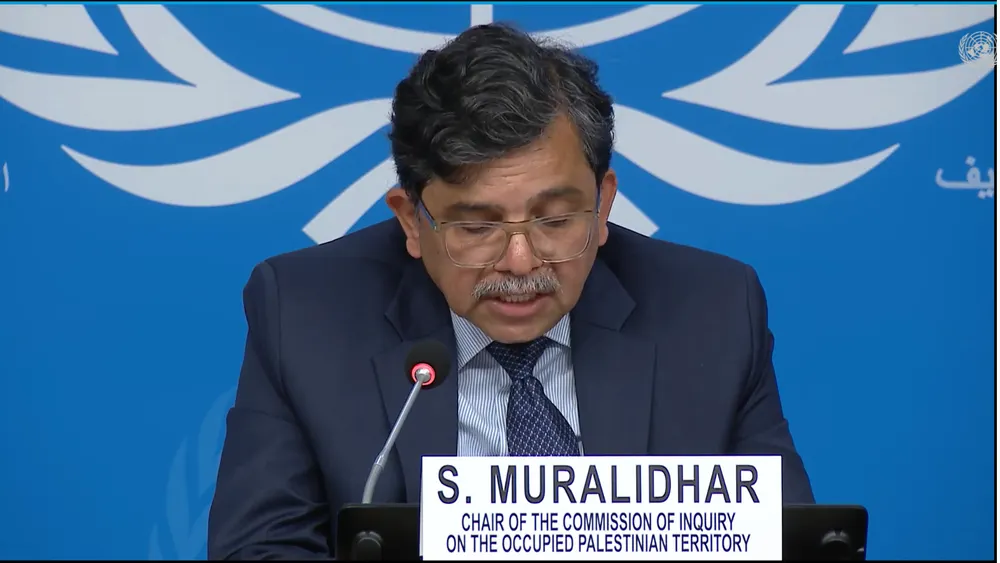
That judge now chairs the UN Independent International Commission of Inquiry on the Occupied Palestinian Territory. On June 23, he presented a 100-page report to the Human Rights Council in Geneva. The report concluded that Israeli forces have deliberately targeted Palestinian children in the Gaza Strip and the West Bank, constituting genocide, crimes against humanity and war crimes. 'The evidence shows that Palestinian children have been deliberately targeted and killed by the Israeli security forces,' Muralidhar said. At least 20,179 children were killed between October 7, 2023 and March 31, 2026, roughly 30 per cent of all fatalities. The pattern of wounds, to the head and upper body, from snipers and quadcopter drones, indicated deliberate targeting rather than incidental harm. Even after the October 2025 ceasefire, children continued to be killed and seriously injured, Muralidhar said, with continued disregard by Israel for the ceasefire and for the protection owed to Palestinian children under international law.
The commission had reached its genocide finding nine months earlier. In September 2025, it concluded that Israel had committed four of the five genocidal acts defined under the 1948 Genocide Convention: killings, causing serious bodily or mental harm, deliberately inflicting conditions of life calculated to destroy the group, and imposing measures intended to prevent births. The June report extended that finding to children specifically, adding forensic analysis confirming deliberate targeting across at least 35 documented instances. The report's full title carries its conclusion: 'The essence of childhood has been destroyed.'
'By targeting children,' Muralidhar said, 'Israel is attacking the very capacity of the Palestinian people to exist and to determine their future.' The destruction of their health, education and development is irreversible. The commission called for genocide charges to be added to the International Criminal Court's existing arrest warrants for Israeli leaders. It submitted thousands of pieces of evidence to support those proceedings. That evidence is now in the hands of the ICC whose judges, as this publication reported on Tuesday, are being financially strangled by US sanctions for receiving it.
Muralidhar is an Indian jurist of unimpeachable standing. He helped decriminalise homosexuality in India as part of the Delhi High Court bench that decided the Naz Foundation case in 2009. He conducted a rare late-night hearing during the 2020 riots to ensure the safe evacuation of victims. He was transferred at midnight for questioning police inaction in communal violence. He is now chairing the world's most politically sensitive human rights commission and making the most consequential findings of his career. His government has not publicly stood behind those findings.
The Other Indian Judge
Justice Dalveer Bhandari has represented India on the International Court of Justice since April 2012. When South Africa brought its case against Israel under the Genocide Convention, Bhandari was on the bench. On January 26, 2024, he voted with the majority when the ICJ issued binding provisional measures ordering Israel to take all steps within its power to prevent genocidal acts, ensure humanitarian aid reached Palestinians under siege, and preserve evidence of crimes committed. The measures were binding on Israel in international law. Israel continued its operations. The court had to issue further orders. On May 24, 2024, Bhandari voted with the majority again, this time ordering Israel to immediately halt its military offensive in Rafah, where more than a million displaced Palestinians had taken refuge after being told by the Israeli military to flee there from the north. He issued an 11-point statement noting that the widespread nature of Israel's military operations indicated the plausibility of genocide, and that the sheer scale of civilian deaths demanded the court act. His term runs until 2027. He has not qualified his position or distanced himself from the majority judgments.
Two Indian jurists, then, in two different international legal bodies, applying two different legal standards and two different evidentiary thresholds, have reached conclusions that point in the same direction. Bhandari found the evidence sufficient to order a halt to military operations. Muralidhar found the evidence sufficient to conclude that genocide against children was being committed and continuing past a ceasefire agreement. India placed one of them on the ICJ. The UN appointed the other to chair its commission. Both are doing what their roles require: following the evidence and naming what they find.
The Government's Abstention
India abstained from voting at the UN General Assembly on three consecutive resolutions concerning Gaza between October 2023 and June 2025. In October 2023, when the UNGA adopted a resolution demanding an immediate humanitarian truce by 121 votes to 14, India abstained among the 44. In September 2024, when 124 countries voted against Israel's occupation of Palestinian territories, India abstained among the 43. In June 2025, when 149 countries voted for an immediate and permanent ceasefire in Gaza condemning the use of starvation and the denial of humanitarian aid as a tactic of war, India abstained among the 19. India's explanation was consistent across all three votes: conflicts could only be resolved through dialogue and diplomacy, and India's position was in continuation of its previous voting record.
India eventually voted yes on a later resolution in September 2025, when Israeli strikes extended beyond Gaza to target Hamas leadership in Qatar. That the threshold for India's yes vote was the expansion of military operations to a third country, rather than the findings of its own judge at The Hague or the 20,000 children documented by its own judge in Geneva, is its own statement about where New Delhi's calculation sits. The calculation has a context. In February 2026, Prime Minister Modi visited Israel and elevated the bilateral relationship to a Special Strategic Partnership, the highest designation in India's diplomatic lexicon. He became the first Indian prime minister to do so while an active ICJ genocide case was being heard against the country he was visiting. India and Israel have built substantial ties in defence technology, counterterrorism intelligence-sharing and agricultural cooperation over the past decade. Israel is one of India's most significant arms suppliers. The Middle East is India's largest source of energy imports and home to millions of Indian expatriates whose remittances form a significant part of India's foreign exchange inflows. These are not trivial interests. They explain, without excusing, why a government whose own judge found genocide against Palestinian children in Geneva maintained studied neutrality in New York throughout most of the conflict.
The studied neutrality has a name in Indian diplomatic tradition. It is called principled non-alignment, the doctrine of retaining strategic autonomy and not being bound to the foreign policy choices of any bloc. It served India during the Cold War when choosing between Washington and Moscow carried genuine costs. Applied to Gaza, it has produced a situation in which India's stated position, abstention and dialogue and the two-state solution, sits in documented tension with the conclusions of its own judicial representatives in two of the world's most authoritative international bodies. The tension is not accidental. It is a choice made repeatedly, explained consistently, and maintained even as the evidence compiled by Indian judges grew more specific and more damning with each passing month.
India calls itself Vishwaguru, a Sanskrit word meaning teacher of the world. It is the frame Prime Minister Modi has used most consistently to describe India's civilisational standing and its role in international affairs. The concept implies not merely economic or military weight but moral authority: the capacity to speak to the world from a position of wisdom rather than merely of interest. That authority is earned by the willingness to say, when the evidence is clear and documented by one's own judges across two international bodies, what the evidence shows.
Muralidhar was transferred at midnight for following evidence about police inaction in communal violence to its documented conclusion. He brought the same instinct to Geneva, where he followed the evidence about the targeting of Palestinian children to its documented conclusion. Bhandari followed the evidence at The Hague to its documented conclusion and voted accordingly. The Vishwaguru's two most prominent judicial representatives in international law have both, in different proceedings, named what they found. The question the gap between their findings and their government's diplomatic position leaves open is not whether India has principles. The question is which ones it applies, to whom, and when.
This Analysis piece is free to read. Future Analysis pieces will be available to registered DiploPolis members first. Free registration takes 30 seconds. No credit card required.
Find this piece interesting?
Dispatches by DiploPolis delivers sharp analysis and pointed commentary on power, politics, diplomacy, and world affairs — directly to your inbox.
No neutrality. No noise. Just argument.