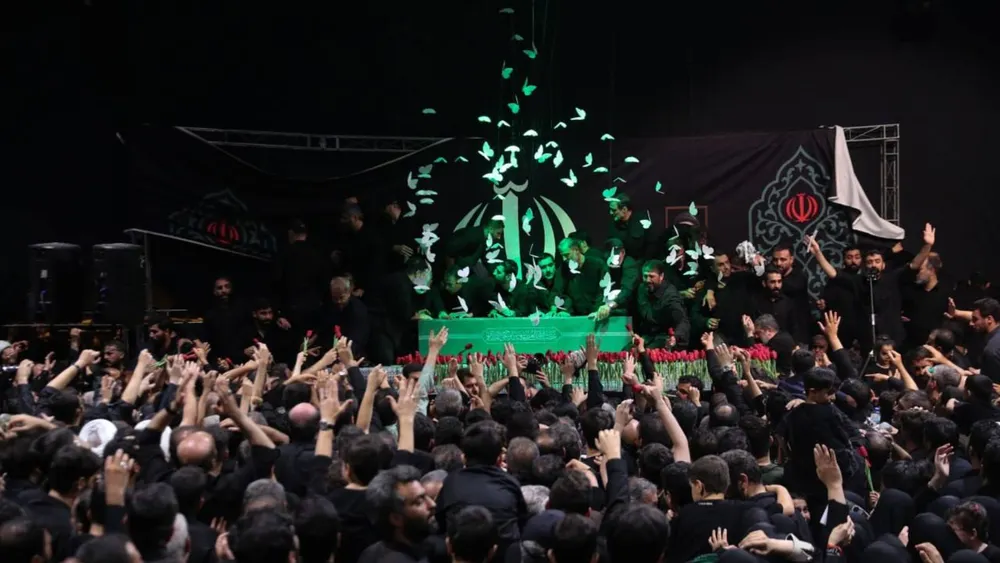
Ayatollah Ali Khamenei's coffin went on display in Tehran this morning. He was killed on February 28 in the US-Israeli strike that opened the war. His funeral was postponed for four months while the war raged. It begins today, and it will take seven days, carrying his body through Tehran, Qom, the shrines of Najaf and Karbala in Iraq, and finally to Mashhad, where he will be buried on July 9 at the shrine of Imam Reza in his hometown. The Iranian government is hoping for 35 million mourners across the seven days. Officials from more than 30 countries have confirmed attendance. Pakistan's Prime Minister Shehbaz Sharif will be there. India is sending its Bihar Governor and a Minister of State for External Affairs.
Mojtaba Khamenei, appointed Supreme Leader on March 8, may not attend his father's funeral. He was wounded in the same strike that killed his father. He has not appeared publicly since February 28. Security officials cannot guarantee his safety if he does. The man who now leads the Islamic Republic, who has been governing Iran through a war and a nuclear negotiation and a ceasefire dispute, has not been seen by his own people in four months. His first public act as Supreme Leader may be leading prayers at his father's burial — or it may not happen at all.
The funeral is a test. Iran's theocracy needs crowds. Large crowds, visible to the world, to demonstrate that the Islamic Republic survived a war against two of the world's strongest militaries and still commands the loyalty of its people. The risk is that the crowds become catastrophic in the wrong direction. Eight people died and 11,000 were injured in the stampede at Khomeini's funeral in 1989. At least 56 were killed in the stampede at Qassem Soleimani's burial in 2020. Iran is planning for millions and hoping for order.
The talks are on hold. Iranian negotiators left Doha after indirect discussions with US envoys Steve Witkoff and Jared Kushner that produced, in the language of the statement, 'positive progress.' Qatar said discussions through mediators will resume after the funeral ceremonies. The 60-day window from the Islamabad Memorandum does not pause for burial rites. Iran's Parliament Speaker Mohammad Bagher Qalibaf said this week that the Iranian people will use the funeral to convey their 'call for avenging the blood of the martyred leader.' Iran's army has warned the US and Israel against launching strikes during the processions. The US has deployed a second Marine unit, typically numbering more than 2,000 personnel, to the Middle East.
This is what a negotiated ceasefire looks like from the inside. The man the US and Israel killed is being buried across seven cities in two countries while his country's new, unseen Supreme Leader weighs whether it is safe to appear at his own father's funeral. The talks are paused. The clock runs. Washington is watching the crowds in Tehran for signs of what comes after.