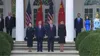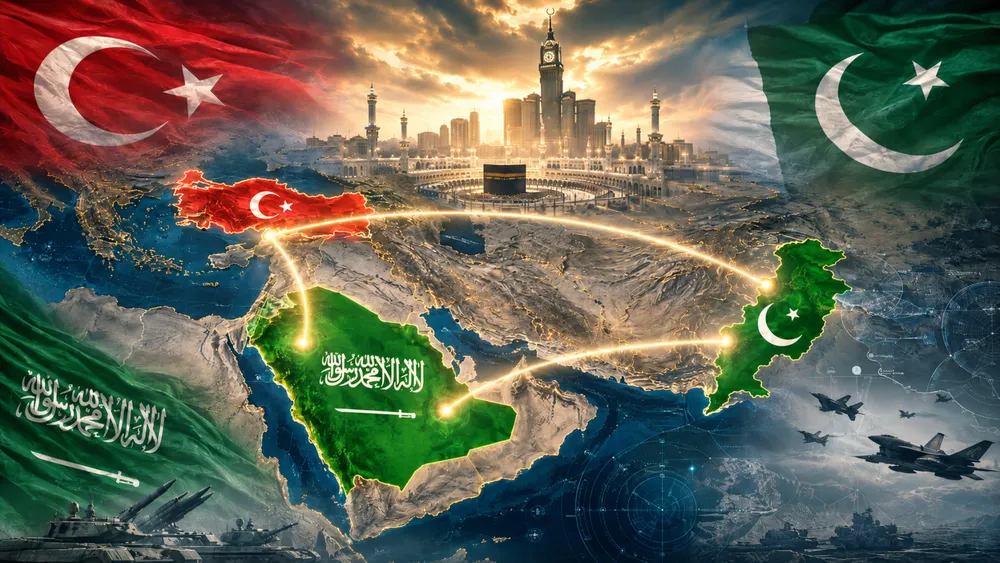
On August 7, Saudi Crown Prince Mohammed bin Salman, Turkish President Recep Tayyip Erdoğan and Pakistani Prime Minister Shehbaz Sharif signed the Mecca Joint Defence Agreement. The text is explicit: any armed attack against any one of the three states shall be regarded as an attack against all. Named for the city in which it was signed, the pact brings together the world's largest oil exporter, NATO's second-largest army and the only nuclear arsenal held by a Muslim-majority country. None of those three was supposed to need a new alliance. The war on Iran was supposed to have eliminated the threat that made one necessary.
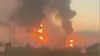
Saudi Arabia has hosted US military forces since 1990. The post-Gulf War arrangement was built on a specific premise: American forces protect Gulf oil infrastructure from Iranian threats in exchange for basing rights and oil market stability. For 35 years that arrangement was the foundation of American Middle East policy. On February 28, 2026, the United States launched a war on Iran. Iran responded by striking Saudi oil facilities, its Red Sea shipping routes and its supply chains. The arrangement produced a war that left Saudi Arabia more exposed to Iranian attack than at any point since the arrangement began. The Gulf states have confronted the limits of US deterrence, as the Atlantic Council confirmed this week. Mecca is what confronting those limits produces.
The pact's combined weight is specific. Nearly 1.4 million active military personnel. 3,400 aircraft. 6,000 tanks. More than 340 naval assets. Saudi Arabia contributes capital, geography, infrastructure and political convening power. Turkey contributes its defence-industrial base — drones, missiles, sensors, electronic warfare systems and NATO-derived military expertise. Pakistan contributes manpower with genuine combat experience and, as the MEPEI analysis notes, 'unstated but unmistakable,' a nuclear arsenal. Pakistan has not explicitly extended nuclear cover to the other signatories — Islamabad has historically reserved its nuclear capability for Pakistan's own security — but the arsenal's presence within the pact's collective defence structure changes the strategic calculus regardless. The Mecca pact is the first collective defence agreement of the 21st century to include the only nuclear power in the Muslim world.
The pact did not emerge from nothing. Saudi Arabia and Pakistan formalised a bilateral collective defence commitment in September 2025. Pakistan had already deployed thousands of troops, fighter aircraft, drones and an air-defence system to Saudi Arabia by mid-2026. Turkey had been selling Saudi Arabia drones since 2023. The Mecca pact merged two converging bilateral relationships — which is precisely why it is likely to be more durable than agreements negotiated cold. The operational cooperation precedes the treaty. The treaty formalises what was already happening on the ground.
Turkey's position within the pact deserves specific attention. Turkey is a NATO member. NATO's Article 5 commits all members to collective defence if any ally is attacked. Turkey has now committed, under Mecca, to collective defence if Saudi Arabia or Pakistan is attacked. Those obligations do not formally conflict — Article 5 covers NATO members, not Saudi Arabia or Pakistan. Pakistan's Foreign Minister confirmed that the pact 'does not abrogate or replace any existing bilateral or multilateral agreements.' But the practical implication is precise: if Iran attacks Saudi Arabia, Turkey is bound by treaty to respond. If Turkey responds to a Saudi attack, a NATO member is militarily engaged with Iran. NATO's Article 5 does not trigger. The other 31 NATO members are not obligated. But a NATO country is in the conflict, without NATO having been formally invoked. Turkey called the Iran war illegal and refused its bases for American strikes. It has now signed a pact that could bring it directly into the conflict through a different legal mechanism.
Egypt was supposed to sign. The original negotiations were quadrilateral. By August, Cairo had dropped out. Washington reportedly signalled its discomfort with Cairo's participation — a signal that produced the absence. Egypt has the Arab world's largest military and a longstanding bilateral security relationship with Washington. Its absence from the final text is the most revealing blank in an agreement otherwise notable for what it contains. A pact without Egypt is smaller. It is also a pact whose quadrilateral ambition was trimmed by the same American patron whose security guarantees were found insufficient. Nobody at any of the three signing tables has confirmed this publicly.
The war on Iran was supposed to end the Iranian threat to Gulf stability. It has produced a new Gulf alliance because three countries concluded that existing arrangements were insufficient. Saudi Arabia did not leave the American security umbrella. It built an additional one, in the holy city, with a nuclear power. The question that follows — what happens if the two conflict — has not been asked at any press conference. It is the most important question the Mecca pact raises.