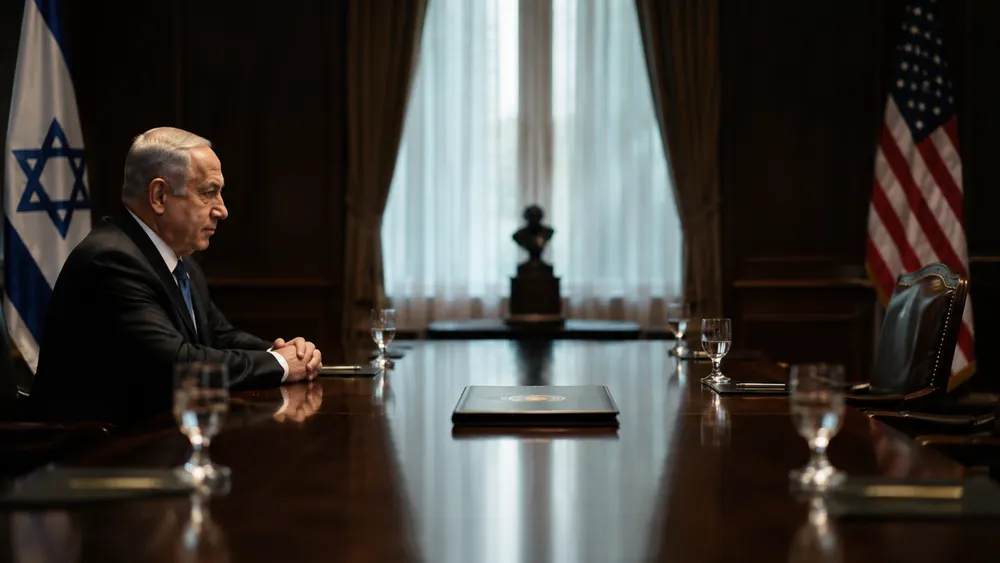
On August 9, Benjamin Netanyahu stood before his cabinet and said: 'I want to clarify this: Israel rejects the 15-point document. I have heard people saying, "You didn't say that." So here I am saying it again.'
The 15-point document was Trump's Gaza peace plan, announced on July 30 as a 'historic' breakthrough, a 'monumental step toward lasting peace and security.' On the same day Netanyahu rejected it, Hamas published a statement reaffirming its commitment to implementing the plan and said it was prepared to 'engage seriously and responsibly' with the process. The White House did not comment.
The ally rejected what the adversary accepted. The patron said nothing.
This sequence, which should be the leading story in every analysis of Middle East diplomacy, has received less analytical attention than it deserves because it is so precisely the opposite of the established narrative. The established narrative is that Hamas is the obstacle — the group that cannot be trusted, the organisation that prevents Gaza from reaching a settlement, the reason negotiations have collapsed repeatedly across two years of war. On August 9, Hamas agreed to Trump's plan. Netanyahu rejected it. The obstacle is not where the narrative said it was.
What the Plan Required and What Netanyahu Refused
Trump's Board of Peace announced on July 30 that it had achieved 'the complete disarmament of Hamas and all other armed groups in Gaza.' The plan — fifteen points negotiated over months with roughly 40 countries including Israel as a participant — called for a phased withdrawal of Israeli troops from Gaza alongside the progressive disarmament of Hamas, with Gaza's day-to-day administration eventually transferred to a technocratic Palestinian committee under Board of Peace oversight.
Netanyahu's objection was to the word 'phased.' He demanded complete and genuine Hamas disarmament before any Israeli forces withdraw. Not phased. Not concurrent. Complete, first, then withdrawal. His cabinet statement was specific: 'The IDF will not carry out any withdrawal until Hamas is genuinely disarmed and will continue to thwart threats against our forces and our citizens.' Finance Minister Bezalel Smotrich said the IDF 'cannot retreat one millimeter in the Gaza Strip.' Netanyahu also used the occasion to reiterate his broader position: 'As long as I am Prime Minister, a Palestinian state will not arise — not in Gaza and not in the West Bank. Not Fatahstan and not Hamasstan.'
The sequencing dispute is not technical. It is structural. Hamas cannot disarm under military occupation because disarmament while occupied is surrender. Israel will not withdraw before disarmament because withdrawal before disarmament, from Netanyahu's perspective, allows Hamas to survive as a political and eventually military force. The two positions cannot be simultaneously satisfied. Netanyahu knows this. His demand for complete upfront disarmament is not a negotiating position. It is a structural impossibility designed to prevent the agreement's implementation while maintaining the appearance of conditionality.
Al Jazeera's reporting from Gaza captured what the rejection means on the ground: it 'raises serious questions for Palestinians about the path out of hostilities.' 'The full rejection here puts the sequencing and the steps into question,' Al Jazeera's Hani Mahmoud said. Egypt's foreign minister said after meeting the UN's special envoy that all parties must 'fulfil their commitments and refrain from taking any actions that could hinder the implementation process.' The mediators said the right things. The implementer said no.
The Third Rejection in Three Months
This is the third formal act of Israeli defiance against American diplomatic initiatives since June. The pattern matters because each instance has occurred without meaningful American consequence, and the absence of consequence has shaped the next act of defiance.
In June, Israeli operations in Lebanon directly undermined the US-Iran nuclear negotiations that the Islamabad Memorandum was designed to advance. Trump reportedly called Netanyahu and told him he was 'f***ing crazy.' Netanyahu continued operations. The Bürgenstock nuclear talks were postponed. They eventually resumed. No consequences for Israel.
In July, Ben-Gvir publicly called on Netanyahu to tell Trump 'no.' Netanyahu attended a US senator's funeral in Washington under an active ICC arrest warrant. He met American officials. He flew home. No consequences.
In August, Netanyahu has now formally rejected the Gaza peace plan that Trump has been promoting as his key foreign policy achievement in the Middle East. Hamas accepted it. The White House has not commented. Israeli forces continue daily operations in Gaza. Israeli forces occupy more than half of the Strip.
CNN noted that Netanyahu's explicit rejection 'will further strain a close relationship' and comes 'after months of growing tensions between the White House and Israel's leadership over Iran.' The straining is real. The consequences, so far, are not.
The Calculation Netanyahu Is Making
Netanyahu is facing elections in October. His political survival depends on satisfying the far right of his coalition — the Smotriches and Ben-Gvirs whose support he needs and whose ideological commitments preclude a Palestinian state, an Israeli withdrawal from Gaza or the acceptance of any American plan that would constrain Israeli military action. The October deadline is not a background fact. It is the operating context for every decision Netanyahu makes about Gaza, about Lebanon, about Trump's peace architecture.
The rejection of the 15-point plan serves three simultaneous purposes. It preserves the coalition. It forecloses the Palestinian state option that Smotrich has made a condition of government participation. And it tests whether Trump, whose Gaza plan has now been publicly humiliated, will impose consequences that would cost Netanyahu votes before October.
The answer Netanyahu has received to that test, across three iterations of defiance, is consistent: Trump will express frustration and take no action. The 'f***ing crazy' call produced continued Lebanon operations. The Ben-Gvir statement produced no diplomatic response. The Gaza rejection has produced, so far, White House silence.
The Liability State piece DiploPolis published in June identified the central dynamic: the liability is visible, the mechanism for addressing it is broken, and in the gap between what Washington knows and what Washington will do, the most radical elements of Netanyahu's government have found their operating space. The August 9 rejection is the most complete demonstration yet of that dynamic. Netanyahu has moved from defying American operational requests to defying American diplomatic architecture — from ignoring ceasefire announcements to rejecting a peace plan publicly, by name, at a cabinet meeting, on the record.
The Question the White House Did Not Answer
Hamas's acceptance of the 15-point plan creates a specific political problem for the established narrative about Gaza. If Hamas accepts Trump's plan and Israel rejects it, then the framing that has defined two years of international coverage — that the obstacle to peace in Gaza is Hamas — requires revision. Hamas's acceptance does not make Hamas trustworthy, democratic or reformed. It makes Hamas, in this specific instance, the party that agreed to the American proposal. That distinction matters for the accountability question.
The Egyptian foreign minister noted that parties must 'fulfil their commitments.' The Hamas politburo called on 'mediators and guarantor countries to assume their responsibilities and prevent any violations.' Both statements are directed at Israel. Egypt is a traditional American ally. The mediators built into Trump's own Board of Peace framework are pointing at Israel as the party in breach.
The White House's silence is not neutral. A patron who touted a plan as a 'monumental step toward lasting peace and security,' watched his ally reject it publicly and said nothing, has communicated something precise: the rejection will not cost Netanyahu anything. That communication is understood in every capital that is watching this war, calculating what American pressure means and how reliably American commitments are enforced.
An ally that can reject its patron's peace plan, at a cabinet meeting, by name, with the words 'I have heard people saying you didn't say that, so here I am saying it again,' and receive no response from the White House — that ally has not merely defied its patron. It has demonstrated the terms of the relationship. The liability state is not a condition that is becoming more dangerous. It is a condition that has already produced its own logic, and the logic is this: say no, wait, nothing happens, say no again.