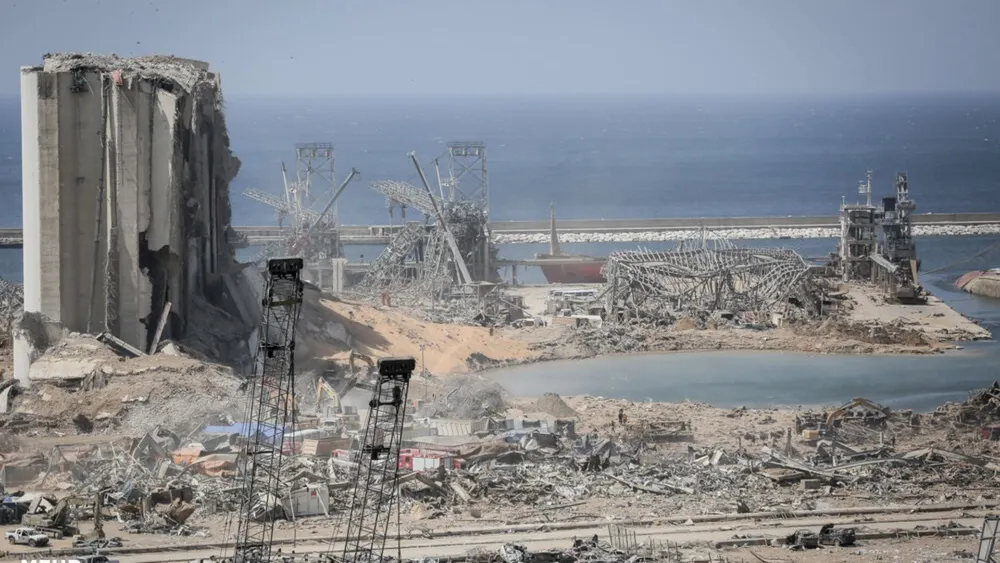
At exactly 6:07 PM on August 4, 2020, 2,750 tonnes of ammonium nitrate stored in Hangar 12 at the Port of Beirut ignited. The blast killed more than 220 people, wounded more than 6,500, levelled entire neighbourhoods and shattered windows as far away as Cyprus. It was one of the largest non-nuclear explosions in modern history.
Fifteen days before it happened, Lebanon's State Security sent a three-page report to President Michel Aoun and Prime Minister Hassan Diab. The report warned that ammonium nitrate 'that could be used to make explosives' was being stored at the port. Both Aoun and Diab later admitted to having received it. Both said they took no action. Fifteen days later, the nitrate exploded.
Today, on the sixth anniversary of the blast, Hiyam al-Bikai stood at the port carrying a photograph of her son Ahmad. 'Until now, we haven't gotten justice. There has been no accountability and nobody has been arrested,' she told AFP. 'This is an extremely painful anniversary. Our pain has not stopped and our wound has not healed.' No one is in custody in Lebanon in connection with the explosion. No indictment has been issued. The public prosecutor is, according to the justice minister, preparing his response.
This is not the story of a country that tried to find accountability and failed. It is the story of a country whose political system treated accountability as a threat to be managed and, for six years, managed it successfully.
The Letter and What Was Done With It
The July 20 warning letter is the factual core of the Beirut explosion case, and it has received less attention than it deserves. It means that the Lebanese head of state and the Lebanese prime minister possessed specific written intelligence that explosive material capable of mass destruction was being stored improperly in a busy commercial port, in the centre of the capital, fifteen days before that material exploded and killed 220 of their citizens.
What the warning produced was not an inspection, not an emergency removal order, not a public safety alert. It produced nothing. The material stayed. The port stayed open. The people of Beirut went about their lives without being told that their government had received a warning about a bomb in their harbour.
What makes this significant is that it transforms the nature of what occurred on August 4, 2020. The explosion was not simply a consequence of negligence accumulated over years of corrupt port management, though it was also that. It was a consequence of a specific decision — or more precisely, a specific failure to decide — made within the period covered by documentation. That documentation exists. That documentation names the people who received it. Those people have acknowledged receiving it. The investigation that Judge Tarek Bitar has spent years trying to complete covers the 70 individuals whose alleged offences include this chain of events.
The investigation's obstruction has therefore never been a mystery about the past. It has been a very clear calculation about the present: those with the power to block accountability are also among those the accountability might reach.
The Six-Year Machine
The legal and political mechanisms used to obstruct the investigation constitute a documented record of institutional self-preservation. The most damaging single actor was Prosecutor General Ghassan Oueidat — who was himself indicted on negligence charges in connection with the blast — and who used his powers to systematically obstruct Bitar's investigation: releasing suspects, banning law enforcement from executing Bitar's orders and filing a lawsuit against Bitar for usurpation of power. Oueidat retired in 2024. His successor Jamal Hajjar lifted the ban on cooperation in 2025. Beyond Oueidat, politicians challenged Bitar's jurisdiction, former ministers filed legal complaints against him, parliamentary immunity was invoked to prevent questioning, and legal challenges accumulated faster than the investigation could process them. The 'state within the state' — the phrase Joe Bou Saab, whose brother died in the blast, used to describe the coordinated obstruction — operated not through violence or overt illegality but through the country's own judicial and parliamentary procedures, applied strategically to produce paralysis.
Bou Saab has attended almost every protest since the explosion and himself faced questioning and detention over demonstrations opposing political interference. Looking back on six years, he described them as the hardest of his life. 'We were fought by the state and by the state within the state,' he said. 'The past six years have aged me by decades. But they also taught me to keep fighting until I reach my goal, both in life and for my brother Joe.'
The system he describes is not unique to the Beirut explosion. It is the operational logic of Lebanese confessional politics — the arrangement in which sectarian patronage networks, overlapping with parliamentary blocs, militia power and commercial interests, produce a governing class whose primary loyalty is to the system's preservation rather than to any citizen it nominally serves. Accountability for the port explosion would require the system to turn on itself. For six years, it did not.
A turning point came, cautiously, in early 2025. The election of President Joseph Aoun and the formation of a government under Prime Minister Nawaf Salam introduced, for the first time in the investigation's history, a political leadership that was not implicated in the obstruction and that explicitly promised accountability. Bitar resumed his probe. In March 2026, he submitted an investigative report to Lebanon's public prosecutor's office, naming 70 individuals for various offences. The case is now with the prosecutor. Justice Minister Adel Nassar told AFP on Tuesday that a decision is expected within 60 to 90 days, after which the case returns to Bitar for the formal indictment act — the step that triggers the trial. Families hope the indictment arrives before the end of 2026.
Salam spoke at today's commemoration. 'Let no one doubt that there is no cover for any official, whatever their position,' he said. 'Accountability will spare no one.' The commitment is the right commitment. The question it leaves open is whether the system Salam now governs is capable of delivering what it has spent six years refusing to deliver. The prosecutor has had Bitar's report for several months. The 60 to 90 day response window is now running.
The cautious optimism the families feel is real. So is the record that produced the caution.
The Anniversary That Was Overshadowed
Cecile Roukoz, a lawyer whose brother died in the blast, told the crowd at the port today: 'No matter how bad the painful circumstances in Lebanon become... the crime of August 4 is not behind us. Knowing the truth and holding the criminals to account remains the priority.'
The specific phrase — how bad the painful circumstances become — is not abstract. Al Jazeera's Zeina Khodr could not be at the Beirut commemoration today. She was in Zawtar al-Gharbiyeh, in southern Lebanon, where Israeli military operations have reduced houses to rubble and driven residents from their homes. She watched an 80-year-old man stand in front of what had been his house and say: 'I feel humiliated. I have no choice but to collect the scrap metal from my destroyed home to sell in order to be able to survive.' He was describing, in specific and personal terms, the cost of a state that has been unable to protect him from external destruction any more than it was able to protect the 220 people who died at the port from internal negligence.
The two stories running simultaneously today — the sixth anniversary of the blast, the ongoing displacement of more than a million people from southern Lebanon — are not separate. They are expressions of the same structural condition. A state that cannot account for a catastrophe it was warned about cannot build the institutions that would give it sufficient sovereignty to resist being treated as a battlefield by stronger powers. Lebanon's accountability failure and Lebanon's sovereignty failure grow from the same root.
The reconstruction bill from the latest Israeli military escalation alone is estimated at $20 billion. Lebanon's government does not have $20 billion. International donors have made reconstruction aid conditional on the disarmament of Hezbollah — using the human cost of the war as leverage in a political negotiation. The World Bank estimated losses from the 2024 escalation at $11 billion, money the government also did not have, reconstruction that had not begun before the next escalation made it redundant. The Lebanese army deployed to some southern villages in late July, and residents returned to inspect ruins that Israeli forces had continued to demolish even after the ceasefire was declared. The municipality head in al-Mansouri told Khodr: 'The Israelis drop stun grenades every time someone tries to reach those areas. Every day there is machinegun fire around the village. There is no stability.'
On the sixth anniversary of the port explosion, Lebanon is simultaneously trying to hold its political class accountable for a disaster they were warned about and trying to survive a military occupation whose destructive logic mirrors the impunity the political class has always assumed for itself. The victims at the port and the old man in Zawtar al-Gharbiyeh are living inside the same failure: a state that knows what is being done to its people and either will not or cannot act.
The Indictment That Has Not Come
Bitar's referral to the public prosecutor in March 2026 is the most significant development in the investigation since it began. Seventy individuals. Six years of work. The families hope the indictment comes this year. The Justice Minister says 60 to 90 days.
What the indictment will not undo is the six years in which it did not come. The obstruction was not merely a delay. It was an education — for Lebanese citizens, for the political class, for every government anywhere that chooses self-preservation over accountability. The lesson the obstruction delivered is that a sufficiently entrenched political system can survive almost any catastrophe if it controls the institutions that would investigate it. The lesson the investigation's survival delivered, against that, is that families who refuse to stop demanding accountability eventually exhaust the machine's willingness to keep blocking them.
Both lessons are true. Lebanon has lived both of them simultaneously, in front of the whole world, for six years.
The families are still at the port. The public prosecutor is still preparing his response. The man in Zawtar al-Gharbiyeh is still collecting scrap metal from his house. The state knew about the nitrate for fifteen days before it exploded, and said nothing. Six years later, it is still preparing its response.
This Analysis piece is free to read. Future Analysis pieces will be available to registered DiploPolis members first. Free registration takes 30 seconds. No credit card required.
Find this piece interesting?
Dispatches by DiploPolis delivers sharp analysis and pointed commentary on power, politics, diplomacy, and world affairs — directly to your inbox.
No neutrality. No noise. Just argument.