In June 2024, protesters flooded the streets of Nairobi. The immediate trigger was a finance bill that proposed new taxes on bread, cooking oil and sanitary products. The deeper anger was at something harder to name. The Kenyan government had not invented the policy environment behind the bill in isolation. The IMF, whose programme Kenya was operating under, had shaped the fiscal conditions that made austerity the path of least resistance. The protesters knew this. Some of them said so explicitly. Their anger was not simply directed at their own parliament. It was directed at an institution headquartered in Washington that had never asked them anything and whose decisions arrived in their lives as school fees cut, subsidies withdrawn, public-sector jobs gone and the price of everything rising. That is not anti-institutionalism. That is memory.
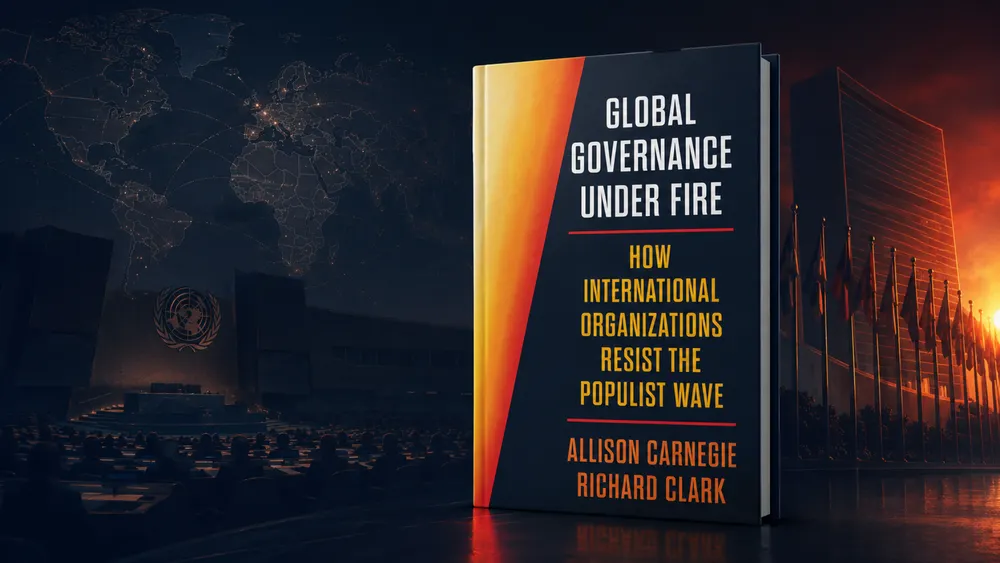
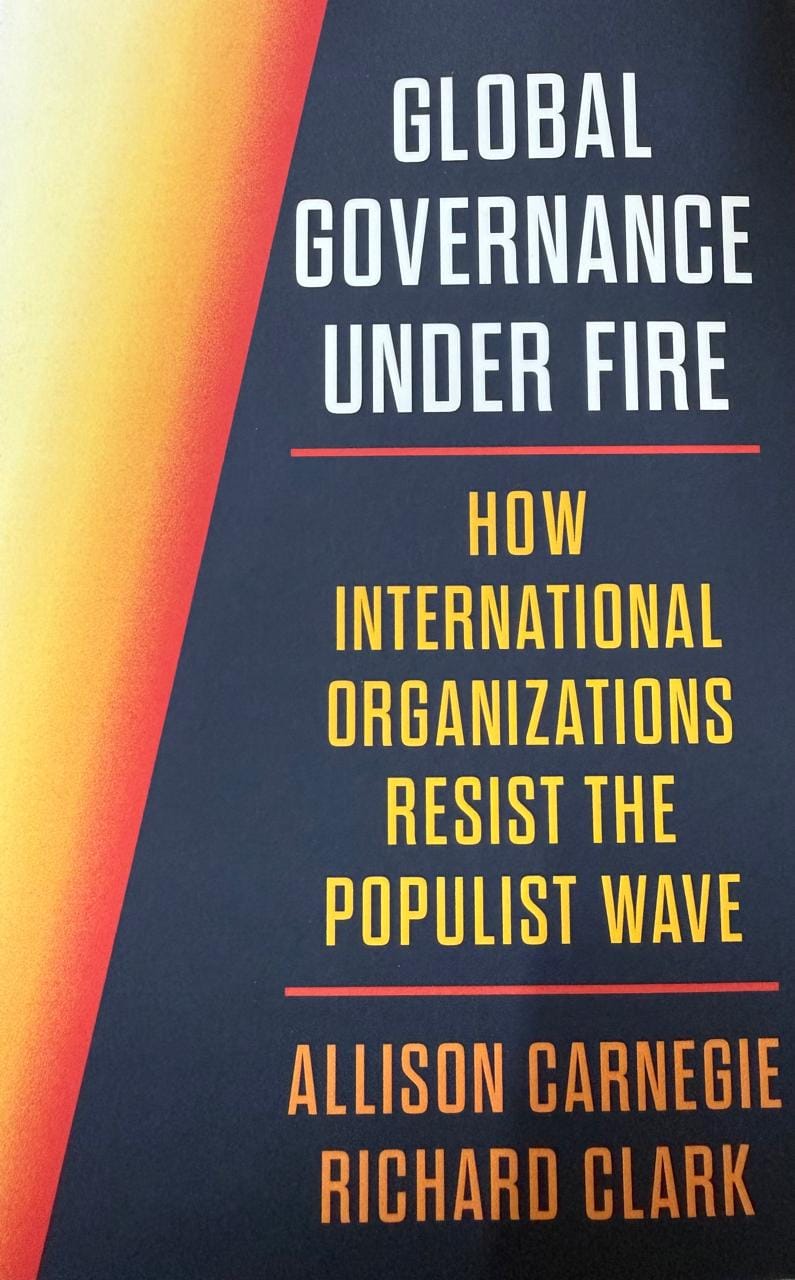
Allison Carnegie and Richard Clark have written, in Global Governance Under Fire (Princeton University Press, 2026), a serious and analytically useful book about how international organisations survive pressure from populist governments and their constituencies. It makes a move that is more sophisticated than the usual lament about populists destroying the liberal order. It treats international organisations not as passive victims of political hostility but as strategic actors: institutions that appease, sideline, adjust, reframe, lower their visibility and court alternative coalitions in order to endure. That is a genuine contribution to how we understand the politics of multilateralism. It also stops well short of the harder question the book almost demands.
Begin with what Carnegie and Clark get right. The typology of institutional response is analytically sharp. International organisations do not simply absorb pressure or collapse under it. They adapt. They change their language when the political climate shifts. They adjust procedural routes when frontal engagement becomes too costly. They accommodate hostile governments when accommodation is cheaper than confrontation and work around them when it is not. Treating this as strategic behaviour rather than passive endurance changes what questions are worth asking. The right question is not whether international organisations will survive populism. It is how they survive it, and what they become in the process.
That reframing is valuable. But the doubt it leaves behind is equally important. Appeasement and sidelining are useful categories, but institutions do not always know what they are doing in real time. Sometimes what looks like strategic resilience from Geneva is improvisation, budget protection, donor management or headline avoidance. The same institutional act can read as pragmatic adaptation in Washington and as betrayal in Nairobi, Delhi or Buenos Aires. Carnegie and Clark explain institutional survival better than they explain institutional legitimacy. Those are not the same thing, and the gap between them is where the book's most significant limitation lives.
The blind spot is the Global South, and the IMF is where it is most visible. Distrust of the IMF across Africa, Latin America and South Asia is not populist theatre. It rests on accumulated historical experience: structural adjustment programmes that cut public services, austerity conditionality applied precisely when countries were most economically vulnerable, currency crises managed in ways that protected creditors while punishing citizens, and governance structures in which borrowing countries remain systematically under-represented because voting shares are tied to economic size. The United States holds roughly 16 per cent of IMF voting power; the entire African bloc, representing 54 borrowing countries with more active IMF lending programmes than any other continent, holds 6.5 per cent. An institution designed to stabilise the global economy reflects, in its very architecture, the power distribution of the moment it was built. That is not a conspiracy theory. It is a documented institutional history with a large academic literature behind it.
The Kenya protests made this history political again with unusual directness. Anger at tax increases and austerity was aimed not only at the Kenyan parliament but at the institution many protesters understood to be shaping the policy environment from a distance. That connection, between a finance bill in Nairobi and programme conditionality agreed in Washington, is precisely the kind of link that Carnegie and Clark's framework struggles to process. Their typology classifies institutional responses to populist pressure. It is less equipped to ask whether the pressure itself contains a legitimate verdict. When the IMF later acknowledged that its programme projections for Kenya had been overly optimistic, the concession arrived after the tear gas. That sequencing is not incidental. It is the wound.
This is the distinction the book does not quite make, and it matters. When Donald Trump attacks the World Trade Organization or the World Health Organization, much of that is nationalist grievance performing as sovereignty defence. When African, Latin American or South Asian publics distrust the IMF, they are often remembering something specific: school fees reinstated, subsidies removed, public-sector workers retrenched, food prices rising and the recurrent humiliation of being told that pain is reform. These are not the same kind of anger. Collapsing them both into the category of populist pressure on international institutions is analytically convenient and politically misleading.
Carnegie and Clark seem aware that legitimacy matters. Their framing acknowledges the concern that international cooperation might survive the populist wave while losing the inclusiveness and effectiveness that gave it value. That is close to the anti-hypocrisy question. It is not quite the same. The anti-hypocrisy question is harsher: were some of these institutions attacked not because they failed to preserve the liberal order, but because they helped build an unequal one? Is the resentment directed at them always a pathology to be managed, or sometimes a verdict to be heard?
If the book cannot fully ask that question, the argument tilts in a particular direction. Populism becomes the problem. Institutions become the threatened good. That is too clean. Some populists are bad-faith arsonists. Some institutions are genuinely worth defending. But an institution can be worth defending and simultaneously guilty of hierarchy, selectivity and hypocrisy. Carnegie and Clark's framework is well equipped to explain how institutions survive. It is less well equipped to ask whether survival, on these terms, is enough.
Global Governance Under Fire is a useful and necessary book. Read it for the typology of institutional adaptation, which is genuinely illuminating. Read it to understand how multilateral organisations navigate political hostility without collapsing. Then read it against Nairobi, against the IMF's history in sub-Saharan Africa, against the voting structures that keep borrowing countries structurally marginal in the institutions that govern their economic lives. An institution that learns to manage anger without listening to the history inside it may preserve its machinery. It will not recover its moral claim.
This Book Review is free to read. Future Book Reviews will be available to registered DiploPolis members first. Free registration takes 30 seconds. No credit card required.
Find this piece interesting?
Dispatches by DiploPolis delivers sharp analysis and pointed commentary on power, politics, diplomacy, and world affairs — directly to your inbox.
No neutrality. No noise. Just argument.