In May 2025, after India launched retaliatory strikes against Pakistan following the Pahalgam terror attack, Prime Minister Narendra Modi visited Adampur air base. Pakistan had claimed Indian aircraft were struck there. The visit was a rebuttal, a piece of visual evidence delivered directly to the camera. It was also something else: a performance of resolve staged as much for Indian television studios and the government's nationalist constituency as for any Pakistani audience. The strikes may have been a legitimate act of state policy. That is not the point. The point is what surrounded them: the saturation language of punishment, humiliation, muscular response and civilisational confidence that turned a security operation into a domestic political event. Rachel Myrick's Polarization and International Politics: How Extreme Partisanship Threatens Global Stability (Princeton University Press, 2025), winner of the Best Book Award from the Conflict Processes Section of the American Political Science Association, does not discuss Operation Sindoor. It does not need to. Its central mechanism explains precisely why that language was necessary, why restraint would have been politically dangerous and why the foreign adversary had become, in a very specific sense, domestically useful.
Myrick's argument is straightforward and genuinely important. Polarisation does not merely produce angry publics and dysfunctional legislatures. It reshapes the strategic environment in which democratic leaders make foreign policy. When domestic political competition becomes sufficiently intense, restraint looks like weakness, ambiguity looks like betrayal and diplomacy looks like softness. The credibility advantages that democracies have historically enjoyed in international relations, reliable commitments, stable alliances, consistent policy, erode when domestic fracture makes every foreign policy choice a battlefield in the internal political war. Leaders find themselves unable to make concessions because concession feeds the opposition's narrative. They find themselves compelled to project toughness because toughness is the only position that cannot be attacked from the right.
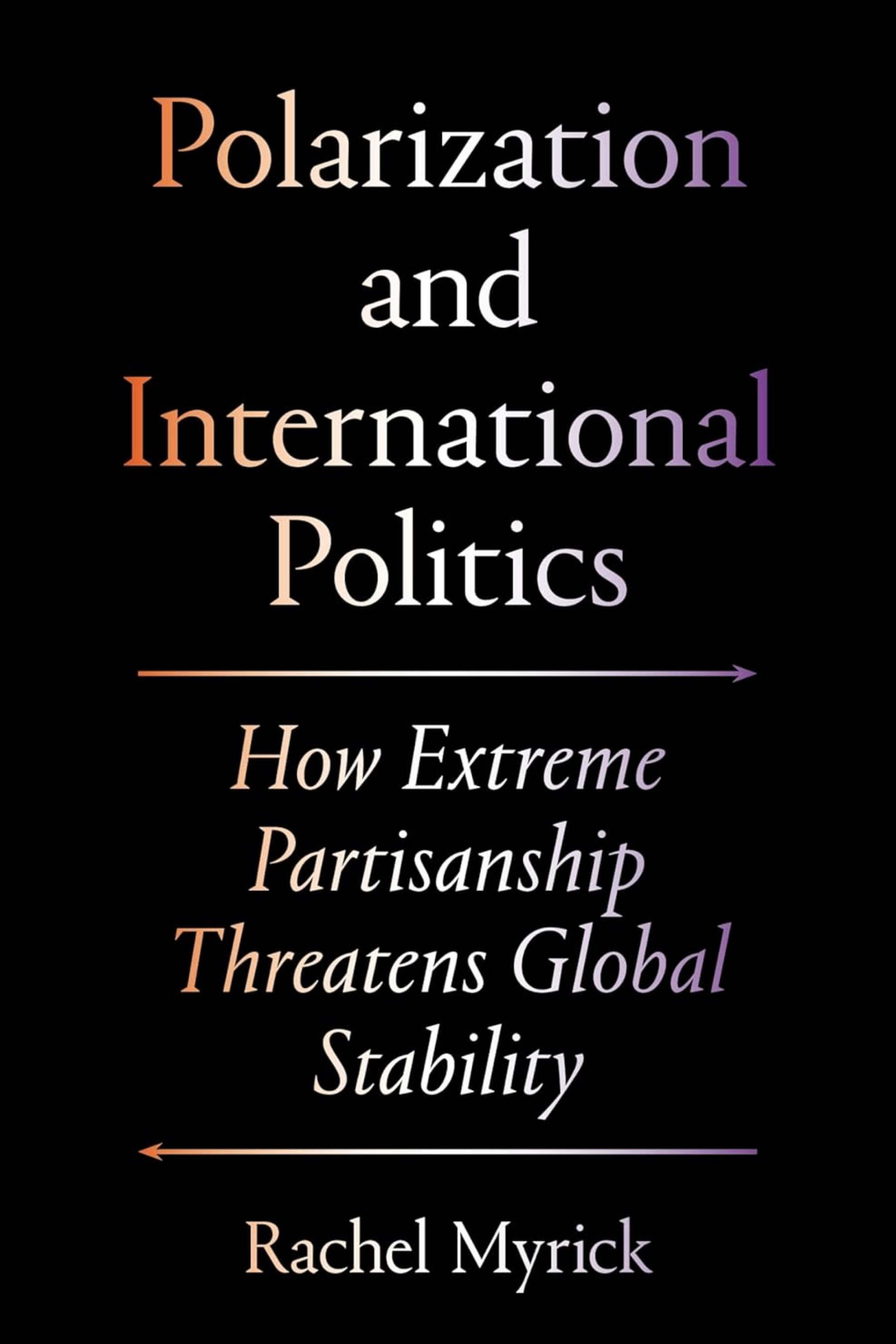
That mechanism is real and the book is right to take it seriously. The American evidence on which Myrick primarily builds her case is substantial. Polarisation has made United States foreign policy less predictable, less credible and more vulnerable to sudden reversal between administrations. Allies cannot be certain which America they are dealing with. Adversaries can wait. The democratic advantage in signalling commitment has been quietly hollowed out by the domestic instability behind the signal. This is an important corrective to the literature that treats polarisation mainly as a domestic problem. Myrick shows it has structural consequences for how the international system works.
The review's more interesting task is to follow the argument beyond its American origin and see where it travels well and where it breaks down. It travels to India, but the mechanism operates differently. Indian polarisation does not primarily produce the policy instability that Myrick identifies in the American case: alternating administrations with opposed foreign policies, congressional obstruction, partisan reversals on alliances and agreements. What it produces instead is a compression of the space between national security and domestic political performance. Pakistan is not only a security problem for India. It is a reliable political symbol, a stage on which resolve can be performed for domestic audiences. The foreign enemy becomes necessary not only because it poses a real threat, but because it serves a recurring domestic political function. In this environment, any Indian leader who chose negotiation over confrontation after a terrorist attack would not merely be making a strategic choice. He would be handing his opposition the single most damaging accusation available in Indian politics: that he was soft on Pakistan. Myrick does not need to visit Adampur to explain why Modi did. Operation Sindoor illustrated that dynamic with unusual clarity. The line between deterrence and theatre did not disappear. It became very difficult to locate.
The Israeli case is where Myrick travels most directly and most powerfully, and the analytical connection that matters most is war aims. In a less polarised political system, war aims can still be brutal, excessive or mistaken. But they are more likely to be debated as strategic questions: what is achievable, what is the cost, what is the exit, what comes after? In Israel, polarisation has made the war aim itself unstable. Is the goal to destroy Hamas, recover hostages, permanently reshape Gaza, preserve Netanyahu's governing coalition, prevent a Palestinian political future, reassure the Israeli public or satisfy the far right? The answer keeps shifting because the war is not only being fought against Hamas. It is being fought inside Israeli politics simultaneously. When Netanyahu faced far-right backlash as the United States pressed for an end to the Gaza war, with Ben-Gvir and Smotrich threatening coalition collapse over any arrangement that left Hamas in any form, the mechanism was visible in plain sight: the external policy choice was being constrained, in real time, by the requirements of internal political survival. The hostage families understood this before the analysts did. They watched their government make choices that could not be explained by military logic alone, choices whose real audience was a domestic coalition rather than a Hamas negotiating team. Myrick's framework names that dynamic with precision. A polarised state does not simply fight an enemy. It fights over the meaning of victory while the war is still unfolding.
Pakistan is where the framework encounters its structural limit, and the review cannot pretend otherwise. Pakistan has polarisation. It has fractious civilian parties, intense political competition, mass mobilisation and the performance of nationalism that Myrick's framework predicts. But polarisation is not the deepest mechanism. The deeper mechanism is civil-military imbalance. Foreign and security policy, on India, Afghanistan, nuclear posture, relations with Washington and Beijing, are substantially shaped by the army, not by elected governments. Civilian parties compete, accuse, perform and mobilise, but the foreign policy ceiling is set elsewhere. When the analysis describes the military's handling of the 2025 conflict with India as a source of domestic consolidation and international attention for the institution itself, it is describing a dynamic that Myrick's framework of partisan polarisation cannot fully capture. The decisive actor is not an elected leader constrained by a polarised public. It is an institution that operates largely outside the electoral accountability that makes the book's central mechanism work. Pakistan's democracy is noisy at the surface and controlled at depth. That is a different political structure than the ones Myrick is explaining, and it requires a different analytical vocabulary.
This is not a failure of the book. It is the honest limit of a framework designed to explain polarised democracies. Myrick's argument assumes a baseline of democratic functionality: parties compete, leaders face voters, institutions constrain, foreign policy choices can be punished or rewarded electorally, and the domestic political environment actually shapes what leaders can and cannot do in the international arena. In much of the world, that baseline does not exist cleanly. Pakistan is the test case, but it is not alone. The review should say this without dismissing the argument: her mechanism is real and travels further than most American political science manages to travel. But it travels best where elected leaders actually control the instruments whose instability she is trying to explain.
Polarization and International Politics is essential reading for anyone trying to understand the present disorder of international relations. It explains why democratic foreign policy has become less predictable, why alliances have become less reliable and why adversaries have learned to wait out administrations rather than negotiate with them. Read it for the American evidence, which is thorough and persuasive. Read it for the framework, which is sharp and genuinely portable. Then test it against India, Israel and Pakistan, and notice where the framework illuminates and where the map runs out. Myrick has written a book that makes you see the international system differently. The cases it cannot fully explain are as revealing as the ones it can. In a world where domestic politics and foreign policy have become increasingly indistinguishable, that is not a minor achievement.
This Book Review is free to read. Future Book Reviews will be available to registered DiploPolis members first. Free registration takes 30 seconds. No credit card required.
Find this piece interesting?
Dispatches by DiploPolis delivers sharp analysis and pointed commentary on power, politics, diplomacy, and world affairs — directly to your inbox.
No neutrality. No noise. Just argument.