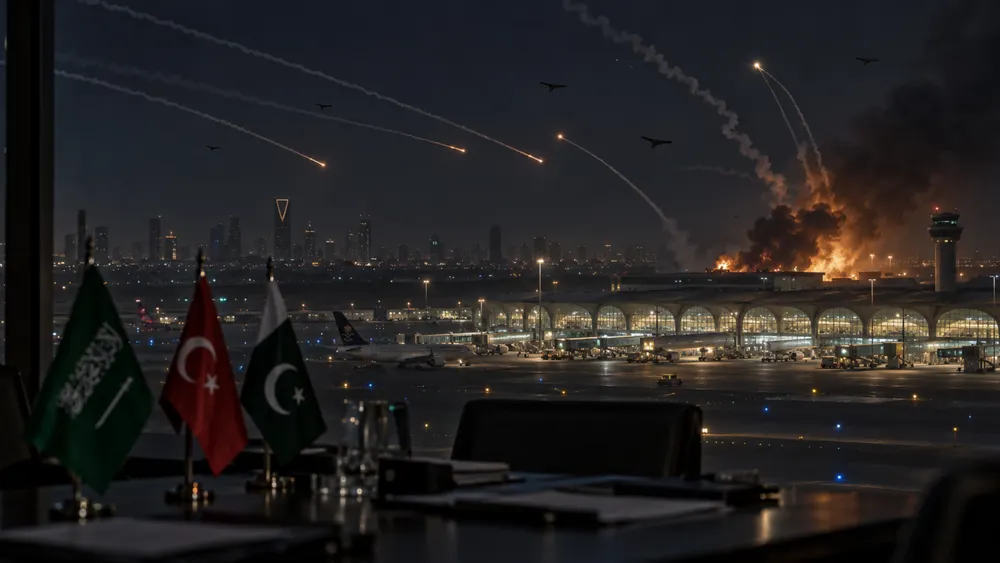
On October 5, 2026, the Mecca Strategic Mutual Defence Agreement was invoked for the first time. The triggering event was a Houthi strike on an Aramco facility outside Riyadh on October 3. Türkiye and Pakistan agreed to deploy forces to Saudi Arabia. The Strategic Political and Defence Committee met in emergency session. The alliance, signed in August, had held its first test.
Six days later, a mixed barrage of drones and cruise and ballistic missiles flew more than a thousand kilometres and struck King Khalid International Airport in Riyadh. Twelve people were killed and 309 wounded. A day after that, three more people were killed and 36 wounded in strikes on Abha airport and Riyadh again. By the end of the week, nineteen people were dead, hundreds more injured, and Saudi Arabia was investigating how its air defences had failed to detect the incoming barrage in time to stop it.
The Mecca Alliance had been invoked. Deterrence had not followed.
This is the central problem the Riyadh airport attacks expose — not about the Houthis, whose capabilities and intentions were well understood before August 7, but about the alliance itself and what it is actually designed to do. An alliance invoked on October 5 that did not prevent strikes killing nineteen people on October 11 and 12 has either failed at deterrence or was never designed to produce it. The distinction matters enormously for what the alliance means, and for what Saudi Arabia has actually purchased by signing it.
The Weapon That Got Through
The initial probe into the defence failure yielded one specific finding: the Houthis first sent drones to clear the way for cruise and ballistic missiles that followed. The drones appear to have been designed to exhaust or confuse Saudi Patriot batteries, creating a window through which the missiles could pass. Saudi air defences had been intercepting Houthi projectiles since February, and had done so with considerable success. The October 11 attack worked because the sequencing was different — saturation first, then strike.
The Houthis' ballistic missiles present a specific problem for Patriot systems. They carry manoeuvrable warheads that can alter course in flight, degrading the probability of interception. The distance from Houthi-controlled territory in Yemen to Riyadh is more than a thousand kilometres — well within the reach of the longer-range systems the Houthis have developed, refined, and battle-tested over years of war. Houthi spokesman Yahya Saree warned that Saudi Arabia 'bears responsibility for any failed interceptions' — a statement of both strategic intent and technical confidence. The Houthis are not surprised when Saudi defences fail. They are counting on it.
The Mecca Alliance brings Türkiye's drone production, Pakistan's military forces, and a combined paper strength of approximately 1.4 million active troops. None of this changes the fundamental geometry of the Houthi threat to Saudi Arabia. The Houthis are not massed on a border that allied forces can reinforce. They are operating from Yemen's interior, launching systems at a range that makes intercept-based defence the primary Saudi option, and they are improving the saturation and sequencing of their attacks in ways that are testing that defence systematically.
What the Alliance Actually Does
Pakistan's forces were confirmed deployed to Saudi Arabia under the trilateral agreement, carrying out duties in 'multiple capabilities and domains'. Prime Minister Shehbaz Sharif said Pakistan would stand with Saudi Arabia 'in every possible way'. Türkiye, Saudi Arabia, Pakistan and Egypt issued a joint statement condemning the strikes as a 'dangerous escalation' and a violation of Saudi sovereignty, backing Riyadh's right to respond under international law, and demanding an immediate and unconditional halt.
A joint statement and a right to respond are not deterrence. They are the infrastructure of future response. The Mecca Alliance, as it has functioned in its first two weeks of activation, is providing what might be called presence deterrence — the signal that an attack on Saudi Arabia will not go unanswered, that forces are in theatre, that the arithmetic of escalation now includes Turkish and Pakistani military commitments alongside the American naval presence in the Gulf. What it has not provided is the kind of deterrence that stops the Houthis from firing before the missiles leave the launcher.
This distinction is not a failure of the alliance's design. It is the alliance's design, correctly understood. Deterrence of the kind that prevents an adversary from attempting an attack — what strategists call deterrence by denial — requires either the ability to destroy the adversary's launch capability before it is used, or the ability to intercept every projectile it fires. Neither option is available to Saudi Arabia or its allies against the Houthi threat. Destroying Houthi launch sites requires a sustained air campaign over Yemeni territory that the United States has not committed to and that the Mecca Alliance cannot conduct unilaterally without accepting enormous escalatory risk. Intercepting every projectile is simply not achievable against saturation tactics at thousand-kilometre ranges.
The alliance was designed to provide something different: the assurance that if the Houthis' campaign against Saudi Arabia intensifies beyond a threshold, the response will be collective rather than bilateral, and that it will involve the deterrent weight of a nuclear-armed state and a NATO-member military in addition to Riyadh's own capabilities. That assurance has value. It is not the same thing as preventing the next attack.
Who Is Watching
Trump told reporters on October 10 that he is considering whether the United States should join Saudi strikes on the Houthis — a statement notable for what it reveals about American positioning. The United States is already coordinating air operations across the broader theatre of the Iran war. It is not already striking Houthi targets in Yemen on Saudi Arabia's behalf. The Mecca Alliance's first activation did not pull Washington into the Yemen dimension of the conflict; it produced a presidential statement of consideration, which is the diplomatic form of 'not yet'.
This is the gap the alliance was, in part, designed to manage. Saudi Arabia signed the Mecca Agreement precisely because it recognised that American protection was bilateral in arrangement but not automatic in practice — that Riyadh could have American bases on its soil and American forces in the Gulf and still watch Washington hesitate before committing to offensive operations in Yemen. The agreement with Türkiye and Pakistan was intended to create a different kind of commitment architecture, one that made a collective response to Houthi escalation more legible and more automatic.
What the October 11-12 attacks have demonstrated is that the architecture functions on paper and in declarations, but that the specific military problem the Houthis pose — precision missiles at long range with saturation sequencing — is not the problem the alliance's combined capabilities are optimally suited to solve. Türkiye's drones are useful in many theatres. Pakistan's forces can reinforce Saudi ground and air capabilities. Neither contribution changes the calculus of a thousand-kilometre ballistic missile with a manoeuvring warhead.
Yahya Saree's warning that Saudi Arabia bears responsibility for failed interceptions was addressed to Riyadh. But the audience was larger than that. It was addressed to Türkiye, whose forces are now in Saudi Arabia. It was addressed to Pakistan, whose prime minister has pledged full military backing. It was addressed to Trump, who is 'considering'. And it was addressed to every government watching the Mecca Alliance's first activation to assess how much the new security architecture of the Gulf has actually changed.
The answer, so far, is less than the signing ceremony suggested. That is not necessarily fatal. Alliances rarely deter the first attack they face. What they change is the response calculus — and the response calculus, after nineteen dead and hundreds wounded and an airport closed in the capital of the world's largest oil exporter, has now genuinely changed. Whether what follows that change is coherent enough to alter Houthi calculations is the question the coming weeks will answer.
This Analysis piece is free to read. Future Analysis pieces will be available to registered DiploPolis members first. Free registration takes 30 seconds. No credit card required.
Find this piece interesting?
Dispatches by DiploPolis delivers sharp analysis and pointed commentary on power, politics, diplomacy, and world affairs — directly to your inbox.
No neutrality. No noise. Just argument.