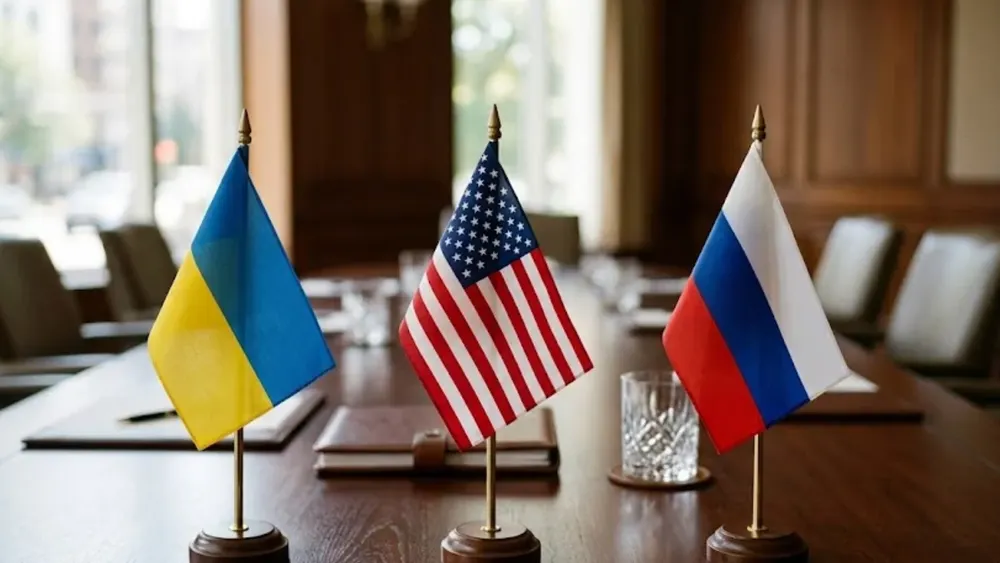
On September 12, at the annual Yalta European Strategy meeting in Kyiv, Kyrylo Budanov was asked about the next round of trilateral peace talks between Ukraine, the United States and Russia. His answer was two words: 'We are preparing. For October.' The date was not disclosed. The venue was not agreed. The format, trilateral, the same format as the Geneva round in February that ended without agreement on any significant point, was confirmed. The preparation was described. October was the month.
Zelenskyy, asked about the September 5 to 6 mission to Moscow and Kyiv by US envoys Steve Witkoff and Jared Kushner, said this: 'We expect the war will continue.'
Both statements are accurate. The October talks are being prepared. The war is expected to continue through them.
The trilateral peace process involving Ukraine, the United States and Russia has now produced four attempted rounds in nine months. The first, in Abu Dhabi in January, was described as 'constructive' and produced no agreement on ceasefire, territory, security guarantees or timeline. The second, in Geneva in February, was described as 'important' and produced the same result, no agreement on the same four questions, before the Iran war disrupted the planned Abu Dhabi follow-up in March. The third, the Witkoff-Kushner Moscow-Kyiv bilateral missions in September, produced Rubio's assessment that talks had been 'substantive' and Zelenskyy's sentence about the war continuing. The fourth is planned for October. The date is not fixed. The venue is not agreed. The obstacles that stopped the previous three rounds are unchanged.
What Three Rounds Have Not Changed
The Wikipedia account of the Geneva round confirms what the process's participants have acknowledged less directly: the gaps that exist between the parties have not closed at any point across nine months of effort. Russia's territorial demands require Ukraine to cede approximately 20 per cent of its internationally recognised territory, including regions where Russia has conducted deportations, executed civilians and installed parallel administrations. Ukraine's position is that it will not recognise Russian sovereignty over occupied territory, that security guarantees must last more than twenty years and that the return of deported Ukrainian civilians is a precondition for any framework.
Jared Kushner said in September that 'territorial demands remain the main obstacle' to reaching an agreement. This is the same obstacle that existed in January when Abu Dhabi produced a 'constructive' atmosphere. The nine months of talks have not moved it. Russia's military representative at the September diplomatic engagement, Yuri Ushakov, expressed 'confidence' that Russia's military objectives would be achieved and cited 'significant advances' on the front line. Russia's opening position has not changed. Russia's military position has improved.
This is the structural condition that makes the October talks analytically distinctive from an ordinary diplomatic round. Peace negotiations typically follow one of two trajectories: the parties negotiate from positions of relative military parity, producing genuine compromise, or one side exhausts itself sufficiently that it accepts terms it would not otherwise accept. The Ukraine peace process is operating in a third condition: one side, Russia, is advancing militarily, has improved its force generation through North Korean troop deployment and continues to receive economic and technological support from China, while the other side, Ukraine, is fighting with weapons stocks that are constrained by the Iran war's depletion of American interceptor inventories and signing contracts for missiles that will take years to arrive.
The June deadline that Trump set for ending the war passed without a deal. The DiploPolis Distraction War piece documented in June how the Iran war consumed the diplomatic bandwidth that American pressure on Russia required. The October talks are occurring after Russia has had an additional four months beyond the June deadline to advance its military position, improve its force structure with North Korean support and observe that the American administration's primary diplomatic attention is directed at the Islamabad Memorandum's collapse and the Trump-Xi summit on Iran.
What October Inherits From the Process
The UK House of Commons Library research briefing published in late September describes the current state precisely: 'Talks are expected to take place in October 2026, although a date has yet to be agreed.' It also records that Russia 'continues to reject meaningful compromise in peace negotiations.' These two facts, October talks expected and Russia rejecting compromise, are the operational parameters of what Budanov called the preparation.
The European architecture supporting Ukraine has evolved during the process. France deployed soldiers and air defence systems to Saudi Arabia in September to protect against Houthi strikes, a separate deployment, but one that draws on the same European defence resources that Ukraine's advocates have been pressing their governments to allocate to Kyiv. Germany discussed giving Ukraine data on Ukrainian men in Germany eligible for conscription, without coercion, as a mechanism to address Ukraine's manpower shortage. Ukraine signed contracts for approximately 1,000 Patriot interceptors that will arrive across years. None of these developments change the October talks' fundamental parameters.
The process's nine-month record produces a specific observation about what the talks achieve independently of whether they produce a deal. Each round has maintained the diplomatic channel between three parties that have been in an active conflict for nearly five years. The channel exists. The talks have not produced a ceasefire, but they have not collapsed into pure military logic without diplomatic contact either. The argument for continuing the process even without progress is that the absence of contact produces worse outcomes than the presence of contact without agreement.
This is a defensible argument. It is also the argument that has justified four rounds of talks against a backdrop of continued Russian advance, continued Ukrainian civilian casualties and continued depletion of Western weapons stocks. The process's defenders can say the channel is open. The process's critics can say the channel is open while Russia advances. Both are correct. The distinction between maintaining contact and producing results has been the operative condition of this peace process since January.
The Two Sentences That Describe October
Budanov's 'For October' and Zelenskyy's 'We expect the war will continue' are not in contradiction. They are a precise description of the same reality from two perspectives. The talks are scheduled because the diplomatic channel must be maintained and because Trump's administration has a political requirement, nine weeks to midterms when Budanov spoke and six weeks when Zelenskyy spoke, to demonstrate that peace is being actively pursued. October is the deadline that the midterm calendar, not the military calendar, has set.
Russia understands this. Putin told Trump in a phone call assessed as 'constructive' that he remained open to discussions, while Ushakov simultaneously expressed confidence about achieving Russian military objectives. The combination of openness to talks and confidence in military trajectory is the optimal negotiating position for a party that is advancing on the battlefield and waiting for the other side's political conditions to change. Russia's optimal outcome is for the talks to continue long enough that Ukraine's military position deteriorates and American political support for Ukraine exhausts itself. October talks serve that outcome as well as any other.
The June deadline Trump set was supposed to be the moment of maximum American pressure, the point at which the threat of abandoning Ukraine would compel Russian compromise. The Iran war removed that pressure from the calendar. The October round arrives without the June pressure and with an additional four months of Russian military time on the front lines. The parties are the same. The positions are the same. The military trajectory favours the same side it favoured in January. The talks are prepared because the alternative to talks is a war that continues without even the appearance of diplomatic resolution.
Zelenskyy's sentence — eleven words, no caveats — describes what October inherits more precisely than any diplomatic communiqué has managed across nine months of effort. The talks are prepared. The war is expected. Both sentences are true simultaneously, in the same conflict, in the same month, at the same level of sincerity.
This Analysis piece is free to read. Future Analysis pieces will be available to registered DiploPolis members first. Free registration takes 30 seconds. No credit card required.
Find this piece interesting?
Dispatches by DiploPolis delivers sharp analysis and pointed commentary on power, politics, diplomacy, and world affairs — directly to your inbox.
No neutrality. No noise. Just argument.