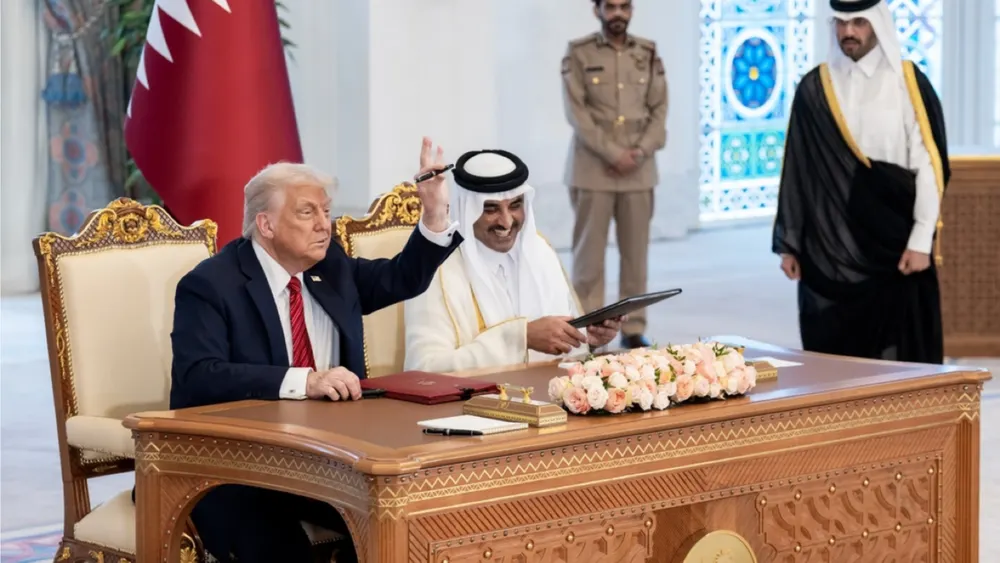
Qatar's Prime Minister Mohammed bin Abdulrahman Al-Thani told CNN at the UN General Assembly that his government is actively passing messages between Washington and Tehran. 'Qatar is working for de-escalation and restoring full freedom of navigation through the Strait of Hormuz,' he said, adding that Doha condemns the targeting of energy facilities and shipping by any party. He then said, in the same interview, that Benjamin Netanyahu is the 'biggest obstacle' to the advancement of the US-backed Gaza peace plan. Qatar is simultaneously mediating between the US and Iran in one war and blaming Israel's prime minister for blocking a deal in the other. Both assessments are consistent with publicly available facts. Neither assessment resolves the problem it describes.
Marco Rubio said this week that Iran is heading toward an economic 'cataclysm.' The naval blockade has cut Iranian oil exports by an estimated 90 per cent from pre-war levels. Iranian currency has collapsed further. The Strait of Hormuz carries less than ten per cent of its pre-war commercial traffic. Bessent predicted that Iran could have nothing left to trade within two weeks; a timeline that has been stated and revised and restated throughout the war without producing the collapse it promised. Rubio's cataclysm and Bessent's two-week clock are the economic version of Trump's two-to-three-week military prediction from April. They describe a trajectory without a fixed arrival.
Qatar is mediating between two parties with fundamentally different understandings of what the other will accept. Iran's conditions, submitted at UNGA and rejected by Trump, include an immediate blockade lift, frozen asset release and an end to the war across all resistance fronts. The US has not stated publicly what it would accept instead. Trump said the US has total control of the Strait and is in no rush. Iran says it has lost faith in Washington as a negotiating partner. Both are true, which is precisely why Qatar is passing messages instead of the parties speaking directly. The dead letter box requires a postal service when neither party will deliver its own correspondence.
The Qatari position is itself under pressure. Netanyahu accused Qatar from the UN podium of supporting Hamas while Qatar was simultaneously mediating the Gaza peace plan. His own adviser met with a senior Qatari official the day before his speech, a detail confirmed by Channel 12, to discuss the implementation of the US-backed plan. Qatar denounced Hamas's military wing while hosting its political bureau. It denounces attacks on shipping while Iran's proxies fire from Yemeni territory toward the same waters Qatar's own tankers transit. The positions are stable precisely because Qatar has learned to hold contradictions without resolving them. This makes it the most useful diplomat in the region and the least trusted by all parties.
213 days into the Iran war, the mediating structure looks like this: Qatar passes messages between the US and Iran while Washington and Tehran claim they are not talking. Pakistan maintains separate channels. Oman finalised a Hormuz deal that has not been announced and may never be. Rubio says Iran faces cataclysm. Bessent says nothing left to trade in two weeks. Iran's president was in New York through Wednesday. Trump rejected the proposal on Saturday. The war continues. Qatar is passing messages.