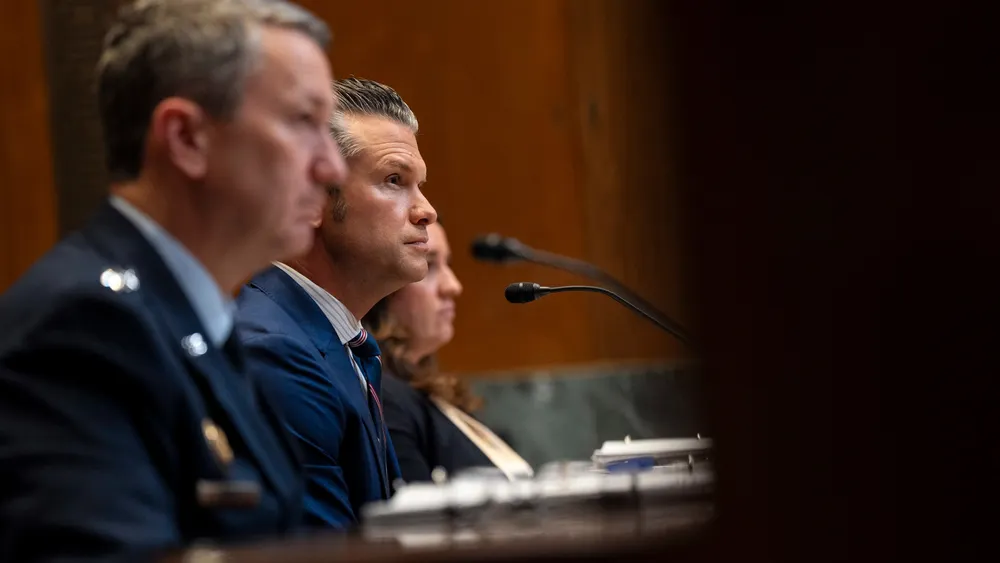
Pete Hegseth sat before the Senate Appropriations Committee on Tuesday and told lawmakers the war with Iran has cost $37.5 billion. Two Democratic sources and a third source familiar with the matter told CBS News the actual cost is much higher, in part because the current estimate does not include military construction for US bases that have been damaged. The administration is asking Congress for a further $87.6 billion supplemental package, of which $67.1 billion goes to the Pentagon.
Protesters interrupted Hegseth's opening remarks several times. RepThe Ledger, Iran, United States, Hegseth, Congress, Rubio, Strait of Hormuz, US-Israel War on Iran, War Cost, Freedom of Navigation, Middle Eastublican Senator John Kennedy told reporters Congress and the American people need 'some straighter answers' from the Pentagon. Democratic Senator Dick Durbin said Hegseth and General Dan Caine did not justify the cost of the war. 'They can't explain how this money is going to be spent,' he said. House Speaker Mike Johnson said at his weekly press conference: 'The commander in chief and the whole Department of War are working very hard to bring this to a resolution. There's a lot of questions about how that will be done.'
The Department of War. Johnson used the phrase without apparent irony. The United States has not had a Department of War since 1947, when it was renamed the Department of Defence. The slip is instructive.
Seventeen American service members have been killed in the war. More than 450 have been injured. The Pentagon on Tuesday identified Sergeant Angel S. Rampersad, 28, of Ozone Park, New York, previously listed as missing, as believed killed in action at Muwaffaq Salti Air Base in Jordan on July 17. On Wednesday morning, Iran struck Camp Doha in Kuwait, Al Azraq Air Base in Jordan and Sheikh Isa Air Base in Bahrain with drones. Kuwait, Bahrain and Jordan reported interceptions. The eleventh consecutive night of American strikes against Iran ended on Tuesday. The twelfth began on Wednesday.
Rubio said in Manila on Wednesday, at the sidelines of the ASEAN foreign ministers' meeting, that the US remains willing to negotiate but Iran is 'not serious about talks.' He said: 'If they're serious, we're serious. If they're not, then we will do what is necessary to protect our interest and also the interests of our allies.' He said the fundamental principle of freedom of navigation was at stake. He noted Iran did not have, under any existing legal mechanism, the right to control traffic through the Strait of Hormuz.
This is the same Rubio who said on June 23 that no country is allowed to charge tolls on an international waterway. The same Rubio whose government charged a 20 per cent toll on July 14 and dropped it 25 hours later when Gulf kings made a better offer. The freedom of navigation principle has appeared in Rubio's statements with remarkable consistency. It has not determined a single decision.
The Strait of Hormuz was fully open before the US and Israel attacked Iran in February. It remains closed. Three oil tankers carrying Saudi crude to Asia reversed course in the Red Sea on Tuesday, apparently in response to Houthi threats against Saudi shipping. The war that was launched to assert freedom of navigation has produced the closure of the waterway it was launched to open and a threat to close the second waterway that the Saudi bypass route depends on.
$37.5 billion. Seventeen dead. Hormuz closed. Rubio is in Manila saying Iran is not serious.
The Department of War is working very hard to bring this to a resolution.