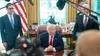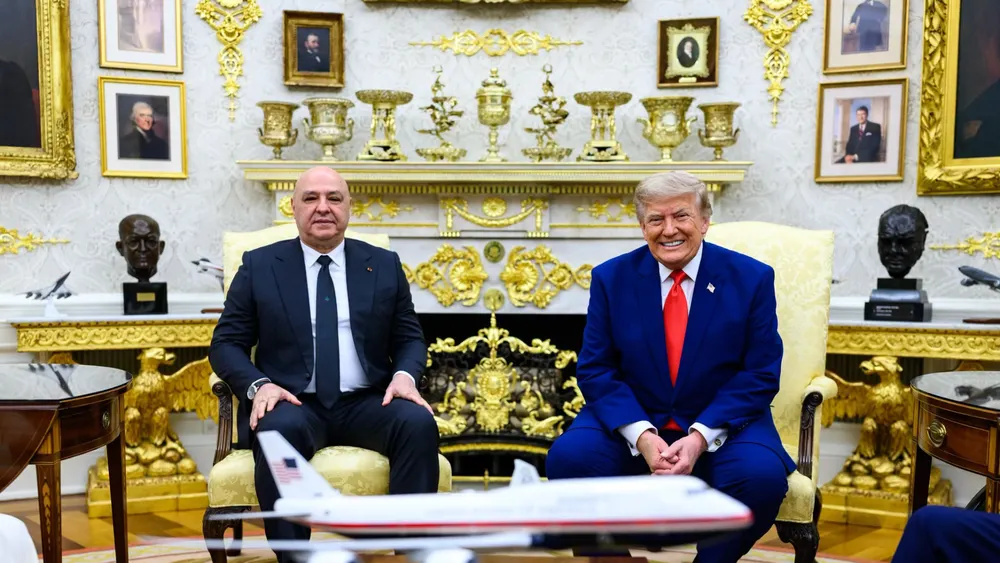
On July 21, 2026, Lebanese President Joseph Aoun met Donald Trump in the Oval Office for the first time. It was the first visit to the White House by a Lebanese head of state in nearly two decades. Aoun had spent four days in Washington, meeting Rubio on Sunday, attending bilateral sessions on Monday and Tuesday, and sitting at the table in the Oval Office where decisions about Lebanon's future had been taken without a Lebanese president present for seventeen years. He had one ask. He left with airline routes.
This is not a critique of Aoun's diplomatic skill. The flattery was calculated and delivered with precision — 'such a great president,' 'your vision is peace,' 'this will be your legacy' — and it produced the warmth it was designed to produce. Trump smiled, said Aoun was handsome and knew how to get to him, and said Lebanon could have anything. The question is what anything turned out to mean, and what it reveals about the architecture of power that a sovereign head of state in a country that has been bombed for months, displaced a million of its citizens and lost 4,250 people since March came to Washington to ask a third government to move a fourth government's army off its territory.
What Aoun Came to Ask
The ask is specific and has been consistent since Aoun was elected in January. Lebanon wants Israeli forces to withdraw from the large swaths of southern Lebanon they have occupied since the autumn military operations of 2024 and 2025. The June 26 framework agreement, brokered by Washington and signed by Israel and Lebanon, sets out a phased plan for Israeli withdrawal accompanied by Lebanese Army deployment and the disarmament of Hezbollah. Implementation was to begin in small pilot zones.
The pilot zones have begun in the narrowest sense. The State Department confirmed on Monday that operations had begun in three villages — Froun, Srifa and Zawtar al-Gharbiya — part of the first pilot zone under the June 26 agreement. On Tuesday, as Aoun was in the Oval Office, Israeli forces fired warning shots at Lebanese soldiers deploying to Zawtar al-Gharbiya, saying the Lebanese soldiers had crossed into the buffer zone outside the actual pilot zone. The Lebanese military said Israeli troops fired at its forces as they were in the process of deploying. Three villages. Three weeks after the framework was signed. Israeli forces present in these villages, warning shots fired at the Lebanese Army attempting to replace them.
Israel has stated its position with clarity. It will not withdraw until it is satisfied that Hezbollah no longer poses a threat. Hezbollah has rejected the framework agreement outright and said it will not disarm under the current terms. The Lebanese Army, the institution Aoun commands and led until his election, cannot disarm Hezbollah by force without triggering a civil war that the army does not have the capacity to win. The sequence the agreement requires — Israeli withdrawal enabling Lebanese Army deployment enabling Hezbollah disarmament — contains a contradiction at every stage. Aoun knows this. He came to Washington to ask Trump to resolve the first step, which only Trump can do by pressuring Netanyahu, which Trump has not done and shows no immediate inclination to do.
The Patron's Priorities
The context in which Aoun's Washington visit took place deserves precision, because it explains what he received. Trump is managing the eleventh and twelfth consecutive nights of American strikes against Iran, a $37.5 billion war whose costs Hegseth disclosed to the Senate on the same day Aoun was in the Oval Office, a Hormuz closure that has driven US gas prices 34 per cent higher since February, a Houthi threat to impose a naval blockade on Saudi Arabia, a 10-day ceasefire proposal from mediators that Washington has downplayed, seventeen American dead and the prospect of striking Iranian nuclear facilities. Lebanon is not the primary concern.
AP noted with precision that 'the US has championed peace in Lebanon but also has been increasingly distracted by a new round of escalation with the war in Iran, which has destabilized much of the Middle East.' The distraction is structural. The Lebanon file, in American strategic attention, sits below the Iran nuclear file, below the Hormuz crisis, below the question of whether to strike Pickaxe Mountain, below the Hegseth supplemental budget request, below the seventeen Americans killed. Aoun arrived at a White House that was simultaneously managing what its Speaker has started calling the Department of War. His ask was heard warmly. It was not acted upon.
What Aoun received: direct flights to Lebanon for the first time in more than forty years, reversing Ronald Reagan's 1985 suspension after the TWA Flight 847 hijacking. A presidential statement that Lebanon had been 'badly treated' and would be helped 'a lot.' A public declaration from Trump that he would be open to speaking directly with Hezbollah if Lebanon asked. The expression 'he can have anything.' No timeline for Israeli withdrawal. No commitment to pressure Netanyahu. No additional military support for the Lebanese Army beyond what was already in discussion. Massad Boulos told reporters: 'It's all about implementation. It's going to take time.'
The Grammar of the Small State
Aoun's visit is a case study in small state strategy applied under optimal conditions and producing limited results. He arrived with maximum legitimacy — elected by consensus, respected by Washington, untainted by Hezbollah association, trusted by Israel as a counterpart. He performed the diplomatic grammar correctly: flattery that gave Trump an entry, a legacy framing that connected Lebanon's request to Trump's self-interest, a forward-looking declaration that Lebanon would 'end hostility with Israel forever' that gave Trump a headline. He secured a meeting that his predecessors could not get for seventeen years.
The result is instructive not because Aoun failed but because it illustrates the ceiling of small state strategy when the patron's attention is elsewhere. The Arab states moved Trump on Netanyahu, as DiploPolis reported last week, by speaking directly to his transactional interests in private presidential conversations. That method worked because the Arab states have leverage Trump wants: investment, oil flows, Abraham Accords expansion. Lebanon's leverage is moral and strategic, not transactional. It can offer Washington a stable southern flank, a Hezbollah disarmed, a peace with Israel. These are real and valuable. They require Israeli cooperation that Washington has not extracted and Hezbollah compliance that is not available.
The framework agreement signed on June 26 was a genuine American diplomatic achievement. Its implementation is blocked at the first step by the same dynamic that has blocked every previous arrangement: Israel's security calculation and Hezbollah's refusal to disarm are structurally incompatible, and the United States has chosen, throughout this period, to prioritise its relationship with Israel over extracting the specific concessions from Netanyahu that would allow the framework to function. Aoun's visit did not change that choice. It confirmed it, politely, with airline routes as the consolation.
What Comes Next
The Rome talks last week produced no timeline. The pilot zones are active in three villages. The Lebanese Army is deploying where Israel permits. Hezbollah continues to fire. Israel continues near-daily airstrikes. The framework exists. The withdrawal does not.
Trump's offer to speak directly with Hezbollah, reported by Times of Israel, is the most significant thing he said in the Oval Office and the least noted in the coverage. Hezbollah is designated a terrorist organisation by the United States. Trump offering to speak directly with it represents a potential shift in the American posture toward the group that could, if followed through, accelerate the framework's implementation by creating a channel that bypasses the current impasse. Whether it is followed through is the question. Trump has made similar gestures toward Hamas, toward the Taliban, toward Iran itself. Gestures and follow-through have been inconsistent.
Aoun declared Lebanon would end hostility with Israel 'forever.' The declaration is his to make on behalf of the Lebanese state. Hezbollah is not the Lebanese state and has not made it. Israel received the declaration warmly and fired warning shots at the Lebanese Army on the same day. The territory remains occupied. The ceasefire with Iran remains broken. The patron is distracted by a larger war.
Aoun came to Washington with the right ask and the right approach at the wrong moment. The moment will not remain wrong indefinitely. When the Iran war finds its resolution, the Lebanon file will rise in American strategic attention. The framework agreement, if it survives until then, will be the vehicle for that resolution. Aoun's task between now and that moment is to keep the framework alive, keep the Lebanese Army credible, and keep Washington's interest sufficiently warm that when the moment arrives, Lebanon has a president in the room who has already been to the Oval Office and been promised anything.
He got airline routes. The territory is still occupied. But he got the meeting. In Lebanon's circumstances, in this week, that is not nothing.
This Analysis piece is free to read. Future Analysis pieces will be available to registered DiploPolis members first. Free registration takes 30 seconds. No credit card required.
Find this piece interesting?
Dispatches by DiploPolis delivers sharp analysis and pointed commentary on power, politics, diplomacy, and world affairs — directly to your inbox.
No neutrality. No noise. Just argument.