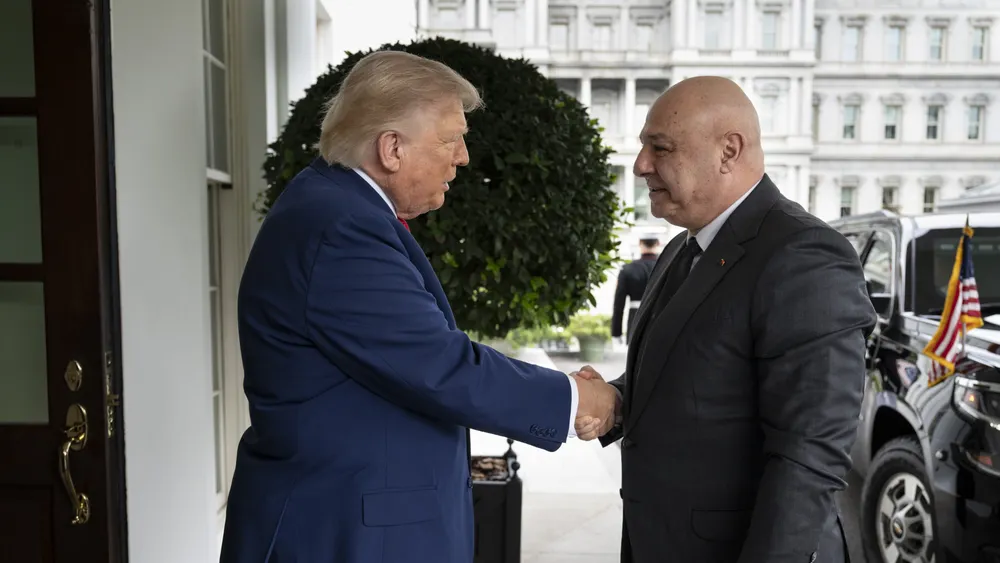
Joseph Aoun came to the White House on Tuesday to ask for one thing. He wanted the United States to pressure Benjamin Netanyahu to withdraw Israeli troops from southern Lebanon so the Lebanese Army could fill the vacuum, Hezbollah would lose its justification for remaining armed, and Lebanon could finally implement the framework agreement signed on June 26 after months of American mediation.
He did not get that.
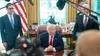
What he got was this. He called Trump a great president. Trump smiled and said: 'He knows how to get to me. Now he can have anything.' He said Lebanon had been 'a very badly treated place and country' and that he was going to help it 'a lot,' without specifying how. He said Israeli forces were 'in the process of redeploying,' which is true only in the narrowest sense: three villages in one pilot zone, out of the large swaths of southern Lebanon that Israel currently occupies. After the meeting, Trump posted on Truth Social that he was directing his administration to allow US airline carriers to fly directly to Lebanon for the first time in more than forty years, reversing a ban imposed by Ronald Reagan in 1985 after the hijacking of TWA Flight 847.
The State Department, on the same day, strongly urged against travel to Lebanon due to the security situation. The flights were announced. The warning remained active. Both are true simultaneously.
This is the geometry of Lebanon's situation with precision. The country has a president who made it to the Oval Office — the first Lebanese head of state to do so since 2009, the first in nearly two decades to receive a formal White House meeting. He performed the required flattery with evident skill. Trump responded warmly and said he could have anything. What he received was a symbolic gesture about aviation routes to a country the State Department was simultaneously warning Americans not to visit, and a presidential statement that Israeli troops were redeploying that Israel has not confirmed.
Massad Boulos, Trump's senior adviser on Arab affairs, told reporters after the meeting: 'It's all about implementation, it's going to take time. This is not easy. Nobody believes for a second that this is going to be an easy task in any way.' At least 4,250 people have been killed in Lebanon since fighting escalated in March. A million have been displaced. The two sides met in Rome last week for another round of US-mediated talks. No timeline for implementation emerged. In Zawtar al-Gharbiya on Tuesday, Israeli forces fired warning shots at Lebanese soldiers who were deploying to the first pilot zone. The IDF said the Lebanese soldiers had crossed into the buffer zone. The Lebanese military said Israeli troops fired at its forces. Both cannot be entirely right. Neither is redeploying.
Aoun told Trump: 'Your vision is peace. Your vision is stability, and I think my vision coincides with your vision.' It is the grammar of the small state addressing the patron: converting Lebanon's need into Trump's legacy, hoping the translation holds. Rib-Hadda of Byblos tried the same approach with Egypt thirty-four centuries ago. He too was promised help. He too waited for troops.
Hezbollah has rejected the framework agreement outright and opposes disarming under the current terms. Israel has insisted it will not leave until it is satisfied Hezbollah no longer poses a threat. Trump said he might even speak directly with Hezbollah if Lebanon asked. The country that was promised everything left with direct flights and a warm handshake.
The territory remains occupied.