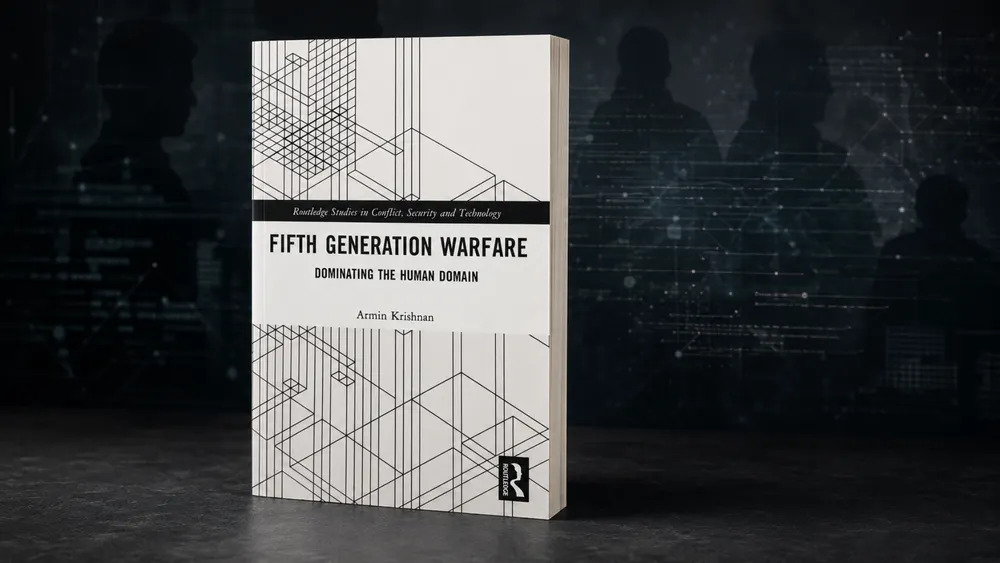
The human domain. The phrase appears in the subtitle of Armin Krishnan's book and it is worth pausing on before reading further. Military doctrine has always had a language for its objects: territory, sea lanes, airspace, cyberspace. Each expansion of the battlefield required a new vocabulary. The human domain is different. It does not describe a place where conflict happens. It describes the mind as terrain, belief as infrastructure and emotional life as a strategic asset to be captured, managed and turned against its owner. Once you accept that formulation, the implications do not stay inside military theory. They come home. They come home because the techniques required to dominate the human domain are not specialised instruments that disappear after deployment. They are learnable, scalable and transferable. Any government that acquires them for use abroad acquires them for use at home as well.
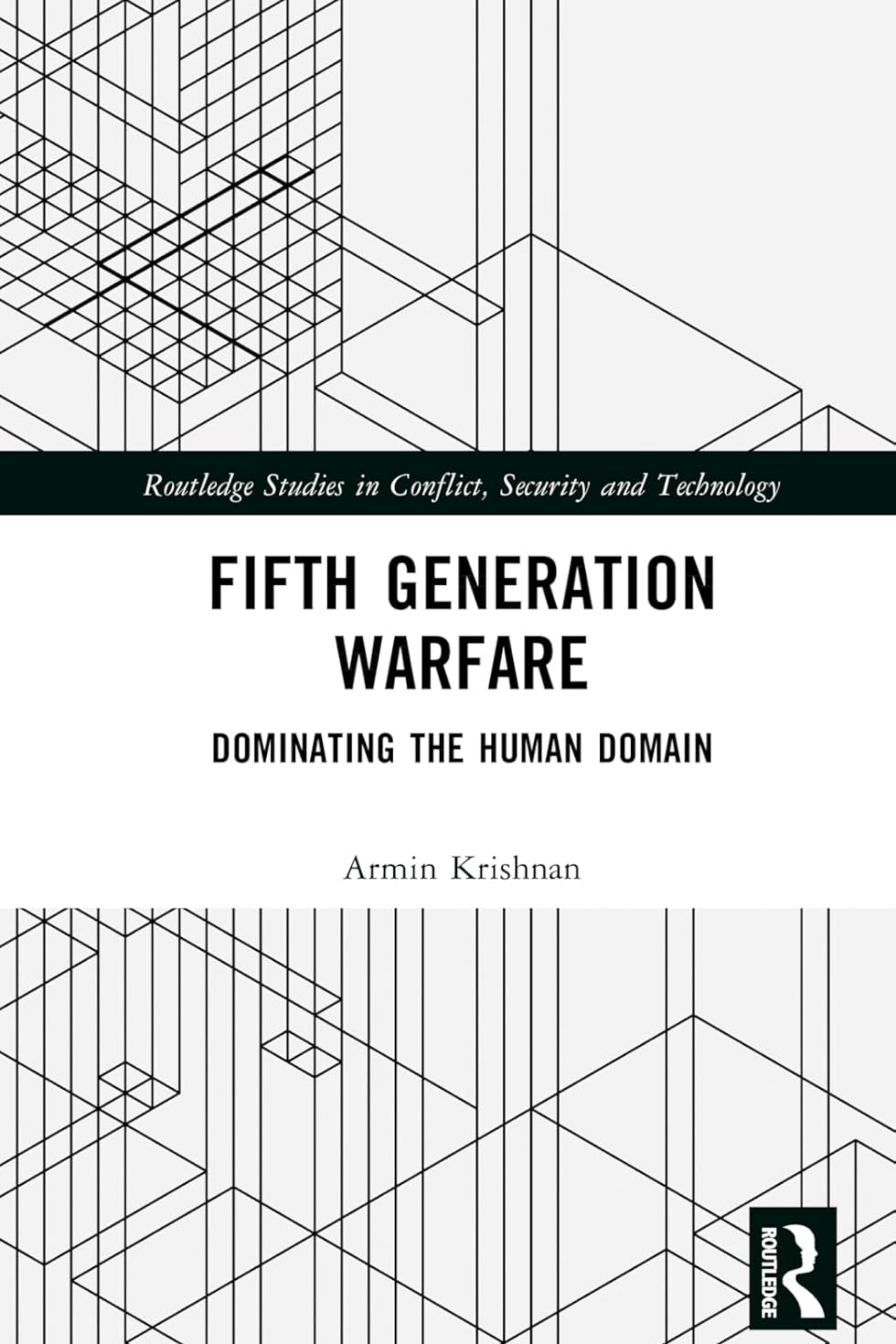
Fifth Generation Warfare: Dominating the Human Domain by Armin Krishnan (Routledge, 2024) argues that contemporary conflict has moved decisively away from kinetic confrontation and toward a form of warfare waged at the societal level through perception management, narrative control, identity manipulation, disinformation, psychological operations and the adversarial use of norms. The fifth generation, in Krishnan's framing, is not simply more technologically sophisticated than its predecessors. It is ontologically different. It does not seek to defeat an enemy's army. It seeks to reorganise an enemy society's sense of reality, so that the population itself becomes the instrument of its own defeat. The soldier is replaced by the algorithm, the bomb by the forwarded video, the front line by the information feed.
That is a serious argument and the book makes it seriously. Krishnan is not writing a polemic or a think-tank brief. He is attempting to describe a genuine shift in the grammar of conflict, drawing on a wide range of contemporary examples from the Arab Spring to Ukraine, from hybrid warfare in the Baltic states to grey zone operations across Asia. The framework he offers is analytically useful: fifth generation warfare operates through secrecy, proxy manipulation, disinformation, big data and psychological warfare, and it targets identity and culture as primary instruments rather than secondary effects. That is more precise than the usual conflation of hybrid warfare, information operations and grey zone conflict into a single undifferentiated category.
The book's strongest insight is the move from information to identity. Propaganda is old. Disinformation is old. Psychological warfare is old. What makes Krishnan's frame colder is that fifth generation warfare is not simply about persuading people to believe a false thing. It is about reshaping the mental environment in which people decide who they are, who threatens them, who deserves protection and who no longer fully belongs to the political community. Once identity becomes a target, the civilian mind stops being collateral. The civilian mind becomes terrain. The aim is not merely to mislead citizens. It is to reorganise their emotional reflexes. The battlefield is not over there. It is the rumour, the forwarded video, the televised grievance, the suspicion planted so often that it starts to feel like memory.
Krishnan's framework is developed primarily within the adversarial state-to-state frame. Fifth generation warfare, as he describes it, is what external actors do to each other's societies. That is where the doctrine lives in the book. It is also where the book underestimates its own argument. The techniques he identifies — identity manipulation, disinformation, proxy actors, big data, psychological warfare — do not respect the boundary between foreign and domestic politics. Once a state develops the capacity to dominate the human domain, it is an assumption rather than a conclusion that this capacity will be used only outward. Governments that learn to manage foreign populations will eventually discover that the same tools can be applied to their own citizens. The doctrine does not change. Only the target does.
India makes this visible with uncomfortable clarity. Krishnan does not discuss India in detail, but his framework describes what has happened to Indian public discourse over the last decade with a precision that books written specifically about India often struggle to match. Not because India is formally at war with itself, but because the techniques fifth generation warfare identifies describe the political environment in which Indian public opinion has been reshaped so thoroughly that many citizens no longer recognise it as reshaped at all.
Consider the elements. Godi media, the term critics use for television channels that function as government cheerleaders, turns governance into permanent mobilisation. The news cycle becomes an instruction in who to fear and who to hate. WhatsApp disinformation decentralises propaganda, making it feel like community knowledge rather than political messaging. The forwarded video arrives from a trusted contact and carries the authority of intimacy. The cow vigilante ecosystem fuses rumour, identity and intimidation into an everyday structure of fear that requires no central command. And the weaponisation of historical grievance creates a citizen who is always injured, always alert and always ready to punish. A Muslim neighbour becomes a demographic threat. A journalist becomes an enemy agent. A court verdict becomes civilisational betrayal. A historical wound becomes a daily command. What is left, after long enough exposure to this environment, is not a citizen capable of political judgement. It is a sensor permanently tuned to threat.
Krishnan's framework gives these phenomena a common grammar. They are not separate pathologies or media failures or political miscalculations. They are components of a systematic reorganisation of the emotional world. The point is not that citizens are misinformed. It is that their capacity to trust, to doubt and to extend solidarity has been selectively rewired. That is what dominating the human domain looks like when it is applied domestically, and it is more politically durable than any external fifth generation operation, because the targets live inside the system that manages them and have no outside from which to observe it.
This is where the book's most important implication sits, and where it does not go far enough. Krishnan treats the domestic application of fifth generation warfare as a risk, a possibility, a warning. The review would go further. For many societies the domestication of these techniques is not a future danger. It is the present condition. External enemies are episodic. Domestic populations are permanent. A government that masters the human domain as a theatre of foreign conflict will find, sooner or later, that the same mastery is available for governing its own citizens. The efficiency gains are considerable. The accountability costs are low. The results are visible.
Fifth Generation Warfare is essential and disturbing reading. Read it for the doctrine, which is precisely described. Read it for the framework, which is genuinely useful. Then carry it home, apply it to the information environment you live inside and ask yourself whether the battlefield Krishnan describes is something you are watching from a distance or something you are already standing inside. The distinction matters less than you might hope. Krishnan's book is disturbing because it describes the future of war. It becomes more disturbing when one realises that, for many societies, the future has already been domesticated.
This Book Review is free to read. Future Book Reviews will be available to registered DiploPolis members first. Free registration takes 30 seconds. No credit card required.
Find this piece interesting?
Dispatches by DiploPolis delivers sharp analysis and pointed commentary on power, politics, diplomacy, and world affairs — directly to your inbox.
No neutrality. No noise. Just argument.