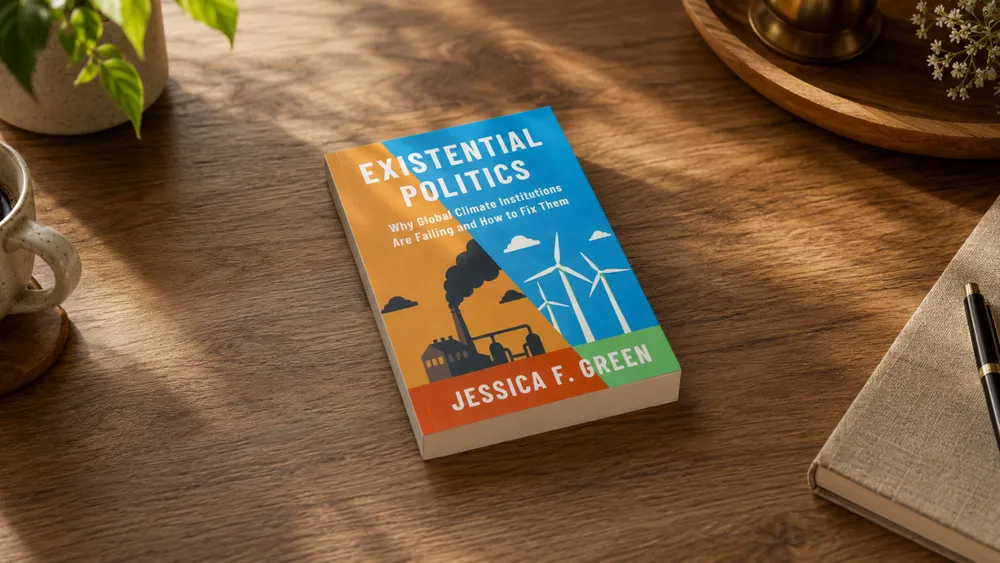
Net zero. Carbon offsets. Nationally determined contributions. Emissions trading schemes. The vocabulary of global climate governance has expanded steadily for three decades while the atmosphere has continued to warm. Each new framework arrives with its own architecture of measurement, reporting, verification and market mechanism. Each one generates its own conferences, its own bureaucracies, its own experts and its own language of managed optimism. And each one has failed to do the one thing that matters: force a rapid and decisive break with the fossil economy. Jessica F. Green's Existential Politics: Why Global Climate Institutions Are Failing and How to Fix Them (Princeton University Press, 2025) is the most honest account I have read of why that failure is not accidental. It is structural. And the structure is political.
Green's central argument is deceptively simple and genuinely radical. Climate governance has misdiagnosed its own problem. For decades it has treated the transition away from fossil fuels as a technical and administrative challenge: measure the emissions, set the targets, build the markets, price the carbon, report the progress. What it has consistently refused to do is name the political conflict at the heart of the crisis. Fossil asset owners, the oil and gas companies, the electric utilities, the petrostate governments, the financial institutions with trillions in exposure to stranded assets, face the loss or devaluation of their wealth in any serious energy transition. Green asset owners, the companies and investors positioned to benefit from the new economy, are fewer and politically weaker. Climate governance has been built on the fiction that these two sides can be gradually reconciled through dialogue, markets and shared frameworks. Green's book says they cannot. One side has to lose.
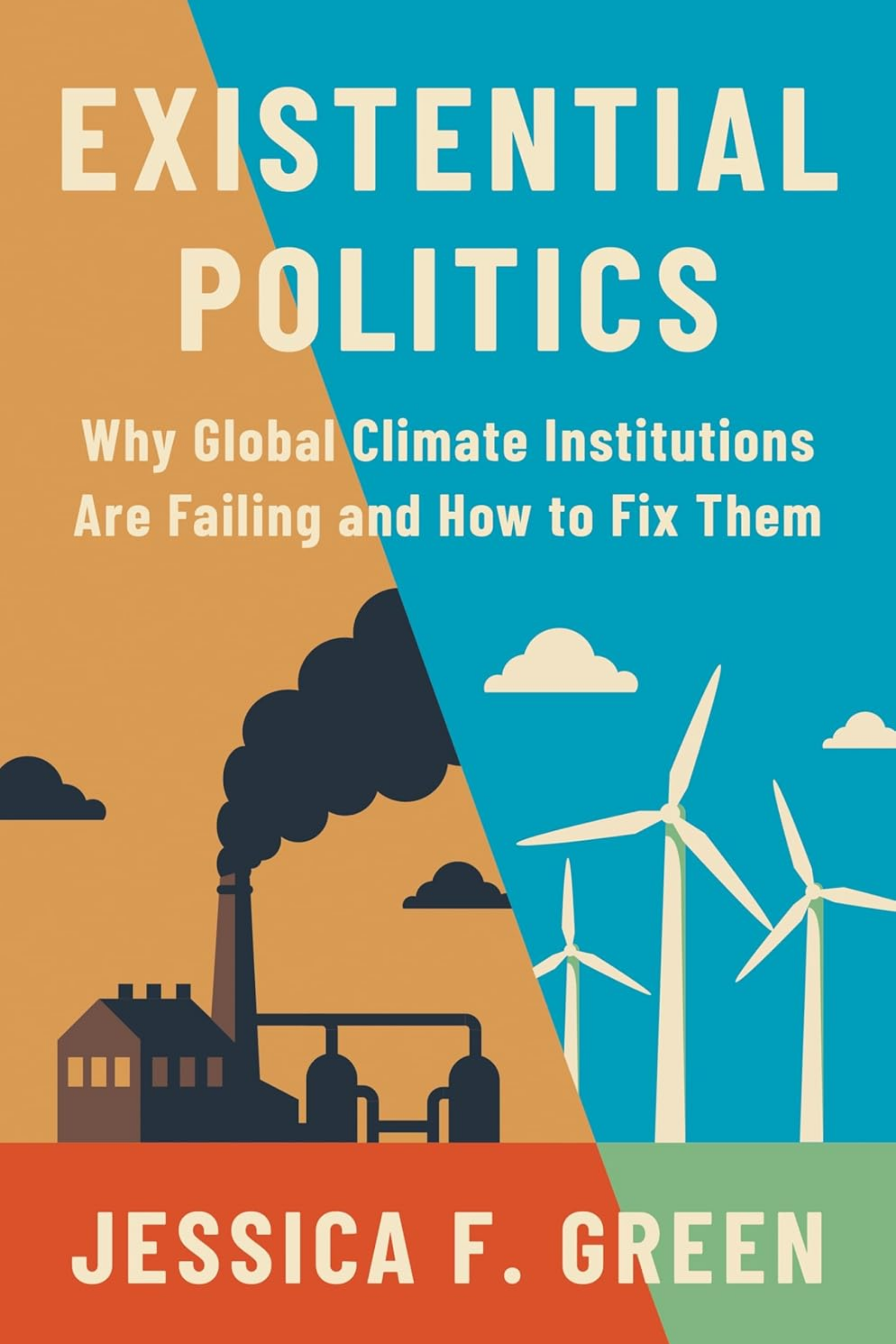
That is a serious argument and it earns the book its place in the climate literature. The move from technical failure to political economy is not new in environmental scholarship, but Green makes it with unusual precision. She is not merely saying that politics gets in the way of climate action. She is saying that the architecture of climate institutions was designed, however unintentionally, to manage the conflict rather than resolve it. Carbon offsets allow fossil asset owners to continue operating while appearing to contribute to the transition. Net zero commitments push the burden of action into a future that current decision-makers will not be held accountable for. Measurement and reporting frameworks create the appearance of progress while the underlying asset structure remains intact. These are not failures of implementation. They are features of a system built around the wrong diagnosis.
Green's prescription follows from the diagnosis. If the problem is asset conflict, the solution is institutional redesign that shifts the balance of power between fossil and green capital. She argues for deploying tax, finance and trade institutions, bodies with real coercive authority, to constrain fossil asset owners and accelerate the accumulation of green ones. That is a more muscular politics than climate governance has typically contemplated, and she is right to demand it.
And yet the argument has a boundary, and the review cannot pretend otherwise. Green names a class position with analytical precision. What she gives the reader less of is a political story with names, offices, balance sheets and vetoes. Fossil asset owners is an exact category. But climate failure is not only systemic. Systems are protected by people: these companies, these utilities, these financiers, these petrostates, these ministries, these trade rules, these elected leaders and these courts. Green gives us the structure of obstruction. A fully prosecutorial politics of obstruction would make visible the specific actors who have spent specific decades and specific billions ensuring that the structure holds. The book approaches that argument. It stops short of making it.
The more significant incompleteness is the Global South, and it is where the emotional pressure of this review sits most heavily. Green is honest about power inside the transition. She rejects the language of offsets and net zero as insufficient and sometimes actively distracting. She is right to do so. But she is less complete on power before the transition begins, and that asymmetry matters enormously.
Poorer countries are not only participants in an energy transition. They are countries trying to industrialise after others grew rich by burning carbon. The atmospheric space was used up by the economies that built the wealth the world's richest societies now hold. The countries least responsible for that accumulation face the worst consequences of it: climate vulnerability, food insecurity, debt burdens that constrain their ability to invest in adaptation, and pressure to decarbonise under rules written largely in institutions where they remain structurally marginal. If Green's book treats them mainly as locations where green investment must be scaled, or as beneficiaries of reformed finance and trade, it misses the full political fact. They are also claimants. They are asking who used the atmospheric space, who built wealth from emissions, who now controls green capital, and who gets disciplined in the name of a transition they did not design.
Green is very good on the politics of asset revaluation. The Global South requires something additional: a politics of historical accounting. Asset revaluation asks who loses value in the transition. Historical accounting asks who accumulated value before the transition, and who paid for it without receiving the wealth. Those are related questions with different answers, and a climate politics that addresses only the first while treating the second as a complication remains only half radical.
The fully radical argument would say three things simultaneously. First, fossil capital must be made to lose. Not gradually accommodated, not compensated indefinitely, not allowed to relabel itself as transitional infrastructure. The old economy cannot be politely managed into moral behaviour. Second, green capital is not automatically just because it is green. A solar supply chain, a battery economy, a carbon market or a climate finance mechanism can reproduce hierarchy if the minerals, patents, finance, standards and profits remain controlled by the same centres of power that built the fossil economy. The geography of green extraction is already beginning to resemble the geography of every extraction that preceded it. Third, the Global South is not a victim category or an investment destination. It is a political subject. Climate justice means adaptation finance, debt relief, technology access, energy dignity and institutional voice. It means that the countries least responsible for the crisis cannot be reduced to project sites for the conscience of those most responsible.
Green's book is powerful precisely because it refuses the technocratic comfort that most climate writing offers. It says climate failure is not a problem of insufficient data, inadequate frameworks or missing political will in the abstract. It is a problem of power, and power has owners. That is a more honest starting point than almost anything else in the mainstream climate literature, and it makes Existential Politics essential reading for anyone trying to understand why three decades of climate governance have produced so little.
But the unfinished argument is this: climate justice is not only the defeat of fossil assets. It is the refusal to let the green transition become another name for an old hierarchy wearing new clothes. Green has written the book that names the disease. The prescription she offers is necessary. It is not yet sufficient.
This Book Review is free to read. Future Book Reviews will be available to registered DiploPolis members first. Free registration takes 30 seconds. No credit card required.
Find this piece interesting?
Dispatches by DiploPolis delivers sharp analysis and pointed commentary on power, politics, diplomacy, and world affairs — directly to your inbox.
No neutrality. No noise. Just argument.