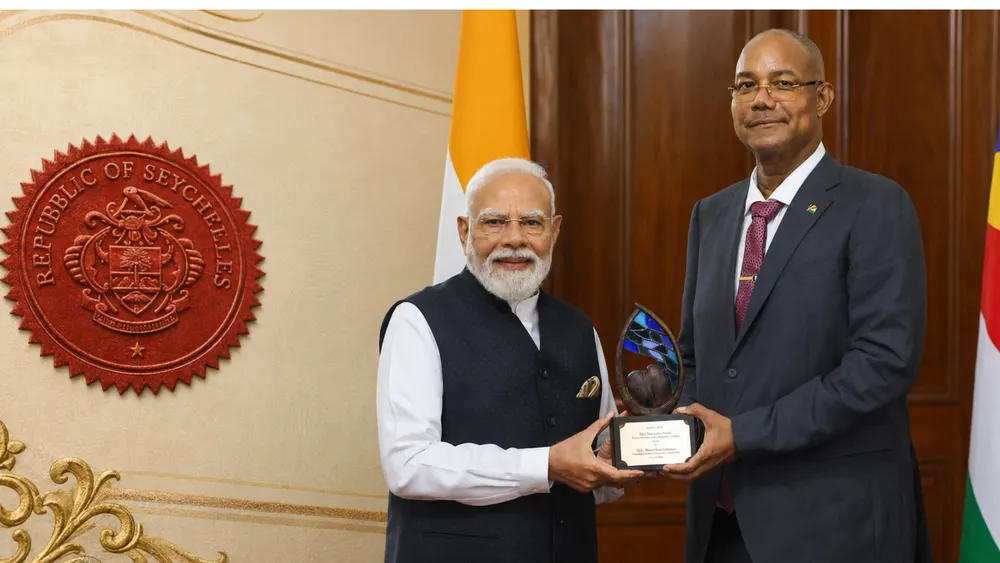
The certificate was flagged as AI-generated. It misspelled 'republic' as 'repubblic' and 'Seychelles' as 'Seycheeles.' The award it accompanied, the Guardian of the Blue Horizon, had been created three days before Narendra Modi landed in Seychelles on June 28. He is its first and only recipient. The Seychelles foreign ministry later said a 'working draft' had accidentally been circulated and that an authentic version had now been issued. The distinction, it insisted, is genuine. What the certificate revealed before it was corrected was something the corrected version cannot undo: the award existed because the visit was scheduled, and the visit was scheduled because the award was expected.
This is not an isolated episode. It is a pattern with a domestic logic and an international cost.
The Cabinet
Modi has received more than 33 foreign state honours since becoming Prime Minister in 2014, more than any other democratically elected serving head of government in history. The list spans Saudi Arabia, Russia, the United States, France, Brazil, Israel, Palestine, Ethiopia, Trinidad and Tobago, Papua New Guinea and Indonesia, whose President Prabowo Subianto conferred the Bintang Adipurna on Modi this morning in Jakarta. The Bintang Adipurna was instituted in 1959 and was previously conferred on Jawaharlal Nehru. It is a genuine honour with diplomatic precedent. It is not the problem.
The problem is a specific subset of the 33, and the problem is not embarrassment. It is what the awards reveal about how Indian foreign policy works and for whose benefit.
In January 2019, Modi received the first Philip Kotler Presidential Award, presented by the World Marketing Summit for his 'outstanding leadership of the nation.' The press release described it as an annual award to be given to a leader of a nation. No other leader has since received it. The award's website lies dormant. The man who conferred it on Modi subsequently received the Padma Bhushan, one of India's highest civilian honours.
In February 2026, Modi addressed the Israeli Knesset and received the Medal of the Knesset from Speaker Amir Ohana. The medal had not existed before Modi's visit. The Knesset's official website page announcing the award was not operational the morning after the ceremony. The Wikipedia page for the medal was created in the early hours of the same night. Opposition politicians in Israel described it as a non-existent honour invented to please Netanyahu's government. Modi is its first and only recipient.
The timing of the Knesset visit warrants its own sentence. The ICC had issued arrest warrants for Netanyahu in November 2024 for war crimes and crimes against humanity in Gaza. The ICJ was hearing South Africa's genocide case against Israel, a case in which Israel had already been ordered by the court to take all measures within its power to prevent genocidal acts. Modi addressed the Knesset, praised Israel's right to defend itself, received a medal created for his arrival and described the moment as 'a great honor.' India abstained on UN resolutions condemning Israeli conduct in Gaza. India's government called the Knesset Medal a proud moment for India's foreign policy.
The Domestic Audience
Nilanjan Mukhopadhyay, the author of a biography of Modi, identified the logic precisely. 'The intention behind collecting these awards is to convey to supporters and potential converts that Modi is being honoured across the world over because of his greatness and that India's rising clout is because of Modi's personality,' he said. The awards are not primarily diplomatic. They are domestic. Each ceremony, each photograph, each headline in the Indian press saying 'Modi receives highest honour' is addressed to the Indian voter who understands the award as evidence of India's rising stature and its leader's personal greatness.
The countries conferring the awards understand this too. An award created three days before Modi's arrival and presented on landing is not a diplomatic gesture. It is an invitation, accepted in advance, with the expected return being the visit itself: the trade deal, the defence agreement, the strategic partnership. Indonesia and India signed 20 memorandums of understanding today, including a framework on critical minerals and a BrahMos missile supply agreement. The Bintang Adipurna and the agreements arrived together. This is not corruption. It is how bilateral diplomacy works. The award is the ceremonial register of the transactional relationship.
Where the pattern becomes a problem is at the point where the transaction involves a government under active international legal proceedings for genocide. The Knesset Medal was not the price of a trade deal. It was the price of Modi's presence in Jerusalem at a moment when Netanyahu needed the legitimacy of a major democratic leader's visible support. Modi provided it. India's government called it a proud moment.
The Vishwaguru's Claim
India calls itself Vishwaguru — Sanskrit for teacher of the world. The concept implies moral authority: not merely economic weight or military capability but the standing to speak to the world from a position of wisdom rather than of interest. It is the frame within which India presents its foreign policy as principled non-alignment, its diplomacy as a voice for the Global South, its international conduct as guided by values rather than by transactions.
The trophy cabinet does not disprove the claim. The Bintang Adipurna, the United Nations Champions of the Earth award, the Seoul Peace Prize, the many genuine honours from countries with which India has built real diplomatic relationships over decades: these are the record of a country that has exercised real influence in the world. The Nehru precedent in Indonesia is part of that record.
What the cabinet also contains is the Knesset Medal, created at midnight for a visiting leader whose government was abstaining on genocide resolutions; the Seychelles certificate, produced by artificial intelligence with the host country's name misspelled; and the Philip Kotler Award, annually bestowed on the leader of a nation, whose website has been dormant for seven years because it was never given to anyone else.
A teacher of the world accepts what it is offered and calls each receipt a proud moment. That is not teaching. It is collecting. The distinction matters when the thing being collected was created for the collection, and when the collection is the point.
This Analysis piece is free to read. Future Analysis pieces will be available to registered DiploPolis members first. Free registration takes 30 seconds. No credit card required.
Find this piece interesting?
Dispatches by DiploPolis delivers sharp analysis and pointed commentary on power, politics, diplomacy, and world affairs — directly to your inbox.
No neutrality. No noise. Just argument.