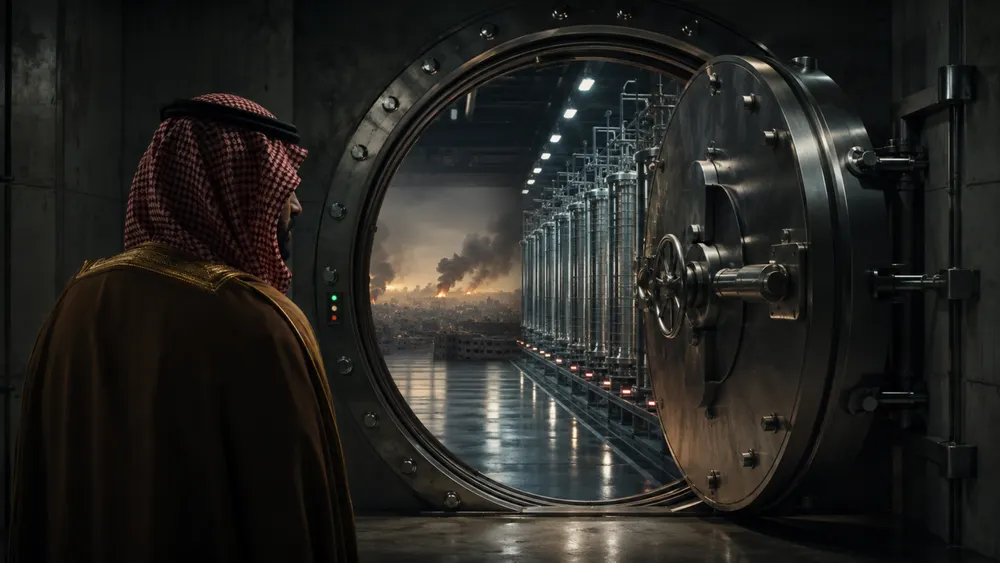
In March 2018, CBS News asked Mohammed bin Salman whether Saudi Arabia would develop nuclear weapons if Iran did. The Crown Prince answered without hesitation: 'Saudi Arabia does not want to acquire any nuclear bomb, but without a doubt, if Iran developed a nuclear bomb, we will follow suit as soon as possible.' In September 2023, Fox News pressed him again. 'If they get one, we have to get one,' he said. Saudi Arabia's foreign minister Prince Faisal bin Farhan stated at the World Policy Conference in December 2022: 'If Iran gets an operational nuclear weapon, all bets are off.'
These are not private assessments or diplomatic rumour. They are public, repeated commitments by the head of government and the foreign minister of the most significant Arab state in the world, made across five years and three separate media appearances, consistently and without equivocation. The condition they specify — Iran obtaining a nuclear weapon — has not yet been met. What has changed since the Iran war began on February 28, 2026 is the proximity of that condition.
The Islamabad Memorandum expired on August 17 without producing a nuclear deal. Iran's enrichment programme is intact. Iran's hardline leadership spent the MOU's 60 days restructuring its military and accelerating missile production. The IRGC commander who is now Iran's top security official has publicly stated Iran will shift from defensive to offensive posture. The war that was launched to end Iran's nuclear threat has not ended it. The question the Saudi commitment now demands is: how close is close enough?
What Saudi Arabia Has Been Building
Saudi Arabia's nuclear ambitions extend beyond the public statements of its leadership. The kingdom is pursuing a civilian nuclear programme of substantial scale — it has announced plans for 16 nuclear reactors and has been negotiating the terms of American nuclear technology transfer for years. The specific terms of that negotiation are the part of the story that has received insufficient analytical attention.
Saudi Arabia's energy minister Prince Abdulaziz bin Salman stated at a mining conference that Riyadh wants 'the entire nuclear fuel cycle, which involves the production of yellowcake, low-enriched uranium, and the manufacturing of nuclear fuel both for our national use and of course for export.' The phrase 'entire nuclear fuel cycle' is the critical one. The centrifuges that enrich uranium to the low levels required for nuclear reactor fuel can enrich it to the high levels required for a nuclear weapon. The reprocessing plants that handle spent fuel rods can separate out the plutonium those rods contain. Both pathways to a nuclear weapon — uranium and plutonium — flow from the 'entire nuclear fuel cycle' that Saudi Arabia has said it wants.
On July 22, 2026, US Energy Secretary Chris Wright and Saudi Minister of Energy Prince Abdulaziz bin Salman signed a 30-year civilian nuclear cooperation agreement. The agreement is in Congress for review. US officials said it could allow Saudi Arabia to enrich uranium domestically — the specific capability that the United States has historically refused to grant to non-nuclear states in the region as a condition of nuclear cooperation. Trump contradicted his own officials the following day, posting on Truth Social that 'there will be no enrichment of material' — an assertion that the deal's documented terms do not clearly support and that US officials privately contradicted. The UAE, which operates four nuclear reactors at the Barakah plant, agreed in its own 2009 nuclear cooperation agreement with the US to forgo enrichment and reprocessing. Saudi Arabia has refused to make the same commitment.
The July 2026 civilian nuclear deal between Trump and Saudi Arabia is therefore not a routine technology transfer. It is a potential transfer of enrichment capability to a country whose leader has publicly said it will build a nuclear weapon if Iran does, whose nuclear ambitions include the entire fuel cycle, and whose closest regional rival's nuclear programme has just survived six months of American bombing without being dismantled.
The Cascade the MOU's Failure Risks
Saudi Arabia is not the only regional government recalculating. Dov Zakheim, writing for the Foundation for Defence of Democracies on August 17, warned that if the Iran deal collapses, Saudi Arabia developing a bomb could trigger Egypt to follow — and that if Egypt followed, the UAE might revoke its existing nuclear cooperation agreement with Washington and pursue its own capability. The cascade is not guaranteed. It is the direction of travel if the Iran nuclear question remains unresolved while enrichment capability spreads across the region.
Egypt has expressed interest in nuclear energy and has moved toward Russian nuclear cooperation for years. It is not a nuclear threshold state in the way Saudi Arabia is approaching. But Egypt is the Arab world's most populous country and its traditional military power. If Saudi Arabia's nuclear ambitions produce a weapon, Egypt's calculation changes. The same calculation that MBS has publicly articulated — we cannot allow a rival to acquire what we do not have — applies to Egypt's relationship with Saudi Arabia as much as to Saudi Arabia's relationship with Iran.
The UAE's position is the most specific near-term risk. The Barakah nuclear plant is operational. The UAE agreed in its 123 Agreement with Washington to forgo enrichment and reprocessing — the so-called 'gold standard' for nuclear cooperation that the Trump administration notably did not require of Saudi Arabia in its July 2026 deal. If Saudi Arabia is allowed to enrich uranium under an American civilian nuclear agreement while the UAE is not, the UAE faces a specific strategic asymmetry within its own neighbourhood. The pressure to revise the Emirati commitment grows in direct proportion to the gap between what Riyadh is permitted and what Abu Dhabi agreed to forgo.
The non-proliferation architecture that exists to prevent exactly this cascade depends on two things: a credible commitment by the United States to enforce the distinction between civilian and weapons-grade nuclear capability, and a resolution of the Iranian nuclear question that does not leave Iran retaining enrichment capacity while demanding that Sunni Arab states forgo the same. The Iran war was supposed to produce the second of these conditions. It has not. The July 2026 civilian deal with Saudi Arabia has complicated the first.
What the War Was Supposed to Close
The United States launched Operation Epic Fury on February 28, 2026, with four stated objectives. The fourth was to guarantee that Iran could never obtain a nuclear weapon. Six months later, Iran's nuclear programme is under negotiation rather than dismantlement. The 60-day nuclear talks the Islamabad Memorandum created expired without an agreement on enrichment. Iran retains its stockpile of highly enriched uranium in underground facilities the IAEA cannot access. The hardliners who spent the MOU period preparing for a larger conflict now head Iran's supreme security council.
MBS's commitment was conditional: Saudi Arabia does not want a nuclear bomb, but will build one if Iran does. That condition has not been triggered. Iran has not built a bomb. The war's stated objective was to ensure it never could. That objective has not been achieved. The condition and the objective are therefore both in suspension, in a specific and uncomfortable relationship: the war's failure to achieve its objective is the factor most likely to eventually trigger the condition.
The nuclear order that the 1968 Non-Proliferation Treaty constructed depends on a distinction between states permitted to hold nuclear weapons — the five permanent Security Council members — and states not permitted to do so. That distinction survived the Cold War, various near-misses and decades of proliferation pressure because the states closest to the threshold believed that American guarantees and American deterrence made acquisition unnecessary. Pakistan and India stepped outside the framework in 1998, accepting the consequences. Israel has operated outside it implicitly for decades. North Korea stepped outside it explicitly. What has not happened is a cascade of Arab states simultaneously concluding that the framework no longer provides the protection it promises.
What MBS said in 2018 and 2023 was not a diplomatic signal. It was a strategic statement, made publicly and consistently, about the conditions under which Saudi Arabia would seek the weapons the NPT says it cannot have. Those conditions have moved materially closer in six months than they had in the preceding eight years. The Iran war did not close the nuclear door it promised to close. The door it may have opened leads to Riyadh.
The Argument That Cannot Be Made Quietly
The specific danger the MOU's collapse creates is not that Iran will build a bomb tomorrow. Iran's enrichment programme and its underground facilities represent a latent capacity, not an imminent weapon. The danger is that the war's failure to resolve the nuclear question, combined with the enrichment rights potentially granted to Saudi Arabia under the July 2026 civilian deal, has created the conditions for the most strategically destabilising development in the region since Israel's undeclared nuclear programme: an openly declared Saudi intent to match Iranian capability, expressed by the head of government in multiple public forums, now backed by a civilian nuclear infrastructure whose own government has refused to rule out the weapons pathway.
The war was sold as the solution to the Middle East nuclear problem. Six months in, with the MOU collapsed and Iran's hardliners in control of its security architecture, the problem has not been solved. What has been created instead is the specific regional configuration in which a nuclear-armed Iran — or an Iran that credibly appears to be approaching nuclear capability — triggers a Saudi response that its own leadership has publicly committed to and whose infrastructure the United States is now helping to build.
This is not an argument against civilian nuclear power or against US-Saudi cooperation. It is an argument about sequencing, conditions and the specific strategic consequence of launching a war to close a door and then signing a deal that opens another one. The Iran war's most consequential legacy may not be what it did to Iran. It may be what it has started in the region around it.
This Analysis piece is free to read. Future Analysis pieces will be available to registered DiploPolis members first. Free registration takes 30 seconds. No credit card required.
Find this piece interesting?
Dispatches by DiploPolis delivers sharp analysis and pointed commentary on power, politics, diplomacy, and world affairs — directly to your inbox.
No neutrality. No noise. Just argument.