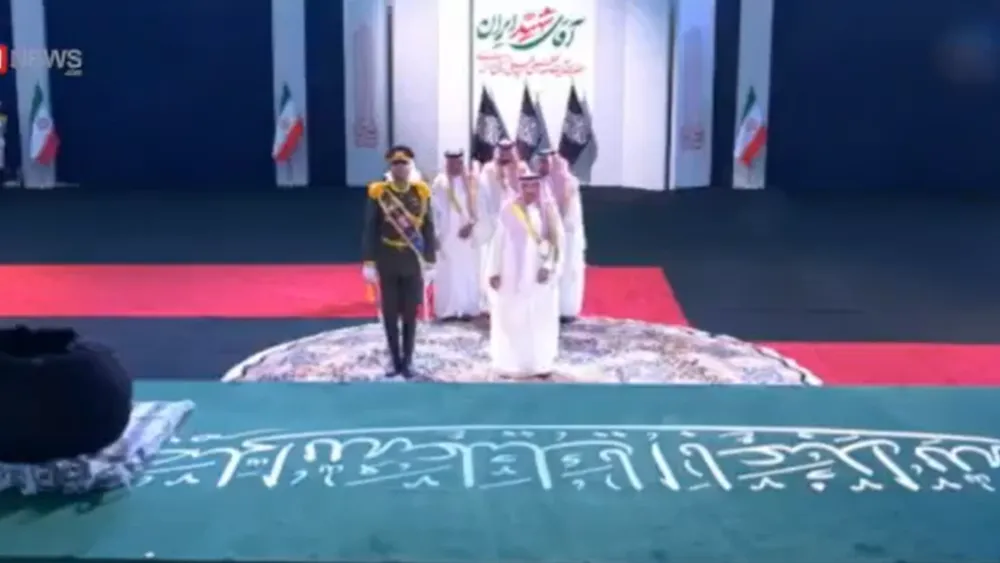
When the Saudi delegation stepped forward at Tehran's Grand Mosalla to pay its respects to the late Supreme Leader, the Quranic recitation that followed was Al Imran 3:13: the verse describing the Battle of Badr, where a vastly outnumbered Muslim force routed a much larger army by the will of God. Badr was fought in what is today Saudi Arabia. The recitation was not random.
Iran's seven-day funeral for Ayatollah Ali Khamenei, which concluded with his burial in Mashhad on July 9, was not a mourning ceremony. It was a foreign policy document written in scripture. For each delegation that attended, representatives from more than 100 countries including Russia, China, India, Pakistan, Saudi Arabia, Turkey and the leadership of every significant movement in Iran's resistance network, a specific Quranic verse was selected and recited. The selections were precise, intentional and, to anyone fluent in both Islamic theology and Middle Eastern geopolitics, transparent in their meaning. Iran used the funeral to tell every government in the room exactly where it stood.
The hierarchy was legible. For Hamas, the verse described a people who had proved true to their pledge to God. For Hezbollah, it promised the upper hand to true believers and framed martyrdom as divine selection. The Houthis received a verse about loyalty, discipline and growth under pressure. Iraq's Hashd al-Shaabi was told that those who die in the cause of God are not dead but alive. Palestinian Islamic Jihad and the Taliban received the opening of Surah Al-Fath: a clear triumph, past and future shortcomings forgiven. These were the movements Iran considers its frontline. Their verses said so.
Russia received a passage from Surah Al-Qasas: 'That home of the Hereafter We assign to those who do not desire exaltedness upon the earth or corruption.' The verse draws on the Quranic narrative of Moses and Pharaoh, contrasting humility and righteousness against arrogance and domination. Read in the context of Russia's positioning as a counterweight to American power, it was either a compliment or a caution: the distinction depending on how Moscow chooses to read itself.
India received Surah Aal-e-Imran 3:173: 'Those to whom people said, Indeed, the people have gathered against you, so fear them. But it only increased them in faith, and they said, Allah is sufficient for us.' A verse about resilience under pressure, about a people warned that enemies had gathered against them who responded not with retreat but with increased conviction. For a country that has faced sustained international pressure over its studied neutrality on Gaza and its deepening relationship with Israel, the selection was pointed without being accusatory. Egypt received verses of righteousness and reward: those who believe and do good are the best of all beings, destined for gardens where God is pleased with them. These were the states that showed up, lent legitimacy and were thanked without being recruited.
Turkey, Pakistan and China received recitations framed in conciliatory language, reflecting Iran's emphasis on partnership and continuity of relations. Turkey's verse elevated those who strive with their wealth and lives above those who stay behind, a passage widely read as a reference to Ankara's cautious posture during the war. Pakistan received something different from all of them: Surah Al-Isra 17:80, a personal prayer. 'My Lord, grant me a truthful entrance and a truthful exit, and grant me from Yourself a supporting authority.' Islamabad spent four months as Washington and Tehran's indispensable intermediary. Iran acknowledged that service with a verse of petition, passage and dignity: a prayer for those who navigate difficult crossings on behalf of others.
The Lebanese government received the sharpest verse of all. From An-Nisa, the passage described a people who would not obey even God's command to sacrifice themselves or abandon their homes, and observed that had they done what they were advised, it would certainly have been far better for them. Lebanon's official government maintained studied distance from both Hezbollah's strikes against Israeli forces and Israel's occupation of southern Lebanese territory. Tehran delivered its verdict through scripture, without a single direct accusation.
Saudi Arabia received Badr. An outnumbered force routing its enemy by the will of God, fought on land that is today Saudi soil. Read generously, a reminder of shared civilisational memory. Read against the evidence of Riyadh's reported alignment with Washington during the war, it was something else: a pointed observation about who fought and who did not, delivered in the register of a 7th century victory that the kingdom's own geography witnessed.
Iran chose July 4 to begin Khamenei's public ceremonies: the 250th anniversary of the United States. Authorities did not acknowledge the timing. They did not need to. At the podium, eulogist Mohammad Rasouli called for Trump's death, telling the crowd it was a disgrace not to kill the one who killed their Imam. As mourners chanted for revenge, Trump gave a speech at Mount Rushmore saying Washington had given Iran 'a week off' for a funeral because America is nice. The following day, he told Axios: 'They are all there. One shot and we can take them all out. But we are not going to do that because then we would have nobody to negotiate with.' Two heads of state. One funeral. Two entirely different registers of communication.
Iran's new Supreme Leader Mojtaba Khamenei did not appear at his father's burial, reportedly still recovering from injuries sustained in the February 28 strikes. A state projecting strength from one of its most vulnerable moments chose, as its primary instrument, not a missile test but a seven-day sequence of scripture, procession and carefully assigned verse.
Iran is simultaneously negotiating a nuclear deal with the country that killed its Supreme Leader, managing the Strait of Hormuz as a financial instrument, hosting the funerary rites of a 40-year leadership era and telling the world, in Quranic register, precisely where every government stands. Washington issues press releases and Truth Social posts. Tehran answers in scripture: the specific verse assigned to each delegation as it walked past the glass case containing the body of Ayatollah Ali Khamenei, each selection a sentence in a document that required no translation for the audience it was written for.
The funeral continues through July 9. The nuclear talks are waiting. Iran has already said what it needed to say.
Every verse had an address.