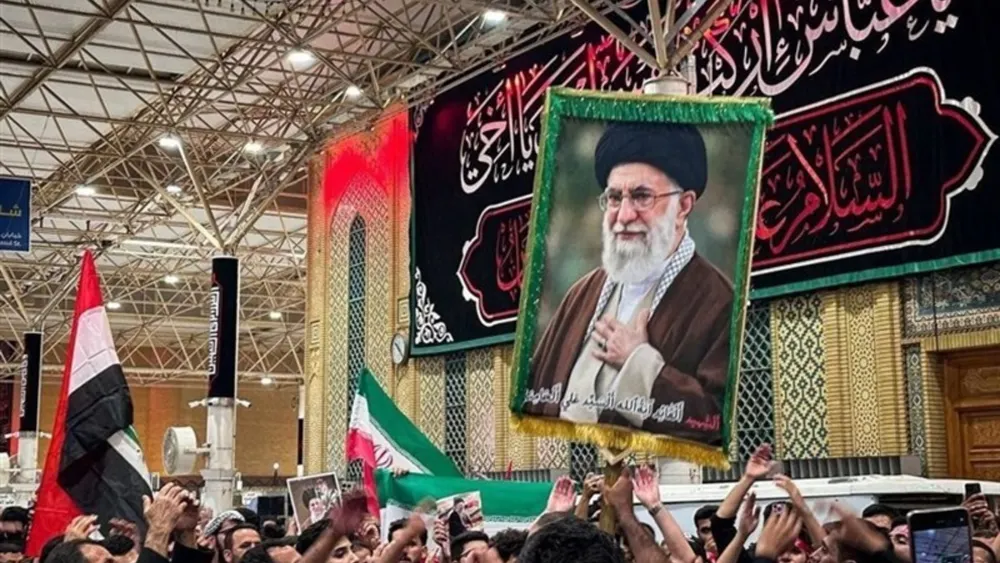
Khamenei's body arrived in Najaf on Tuesday evening, still moving through the processions of a funeral that has taken his coffin through Tehran, Qom and now into the holy cities of Shia Islam. Iran's president had flown to Najaf to accompany the ceremonies. The talks between Washington and Tehran were on hold for the mourning period. The war, it turned out, was not.
On Monday, Iran struck three commercial vessels in or near the Strait of Hormuz: a Qatar-flagged liquefied natural gas tanker that caught fire, a Saudi-flagged crude carrier hit by IRGC missiles and a third vessel confirmed by British maritime authorities. Iran said the ships had ignored designated routes and tampered with their tracking equipment. The US said the attacks were unwarranted, dangerous and a clear violation of the ceasefire.
The US then revoked the licence authorising Iranian oil sales, a key provision of the memorandum of understanding signed in June, and launched more than 80 strikes over four hours against Iranian air defence systems, command and control networks, coastal radar sites, anti-ship missile capabilities and 60 IRGC small boats. Iran responded by striking what it claimed were US military sites in Bahrain and Kuwait. Kuwait activated its air defences. Sirens sounded in Bahrain.
Both sides have now accused the other of violating the memorandum of understanding. Iran's deputy foreign minister cited Articles 1, 2 and 10: the strikes on southern Iran, the reimposition of oil sanctions and Israeli attacks in Lebanon respectively. The US said Iran's attacks on commercial shipping were a clear breach of the ceasefire's freedom of navigation commitments. Both accusations are substantively correct. When both parties to an agreement can credibly accuse the other of material breach 19 days after signing, the document was not a peace agreement. It was a framework for managing pain rather than ending the war.
Iran's Parliament Speaker Mohammad Bagher Qalibaf said the era of bullying and extortion was over. 'We don't fold,' he wrote. Iran's Foreign Minister Abbas Araghchi sent a four-word message to Washington that carries more than any legal brief: 'Honor your signature.' He also warned that final deal negotiations would not resume if US threats continued.
The US response, through an official, was that the memorandum is 'entirely performance-based' and that Iran will 'only reap benefits if they exhibit good behavior.' This is the description of a compliance mechanism without a neutral arbiter. When one party defines good behavior and decides unilaterally whether it has been exhibited, the other party has signed a document whose enforcement depends entirely on the goodwill of the enforcer. The ceasefire held briefly when both sides found the pain of continuation greater than the cost of restraint. The moment either recalculated, the document would not hold them. That moment arrived before the funeral was over.
At the NATO summit in Ankara, Trump said he was 'very disappointed' with the alliance's response to the war. He described it as 'not even a war. It's a military operation, it's a denuclearization, that's really what it is.' If the denuclearization were complete, there would be no need for 80 strikes in the fifth month after it began. Iran's nuclear programme was not destroyed in February. It was dispersed and hardened, as analysts predicted it would be. The 60-day negotiating window the memorandum created was supposed to produce an agreement about its future. That window is open. What is flying through it, at the moment, are not diplomatic offers.
An Iranian adviser told state television this week that it was 'quite clear that the US will lead the negotiations to failure.' He may be right. He may be describing a strategy rather than a prediction. Either way, the memorandum that analysts described as a framework for two exhausted parties to manage their mutual pain is now producing what such frameworks reliably produce when the pain becomes temporary: a test of whose nerve holds longer, conducted with missiles.
'Honor your signature,' Araghchi said. The signature is 19 days old. The body is still in Najaf. The war resumed while the funeral was moving.