On the morning of July 11, 2026, in Auckland, a New Zealand journalist asked Rudrendra Tandon, Secretary (East) in India's Ministry of External Affairs, why Prime Minister Narendra Modi had not held a press conference during his visit to New Zealand. Tandon's response began with a chuckle. 'Your question has that quality of déjà vu,' he said. He then explained that it would not be 'appropriate for me as a civil servant to question Mr Modi's political method,' before describing Modi as a 'quintessential Indian politician' and noting that Indian voters are 'predominantly rural folk' who 'don't like being spoken down to, and they don't like being spoken to through intermediaries.' MEA spokesperson Randhir Jaiswal offered a briefer version: 'The Prime Minister has his own style of communication.'
It was the third time in two months that a foreign journalist had put the same question to a Modi diplomat during an overseas visit. It was also, in one sense, the wrong question. The more important question is not why Modi avoids the press. It is what he does instead — and what the thing he does instead is actually for.
The Machine
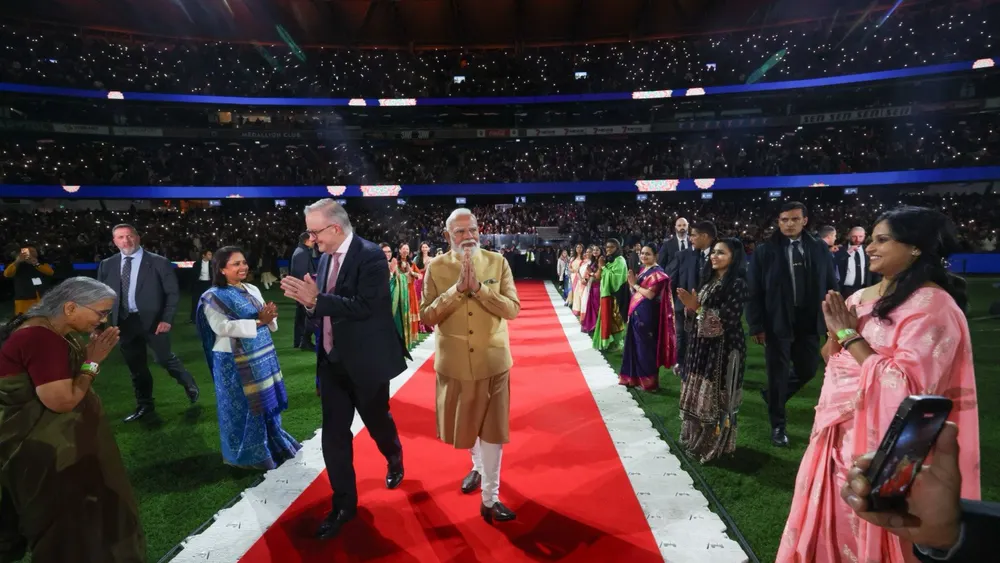
The Auckland question made international headlines. The Melbourne event the week before had already been noticed, though for different reasons. On July 9, approximately 30,000 members of the Indian diaspora filled Marvel Stadium for a community reception attended by Prime Minister Anthony Albanese and Victorian Premier Jacinta Allan. It looked, to every camera present, like a spontaneous outpouring of affection for a visiting head of government. It was not spontaneous.
The Australia India Foundation had spent months enrolling community organisations as 'welcome partners,' circulating a message that listed their responsibilities explicitly: rallying community support and attendance, and 'ensuring allocated seats are used.' More than 400 such organisations joined, and 300 volunteers coordinated logistics across multiple cities, with attendees travelling from Perth, Darwin, Adelaide and Brisbane. The crowd was real. The infrastructure behind it was carefully constructed, and it was not new.
Modi has been doing this since September 2014, when approximately 19,000 Indian Americans gathered at Madison Square Garden in New York for his first overseas diaspora event as Prime Minister. An elaborate procedure was worked out by Vijay Chauthaiwale, who led the BJP's foreign-policy cell: community organisations registered, were assigned seat quotas, and received entry passes in exchange for submitting their names, email addresses and passport details to the event committee. Those details went to BJP headquarters in Delhi, where they built a database of overseas Indian supporters available for electoral mobilisation and donations. When 60,000 British Indians filled Wembley Stadium in November 2015, the same procedure applied. The Diplomat, reporting on the Melbourne 2026 visit, confirmed the formula remains intact: 'Such events are part of India's soft power projection, and a way for Modi's party, the BJP, to cultivate links within and attract donations from diaspora communities.'
In Auckland, the same registration machinery applied. Organisers behind the 'Kia Ora Modi' event at Spark Arena sought to raise at least $1 million for the community reception and built the crowd through a community organisation registration procedure modelled on the same quota-based system used at Madison Square Garden and Wembley. The venue held approximately 13,000 people and sold out. Outside, more than 100 protesters gathered — Sikh separatists, anti-immigration activists and Free Palestine supporters — a detail that received less coverage than the crowd inside.
What followed across twelve years was a systematic rollout of the same format across every major diaspora hub. London's Wembley 2015. Houston 2019, where 50,000 people attended and Donald Trump stood on stage with Modi before a presidential election year. Sydney 2023, where Albanese introduced Modi as 'the boss' before a crowd of 21,000, though the remark later drew backlash from human rights advocates and parts of the diaspora itself. Melbourne 2026. Auckland 2026. The formula is consistent: a venue filled by community-mobilisation infrastructure, a host-country leader present on stage as an endorser, footage that travels home to Indian television as evidence of global prestige. The agreements reached at the bilateral summits receive a fraction of the coverage the stadiums generate. The spectacle is not a sideshow to the diplomacy. For the audience it is designed to reach, it is the primary output.
The Agreements Were Real
The substance of the Indo-Pacific tour deserves acknowledgement before the performance is examined, because the performance critique only lands if the substance is granted.
In Jakarta, Modi met President Prabowo Subianto and signed agreements covering defence, critical minerals, digital commerce, space, agriculture and education. Indonesia agreed to procure BrahMos supersonic cruise missiles and air-to-air missiles worth approximately $630 million, a significant expansion of India's defence export footprint in Southeast Asia. He coined a new formulation for the relationship: the 'Ganga-Mahakam Vision.' Bilateral trade stands at $28 billion. He addressed the Indian diaspora at the Jakarta International Convention Center and visited Prambanan Temple in Yogyakarta to inaugurate a joint restoration project. By any conventional measure, a success.
In Melbourne, Modi signed agreements on maritime security, civil nuclear energy, skill development, emerging technologies, science and technology and filmmaking. The uranium export arrangement, enabling Australia to supply India with uranium for peaceful purposes under the 2015 Civil Nuclear Cooperation Agreement, was a substantive outcome. The bilateral relationship, upgraded to a Comprehensive Strategic Partnership in 2020, was deepened across multiple sectors.
In Auckland, the first Indian Prime Minister's state visit to New Zealand in four decades produced a Strategic Partnership declaration and a bilateral trade target of Rs 35,000 crore by 2030. A free trade deal signed in April, which had already sparked debate in India under headlines about a 'butter chicken tsunami' of imported goods, formed the backdrop.
The tour's strategic logic was coherent. Modi was reinforcing India's Act East Policy, deepening defence ties, securing critical mineral supply chains and calibrating relationships that matter as China asserts itself across the region. None of this was performance. It was genuine foreign policy, pursued with some consistency.
The problem is what surrounds it — and what it is for.
Oslo, Melbourne, Auckland
The press conference question established its own pattern running parallel to the stadium pattern. In May 2026, during a five-nation European tour, Norwegian journalist Helle Lyng Svendsen positioned herself near the exit of a bilateral event and called out to Modi as he left: 'Prime Minister Modi, why don't you take some questions from the freest press in the world?' Modi did not respond and walked away. Lyng followed and asked: 'Do you deserve the trust of our government?' She received no answer.
The video she posted on X, captioning it with Norway's number one World Press Freedom Index ranking against India's 157th, went viral across India within hours. What followed was not political debate. Lyng received death threats. Her Instagram and Facebook accounts were suspended after a mass-reporting campaign. MEA Secretary (West) Sibi George, cornered at a subsequent briefing, became visibly agitated and told her: 'This is my press conference.'
In Melbourne on July 9, a Seven News reporter observed on air that Modi 'famously avoids unscripted news conferences, preferring more stage-managed appearances instead.' The observation circulated on Indian social media within hours and prompted outrage among BJP supporters. Sky News host Danica De Giorgio was less restrained, describing the rally as a 'rockstar reception' and criticising Albanese for being 'all over Modi like a rash.' She noted that a Victorian state election is due in November 2026, and that Victoria's Indian-Australian diaspora is a community Albanese and Jacinta Allan have reason to court. The warmth, she suggested, was not purely diplomatic. SBS News led its bulletin the same evening: 'Fanfare and protests as Modi mania comes to Melbourne.'
The pattern from Houston 2019 to Melbourne 2026 holds at the host-country political level. Albanese introduced Modi as 'the boss' in Sydney 2023 before his own federal election. Trump appeared at Howdy Modi in Houston 2019 before his 2020 campaign. Albanese and Allan were both on stage at Marvel Stadium with a Victorian election approaching. Luxon attended Spark Arena for the 'Kia Ora Modi' event though it was not part of the formal state programme, explaining that he wanted to 'celebrate New Zealand's strong people-to-people ties with the Indian community.' The diaspora event produces photographs that serve the host government's domestic interests as much as India's foreign policy.
What Newsdrum correctly identified as a pattern of press conference avoidance across three countries is the visible surface of a deeper structure: the same trips that avoid the press produce spectacles that replace it. Modi has not held a solo unscripted press conference in India since taking office in May 2014. Twelve years. Three election victories. He has given interviews to selected media, appeared at joint press statements with foreign leaders and participated in events controlled by his own team. In 2023 in Washington, Wall Street Journal journalist Sabrina Siddiqui asked him about the treatment of religious minorities in India. He responded that 'democracy is in India's DNA' and that India 'does not discriminate between people irrespective of their caste, creed or religion.' He did not take a follow-up question. That exchange remains among the closest Modi has come to unscripted media engagement during an overseas visit.
India is ranked 157th out of 180 countries in the 2026 World Press Freedom Index, six places lower than 2025, rated 'very serious' and below Gambia and Sierra Leone. The RSF notes that Modi 'does not hold press conferences, grants interviews only to journalists and YouTubers who cover him in a favourable light, and is highly critical of those who do not show allegiance.' Godi media, the term critics use for channels that function as government cheerleaders (from the Hindi word godi, meaning lap), is not a fringe description. It is the acknowledged operating reality of mainstream Indian broadcast news. Foreign journalists asking questions at bilateral summits are, to that ecosystem, an anomaly. They are doing something Indian television stopped doing years ago.
What the Silence and the Spectacle Are For
The two strategies — avoiding the press and staging mass spectacle — are not separate choices. They are the same choice expressed in two directions.
The stadium event produces what the press conference would undermine. It generates images of adulation that travel back to Indian television as evidence of global prestige and domestic legitimacy. Modi before 60,000 at Wembley says: the world loves India and its Prime Minister. Modi before 50,000 at Houston says: even in America, even alongside its President, we are received as equals. Modi before 30,000 at Marvel Stadium says: Australia recognises what we are. Godi media runs all of it. The question of whether these crowds were mobilised through quota-based community organisation, whether the footage is the product of months of advance logistical work, whether the host-country leaders present on stage have their own domestic electoral reasons to be there — none of that travels home.
The press conference would disturb this image. An unscripted question about religious minorities in India disturbs it. A Norwegian journalist asking about press freedom disturbs it. A New Zealand reporter asking why Modi does not speak directly to the press disturbs it. The answer to the press conference question — the answer Tandon could not give — is that the stadium event and the press conference avoidance are the same strategy. One creates the image. The other protects it.
Tandon's 'quintessential Indian politician' formulation is more honest than he intended. A quintessential Indian politician, in this context, is one who understands that mass spectacle is more durable than media scrutiny, that an image of 30,000 people on their feet outlasts any question a journalist might ask, and that the machinery of mobilisation, carefully disguised as organic enthusiasm, has become one of the most effective tools of political communication available. It works. It has worked for twelve years. It has filled stadiums on four continents and produced footage that has played on Indian television across three election cycles.
Svendsen, interviewed after the Auckland incident, said being targeted by godi media anchors in May had felt worth it once Auckland confirmed the same question was being raised on the other side of the world. Rahul Gandhi put the political stakes plainly: 'What happens to India's image when the world sees a compromised PM panic and run from a few questions? When there is nothing to hide, there is nothing to fear.'
The stadiums in Melbourne and Jakarta were full. The agreements were signed across all three capitals. The diplomatic credit is genuine. And at every stop on this tour, and every tour before it, the formula held: a venue filled by invisible machinery, a press conference declined by visible design, and footage heading home to an audience trained over twelve years not to ask why.
This Analysis piece is free to read. Future Analysis pieces will be available to registered DiploPolis members first. Free registration takes 30 seconds. No credit card required.
Find this piece interesting?
Dispatches by DiploPolis delivers sharp analysis and pointed commentary on power, politics, diplomacy, and world affairs — directly to your inbox.
No neutrality. No noise. Just argument.