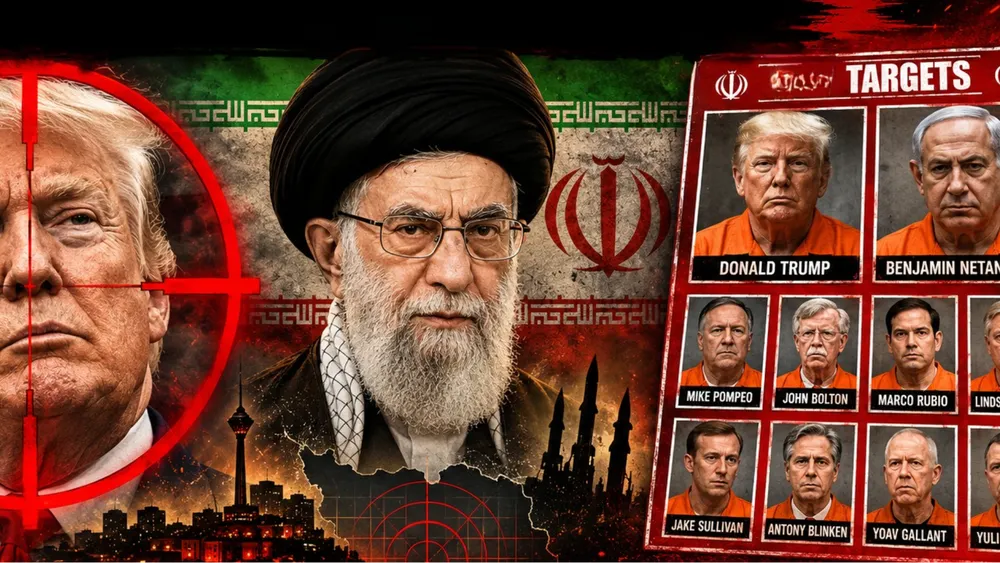
Hamshahri published the infographic on Saturday night. The newspaper is owned by the Tehran municipal authority and is known for its provocative tone. The image was precise in its construction: Trump and Netanyahu in the top row, depicted in orange prison uniforms with sniper crosshairs drawn on their foreheads. Eleven others beneath them — Rubio, Hegseth, the CENTCOM commander Brad Cooper, US Ambassador to Israel Mike Huckabee, the Israeli Defence Minister Israel Katz, Israeli Foreign Minister Gideon Sa'ar, IDF Chief of Staff Eyal Zamir, Starmer, Macron, Meloni and Merz — all depicted in orange prison uniforms, no crosshairs. The distinction is deliberate. It had no official endorsement. Mojtaba Khamenei, in the statement the newspaper published alongside it, did not disclose names. He said Iran had a list. Hamshahri supplied one.
The infographic was published alongside Mojtaba Khamenei's first public words since his father's six-day funeral procession ended in Mashhad last Thursday. The new Supreme Leader said vengeance was the will of the Iranian nation and must inevitably be carried out. Those responsible, he said, will take to their graves the wish of a peaceful death in their beds. These were his first words to the world. He chose them for the occasion.
By Monday morning, Iran's Foreign Ministry spokesperson confirmed that mediators are continuing their efforts to resolve the conflict with Washington. Qatar and Oman are still working the phones. The diplomacy that produced the Versailles MOU, the agreement now in tatters after three weeks of mutual violation, has not formally ended. The kill list did not end it. The strikes did not end it. Both exist alongside the mediation and neither has cancelled the other.
This is the observation the coverage is not making.
Iran's political culture has always held these things simultaneously. The 2015 JCPOA was negotiated while Khamenei the elder was delivering speeches denouncing the United States in terms no American diplomat could repeat publicly. Hezbollah received its weapons during ceasefires. The proxies operated while the diplomats talked. The Supreme Leader's statements and the Foreign Ministry's statements occupied different registers of the same system. The kill list is the failure register. The mediation is the success register. Publishing the first does not preclude pursuing the second. Iran has never believed otherwise.
The visual grammar of the list makes the argument more precise. Trump and Netanyahu are marked twice: crosshairs for killing, prison uniforms for trial. The other eleven, including American and Israeli officials alongside the European leaders, wear uniforms only. Iran is not drawing a simple line between the West and the rest. It is drawing a line between two people and everyone else. Trump and Netanyahu ordered the February 28 strikes. The others enabled, facilitated or failed to prevent them. The architects face the crosshairs. The enablers face the dock. For countries that spent months insisting they were not parties to this war, the distinction between a crosshair and a prison uniform is cold comfort. But it is a distinction. Iran has issued a verdict on complicity and calibrated its punishment accordingly.
Trump responded by saying the United States would 'completely decimate and destroy' Iran if it attempted to kill him. He suggested a standing order to that effect. AP analysis noted that no such pre-authorised retaliation mechanism legally exists — any response to an assassination of the president would fall to his successor, JD Vance, to decide. The threat is real. The mechanism is more complicated than the post implied. What is clear is that Israel tipped off Washington about a specific plot against Trump's life during the NATO summit in Turkey, prompting him to leave Ankara on an older Air Force One rather than the new plane Qatar had gifted. The kill list is not purely rhetorical. The precautions against it are not either.
The list did not appear in Hamshahri's print edition on Sunday. That detail is worth holding. The infographic was published online, in the register of social media and symbolic communication, not in the register of the permanent record. The newspaper supplied the names. The Supreme Leader supplied the principle. Both operate in the channel Iran uses for signalling, not the channel it uses for governing. The Foreign Ministry's channel, the mediators' phone calls, the Oman back-channel, the Qatar conversations, continues to run in parallel. Both channels are open. Iran is speaking through both.
Mojtaba said those responsible will not die peacefully in their beds. His government's diplomats are still trying to find a deal that would make that unnecessary. The kill list and the phone call exist in the same political framework because, in the Islamic Republic, they always have.