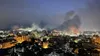
Doha residents received emergency alerts on their mobile phones just after midnight on Sunday telling them to remain indoors. AFP journalists in the capital watched missile interceptions light up the night sky. Kuwait activated its air defences. Sirens sounded in Bahrain. The UAE intercepted ballistic missiles, cruise missiles and drones across its airspace. Jordan's military shot down eight projectiles fired toward its territory. The Islamic Revolutionary Guard Corps struck Al Udeid Air Base in Qatar, the largest US military facility in the Gulf, with ballistic missiles, claiming damage to its command and control centre and aircraft maintenance facility.
By Sunday morning, Qatar announced four days of national mourning. Not for the attacks. For the death of its former Emir, Sheikh Hamad bin Khalifa Al Thani, who died at 74 having spent 18 years building the very infrastructure Iran struck while his country buried him.
Sheikh Hamad came to power in 1995. He found a small, quiet Gulf emirate and built it into something the world could not ignore. He developed Qatar's liquefied natural gas fields into the largest export operation on earth. He launched Al Jazeera, which gave Arab audiences a journalism that had no precedent in the region. He brokered ceasefires in Lebanon, Sudan, Darfur and Yemen. He granted Hamas a political bureau in Doha, maintained working channels with Iran, hosted the Afghan peace talks and simultaneously invited the United States to build Al Udeid Air Base on Qatari soil, the largest American military installation in the entire Gulf region, home to US Central Command's forward headquarters, the operational nerve centre from which America's wars in the region have been planned and executed for more than two decades.
He built Qatar on the premise that you could talk to everyone. That a small, wealthy, well-connected country with no enemies and universal communication channels could be the permanent neutral ground of Middle Eastern diplomacy. The base that hosted US forces and the channels that reached Tehran could coexist. The bridge could carry traffic in both directions indefinitely. He believed it enough to stake the country's entire foreign policy identity on it. He handed his son, the current Emir Sheikh Tamim, a country whose principal value to the world was that nobody doubted Qatar's willingness to pick up the phone.
Iran struck Al Udeid on Sunday. The IRGC said it targeted the base's command centre and maintenance facility. Qatar said its defences intercepted the missiles. The dispute over what was actually destroyed is almost beside the point. The strike itself is the message. Iran has declared that any country hosting US military forces is a party to this war, regardless of that country's diplomatic posture or its role as a mediator. Qatar, Bahrain, Kuwait, Jordan, the UAE and Oman said they were not in this war. All six received Iranian missiles on Sunday. Their offence, in Tehran's account, is that they signed bilateral defence agreements with Washington decades ago and allowed the United States to build facilities on their territory. They did not bomb Iran. They did not authorise the strikes. They hosted the infrastructure. Iran has decided that is enough.
Bahrain's ambassador to the United Nations put the other side plainly at the Security Council on Friday: Iran was exploiting diplomacy to buy time while continuing military operations. He said the pattern was consistent, ceasefire, negotiation, violation, escalation. The Security Council listened and changed nothing. Trump declared the ceasefire 'over' at NATO, then said he remained open to negotiations. Iran declared the Strait of Hormuz closed 'until further notice.' Qatar's prime minister called Iranian Foreign Minister Araghchi and urged restraint. The call took place while Doha's air defences were still tracking incoming projectiles.
Sheikh Hamad built the bridge. He spent 18 years proving that small states could function as honest brokers if they were wealthy enough, connected enough and disciplined enough to never take a side. He built Qatar's institutions around that proposition. Al Jazeera reported on everyone's wars without becoming anyone's propaganda. Doha negotiated everyone's ceasefires without becoming anyone's proxy. Al Udeid housed America's forward command while Qatar's foreign minister took calls from Tehran.
Iran has reviewed that proposition and rejected it. The bridge he built is now a target. The base he agreed to host made it one. He died on Sunday morning. The sirens were already going.