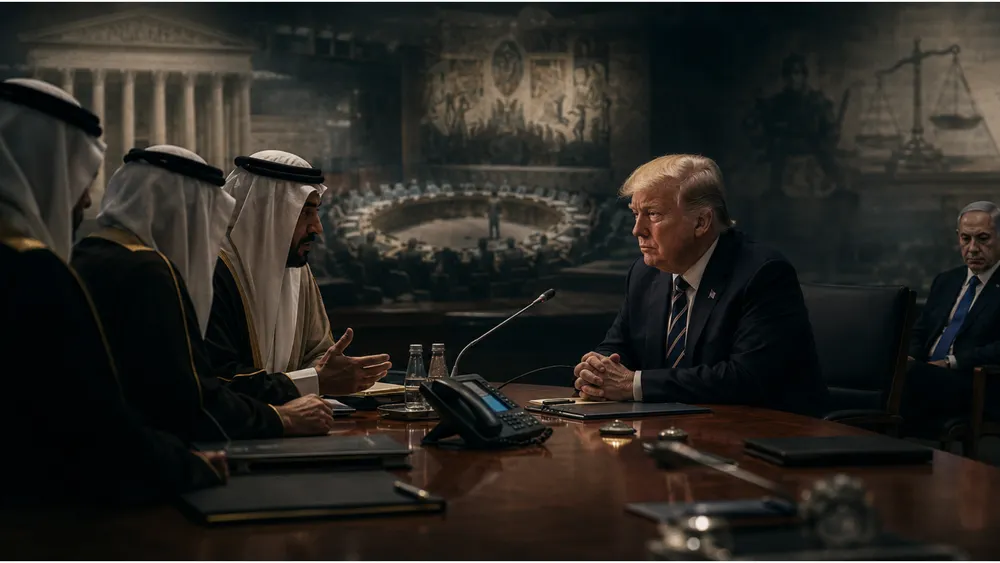
On July 15, 2026, Arab diplomats told the Israeli news channel Kan that their leaders had delivered a message to Donald Trump: Benjamin Netanyahu is the obstacle to regional peace. Those words, in that form, mark something that has not happened before in the current phase of American Middle East diplomacy. The International Criminal Court issued arrest warrants for Netanyahu in November 2024. They sit unexecuted. The United Nations Security Council received resolutions demanding ceasefires in Gaza and Lebanon. They were vetoed. The G7 issued communiqués. They were noted and disregarded. The International Court of Justice issued provisional measures in South Africa versus Israel. They were violated within weeks. None of those institutions, deploying every mechanism that international law and multilateral diplomacy possess, moved the American president's view of Netanyahu by a measurable degree.
The Arab leaders moved it in a private conversation.
The report specifies what the Arab states argued. Not that Israel was violating international law. Not that the ICC's arrest warrants should be honoured. Not that the provisional measures issued in The Hague required compliance. They argued that Netanyahu was obstructing Trump's vision for the region — his deals, his architecture, his legacy. They spoke to Trump in Trump's language, about Trump's interests, and Trump began to view Netanyahu as 'an obstacle to realising his vision for the region,' the diplomats said. The countries making that argument are now waiting quietly for Israel's October elections, working behind the scenes to shape Trump's view of what comes next, and declining to make any of this public in order to avoid the appearance of interfering in Israeli internal affairs. They have found the lever. They are applying it carefully.
What the Arab states did this week is worth examining with more precision than the headline allows, because the method contains an argument about how power actually works in the current international environment — and the argument is not comfortable.
What the Arab States Have Known
The Gulf states had urged Trump not to go to war with Iran. Saudi Arabia, Qatar, the UAE — all of them warned before February 28 that a military operation against Iran would produce Iranian retaliation against their territory, their infrastructure, their shipping. They were right. Iran fired missiles and drones at Kuwait and Qatar. Iranian proxies struck Saudi targets. The Strait of Hormuz closure disrupted energy markets on which Gulf state revenues depend. The war that Netanyahu presented to Trump in the Situation Room in February was sold as a decisive operation that would transform the regional order in Israel's favour; it produced instead a memorandum of understanding that changes nothing essential about Iranian nuclear capability, a Lebanon crisis that has consumed months of American diplomatic bandwidth, and a pattern of Israeli operations that Trump's own secretary of state has struggled to manage.
The Chatham House assessment published this month is blunt: the Trump-Netanyahu relationship has reached an all-time low. Trump secured the Iran ceasefire not through Israeli cooperation but through Saudi Arabia, Qatar, Turkey and Pakistan. When the Islamabad Memorandum needed to be signed, Netanyahu was not in the room. When the Bürgenstock nuclear talks were postponed because Israeli strikes in Lebanon were threatening to collapse the negotiations, the administration's frustration landed publicly: Trump said Netanyahu 'needs to be more responsible' and 'I'm not happy' with Israel's Lebanon operations. On June 2, Axios reported that Trump told Netanyahu he was 'f***ing crazy' and that Arab leaders 'don't want you there.' Netanyahu continued operations in Lebanon after the call.
The Gulf states know this history in detail because they lived it. They were the countries Trump turned to when Israel became the obstacle to his own diplomacy. They absorbed the cost of a war they advised against. And they are now making a strategic calculation: the most efficient route to a post-war regional settlement runs not through The Hague or through the UN Security Council but through Trump's sense of his own legacy, applied directly against the leader who has most consistently undermined it.
The Method and What It Reveals
The Arab argument, as reported, has three components. First: Netanyahu is blocking Trump's vision, specifically the expansion of the Abraham Accords and a broader regional normalisation architecture that requires Saudi participation. Saudi Arabia has made clear it will not normalise relations with Israel without a credible path to Palestinian statehood. Netanyahu's government, in which Finance Minister Bezalel Smotrich has made public statements about annexing Syrian territory and in which National Security Minister Itamar Ben-Gvir has called for Israeli settlement in Gaza and Lebanon, and in which the prime minister publicly endorsed the Greater Israel vision on Israeli television in August 2025, is not producing that path. Saudi participation in the Abraham Accords is Trump's most significant potential foreign policy achievement. Netanyahu is the obstacle to it.
Second: the October elections create a window. The Arab states are not asking Trump to force Netanyahu out. They are positioning themselves for a post-Netanyahu Israel, signalling to Washington that the problem is the man rather than the state, and that a different Israeli government might produce a different regional outcome. The diplomatic argument is carefully calibrated: it applies pressure on Netanyahu personally while preserving the US-Israel relationship institutionally.
Third: there is the Qatar dimension. Former Mossad official Dr. Udi Levy said on Tuesday that Qatar had reached Israeli decision-makers through back-channels — 'just like the Mossad reached Iran's,' he said. The Gulf states have demonstrated, across the past eighteen months, that they have access to every room in this conflict. They reached Tehran through Pakistan. They reached Washington through direct presidential conversations. They reached Jerusalem through channels that a former intelligence chief considers equivalent to covert operations. The moral voice of international law has no access to these rooms. The pragmatic voice of strategic interest does.
What this method bypasses is important to name. The Arab states are not arguing for Palestinian rights. They are not citing the Genocide Convention, the ICC arrest warrants, the ICJ's provisional measures, or the UN resolutions that their own governments voted for. They are arguing that Netanyahu is bad for Trump's deals. The argument is correct as far as it goes. Netanyahu has derailed Trump's Iran diplomacy, blocked the path to Saudi normalisation, and produced an Israeli government whose public statements alarm every Arab capital in the region. The argument is also entirely transactional, entirely personal, and entirely divorced from the question of what Israeli policy toward Palestinians actually is and what it would need to become.
Lebanese President Joseph Aoun has refused to engage with Netanyahu as long as Israeli troops remain in Lebanon. That position has moral and legal coherence. But the Arab states' broader argument to Trump is not Aoun's argument. It is the argument of governments that want regional stability, economic integration and American security guarantees — and have concluded that Netanyahu, specifically, is preventing all three. The Palestinians appear in this argument only as the Saudi condition, the two-state requirement without which Riyadh will not normalise. They are the price of the deal, not the subject of it.
Whether the Lever Moves What It Appears to Move
The history of American pressure on Israeli prime ministers is shorter than it is often assumed to be. The most serious confrontation was Eisenhower over Suez in 1956, when the American president threatened economic consequences and Ben-Gurion withdrew. The Al Jazeera analysis of Trump-Netanyahu tensions notes that George Bush senior withheld loan guarantees from Shamir over settlements — and Shamir was replaced at the following election. In both cases, American pressure intersected with Israeli democratic processes to produce a change of leadership. In neither case did the change of leadership produce a fundamental shift in Israeli policy toward Palestinians.
This is the question the Arab states' strategy leaves unanswered. It is possible that the October elections produce an Israeli government prepared to commit to a Palestinian state pathway, to withdraw from Lebanon and Syria, and to participate in a regional normalisation architecture that includes Saudi Arabia. It is also possible that the October elections produce a different Israeli government with the same strategic objectives and a more diplomatic manner of pursuing them. Polls currently show Yashar narrowly ahead of Likud in seat projections, with Eisenkot leading Netanyahu by 43 per cent to 34 per cent as preferred prime minister. Eisenkot is not Smotrich. He is also not a figure whose commitment to Palestinian statehood has been the centrepiece of his political career.
The Arab states have found the lever that moves Trump. They used it because eighteen months of international law failed to move him. They used it in the only language Washington currently understands, and they used it with precision and patience. The method worked because it bypassed the moral framework entirely and spoke directly to Trump's transactional interests. Whether it produces anything for the people whose situation prompted the argument depends on whether a post-Netanyahu Israel is actually a different Israel — which the history of this conflict gives no particular reason to assume.
The ICC cannot reach Netanyahu. The UN cannot compel compliance. The G7 cannot enforce its communiqués. The Arab states, working through private presidential conversations, may be the only mechanism that has moved the needle. That is an indictment not of their pragmatism but of the international order they were forced to work around.
This Analysis piece is free to read. Future Analysis pieces will be available to registered DiploPolis members first. Free registration takes 30 seconds. No credit card required.
Find this piece interesting?
Dispatches by DiploPolis delivers sharp analysis and pointed commentary on power, politics, diplomacy, and world affairs — directly to your inbox.
No neutrality. No noise. Just argument.