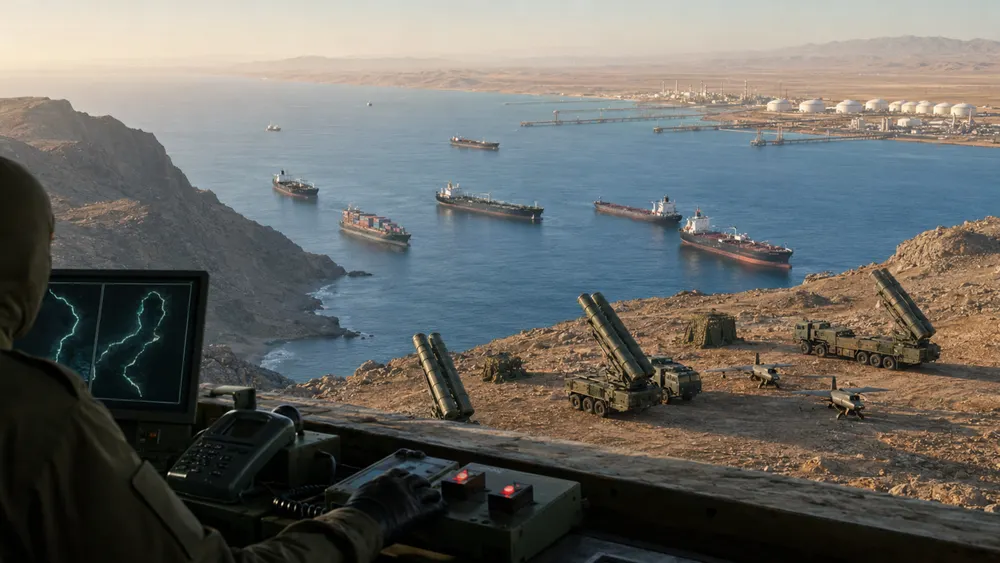
Three sources told Reuters on Thursday that Iran has instructed the Houthis to stand ready to close the Bab el-Mandeb if the United States strikes Iranian power infrastructure. A source close to the Houthis confirmed that missiles and drones have been deployed near the strait and are awaiting an order to begin. The detail that distinguishes this from prior Houthi threats: IRGC representatives already stationed in Yemen will control the timing of any closure, not the Houthis themselves. Command authority does not rest with the group. It rests with the Revolutionary Guard. Iran has built the same command structure at both chokepoints: Hormuz and Bab el-Mandeb.
The Bab el-Mandeb is the 30-kilometre passage between Yemen and Djibouti at the southern end of the Red Sea. Since Saudi Arabia's Hormuz bypass came fully online in March, approximately 7 per cent of global energy supplies have been transiting this route, redirected through the Saudi East-West Pipeline, which runs from Abqaiq on the Gulf coast to the Red Sea port of Yanbu. The pipeline is rated at 7 million barrels per day but the Yanbu export terminals can load approximately 4.5 million barrels per day, creating a structural ceiling on exports. The bypass was designed to handle a short disruption. It has now been running at its operational limit for four and a half months. There is no expansion that can come online in any relevant timeframe.
If the Bab el-Mandeb closes, the Saudi bypass route loses its exit. The pipeline crude reaches Yanbu and has nowhere to go. The Cape of Good Hope route adds roughly three weeks and 6,000 miles to voyage times. It can carry additional volume but cannot replace the current Red Sea flow within any timeframe that prevents a second price shock. The world's two main Middle East oil export routes would both be closed simultaneously, for the first time since both were constructed.
Iran has decided the threat to civilian infrastructure crosses a threshold. Trump said on Tuesday that power plants and bridges would be targeted next week if Iran did not return to negotiations. The UN human rights chief has said that deliberately targeting civilian infrastructure is a war crime. The Bab el-Mandeb instruction is Iran's response to that threat: if Washington destroys Iranian civilian infrastructure, Tehran will destroy global energy infrastructure. The logic is symmetrical. It is also, in terms of economic damage, not symmetrical at all. A Bab el-Mandeb closure does not primarily hurt the United States. It primarily hurts Europe, South Asia and East Asia, which depend on the Red Sea for energy and shipping.
The operational capability is not theoretical. The Houthis sank the MV Eternity C between July 7 and 9, killing four crew members and taking eleven hostage. The MV Magic Seas was sunk on July 6. MARAD Advisory 2026-006 remains in effect, formally warning commercial vessels against transiting the Red Sea, Bab el-Mandeb, Gulf of Aden and Arabian Sea. The Red Sea has not been closed. It has been made too dangerous for normal commercial traffic. The step from dangerous to closed is the IRGC representative in Yemen making one phone call.
The Suez Canal connects the Red Sea to the Mediterranean. If Bab el-Mandeb closes, the canal loses its traffic. Egypt earns approximately $10 billion annually in canal revenue. A closure of the southern Red Sea entrance would strand that income. Cairo has been quiet about the war. It would not remain quiet about Bab el-Mandeb. The closure would produce a secondary diplomatic crisis involving a country that has stayed carefully out of this one.
The question Trump's power plant threat has produced is not whether Iran will retaliate. It is which retaliation Iran considers proportionate. The Bab el-Mandeb answer is: whatever hurts everyone else's economy the way Iranian sanctions have hurt Iran's. The IRGC controls both straits. It does not need to fire a weapon to demonstrate this. The Reuters report is the demonstration.