

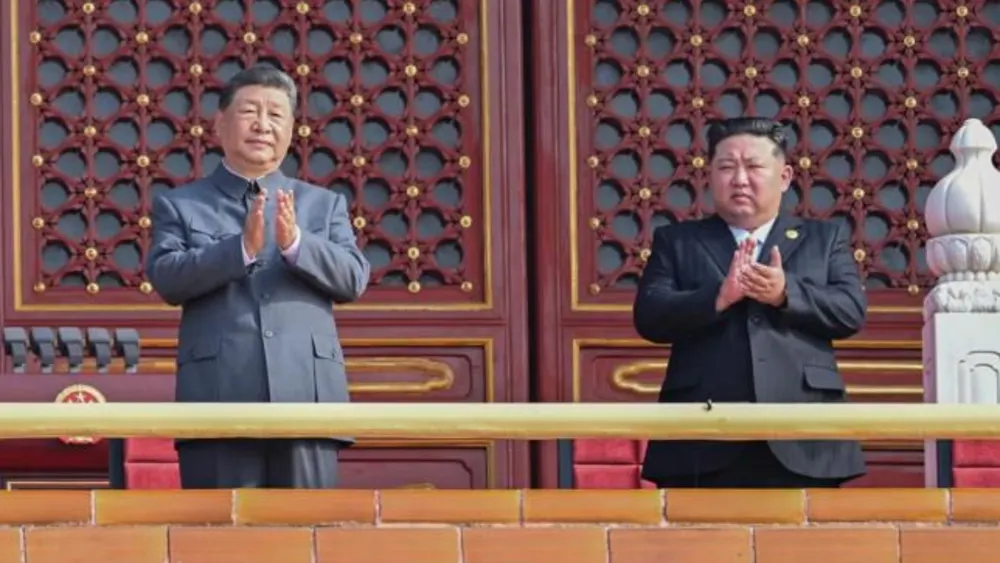
Days before Xi Jinping arrived in Pyongyang for his first state visit in seven years, Kim Jong Un was at a factory. Not preparing for the visit — the visit did not need preparation, it had already been won. Kim was touring a plant that manufactures weapons-grade nuclear material, telling engineers he intended to expand North Korea’s nuclear forces at an exponential rate. The following day Xi arrived, his first overseas trip of 2026, and the two men inspected honour guards together and issued a communié about strategic cooperation. The sequencing is the argument.
Kim did not tour the factory as a performance for his incoming guest. He toured it because Xi’s arrival was itself the confirmation — proof that Kim’s leverage had grown to the point where he no longer needed to manage the relationship carefully. The message was not addressed to Xi. It was delivered with Xi watching.
The road to that factory started in Ukraine. North Korea has supplied Russia with artillery shells, ballistic missiles and, according to the intelligence assessments of multiple governments, somewhere above 10,000 troops since Russia’s war expanded in 2022. In return, Pyongyang has received Russian military technology, satellite launch cooperation and technical assistance with its weapons programme. The transaction was not complicated: Kim had surplus military production capacity, Russia had a war and neither party needed international approval to proceed. Neither asked for it.
China has watched this partnership develop with competitive concern. North Korea depends on Beijing for roughly 95 percent of its trade, a dependency that has been Beijing’s primary lever of influence over Pyongyang for decades. That lever functions when Kim has no alternative patrons. It loses its grip when Kim has spent three years building a military relationship with Russia that delivers what Beijing cannot easily provide: battlefield-tested weapons knowledge, space launch cooperation and a patron that is itself in open confrontation with Washington. Xi did not fly to Pyongyang as a gesture of friendship. He flew because the dependency Kim is supposed to have on China has become considerably more complicated than Beijing prefers.
The international system spent twenty years constructing the architecture of North Korean isolation. Thirteen rounds of UN Security Council sanctions since 2006. Coal export restrictions, oil import caps, bans on North Korean labourers working abroad, asset freezes, travel prohibitions on the leadership. The stated logic was that sustained economic pressure would eventually compel Pyongyang to negotiate a nuclear deal. What the pressure produced instead was a state leadership whose primary acquired skill is identifying what great powers need that they cannot easily source elsewhere, and a negotiating position that grew stronger each year the sanctions remained in place. The isolation was supposed to make Kim a supplicant. It made him a supplier.
Consider what Kim has accumulated since 2022. He delivered enough artillery to affect the course of a major European war and received military technology in exchange. He acquired a bilateral relationship with Moscow that gives him strategic insurance Beijing cannot cancel unilaterally. He forced China’s president to travel to see him, something Xi had not done in seven years, to reassert a seniority in the relationship that Beijing can no longer simply assume. All of this while running a gulag system the United Nations has compared to the camps of the Nazi period, conducting missile tests over the Sea of Japan and publicly announcing nuclear expansion programmes at press briefings. The international community called these acts violations. The international community is now sending heads of state.
The joint statement described a new historical starting point for the relationship. What it described, in the language of actual events, is Beijing acknowledging that its influence over Pyongyang requires active maintenance rather than passive assumption. Kim has made himself indispensable to two of the three great powers that border him by being genuinely useful to one of them in a war the other opposed. The international system that was designed to isolate him has made him the most courted leader on the peninsula and across the surrounding region. He identified his leverage, built it patiently and used it at the right moment. The architecture constructed to contain him provided the conditions that made all of it possible.


