On July 9, 2026, Narendra Modi stood before 30,000 people at Marvel Stadium in Melbourne. Anthony Albanese stood beside him. The crowd had been assembled over months by more than 400 community organisations with seat-filling quotas. The footage went home to Indian television within hours as evidence of a nation the world admires — a civilisation whose time has come, a leader who fills stadiums on four continents because history has chosen him. Ten days later, in Auckland. Before that, Jakarta. Before that, Washington. Before that, Tokyo. The formula is consistent: a staged crowd, a host leader close enough to be photographed as an endorser, footage that travels home as proof of Vishwaguru. Teacher of the world. The Mother of Democracy, radiant on the global stage.
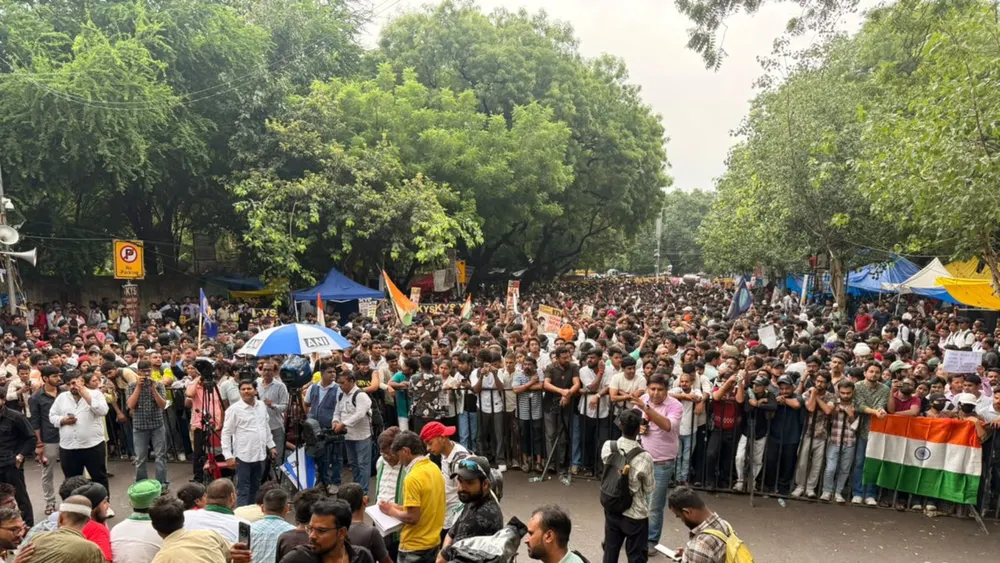
On July 20, eleven days after Melbourne, Delhi Police used tear gas and batons against thousands of students who had marched on parliament demanding the resignation of Education Minister Dharmendra Pradhan over a question paper leak that forced more than two million students to retake their medical entrance examinations. At the emergency ward of Ram Manohar Lohia Hospital that evening, students arrived with bloodied bandages, stitched wounds and bruised and swollen limbs. One protester, struck on the head with a police baton, lost consciousness in the crowd. Friends pulled him out and carried him to hospital. He was discharged hours later with two stitches. More than 150 were hospitalised in total. The government cut mobile internet across central Delhi. The videos went everywhere anyway.
In one video that circulated widely, a young girl stood in the tear gas and pleaded with a police officer in Hindi: 'If your own children were here, would you treat them like this? Aren't we your children too? Please let us go. Don't use batons against us. Don't you feel any compassion for us?' The officer did not answer. The government has not answered. Modi has not answered.
The New York Times reported 'chaotic scenes' on the streets of Delhi while 'a smiling Mr Modi' tried to project an image of calm inside Parliament. He did not address the protesters' specific demands. He said only that steps had been taken to prevent paper leaks. His image as a strongman, the Times noted, 'may also be showing cracks.'
The stadiums said: is this not a country the world admires? Parliament street on July 20 said something else.
What the CJP Is and Why It Matters
On May 15, 2026, Chief Justice of India Surya Kant compared unemployed youth to 'cockroaches' and 'parasites of society' during a Supreme Court hearing. The remark was intended as a reprimand. What it produced was a movement.
Abhijeet Dipke was studying at Boston University when it happened. On May 16, he posted a single line on X: 'What if all cockroaches come together?' The comment was meant as humour. Within 24 hours, the Cockroach Janta Party had 50,000 digital members. He flew back to India to lead the protest in person. What had begun as a meme became, over six weeks, the largest youth-led demonstration New Delhi had seen in years.
At Jantar Mantar, the protest's physical home — the eighteenth-century observatory in central Delhi that has become the site the government permits demonstrations to occupy at a safe distance from parliament — the stage carried the faces of the dead. At least a dozen NEET aspirants had died by suicide in the days after the examination was cancelled. Their photographs were displayed on the protest stage. The CJP's demand was not only Dharmendra Pradhan's resignation. It was justice for students who had prepared for years, paid everything their families had, and died when they discovered the exam they had sacrificed for had been sold.
The movement drew Sonam Wangchuk, the Ladakhi environmentalist and activist, who joined an indefinite hunger strike at Jantar Mantar in solidarity. On July 18, police forcibly removed him from the protest site and took him to hospital against his wishes, holding sheets to block the view of cameras as they carried him away. It was this act that turned the protest from a significant demonstration into a national confrontation.
By July 20, the movement was no longer only students. Professionals, families and civil society organisations had joined. The BBC described it as 'one of the most visible expressions of public dissent against Prime Minister Narendra Modi in recent years.'
Amnesty International issued a statement saying the images from Jantar Mantar show 'how peaceful dissent is being suppressed in India' and that the police response raises 'serious questions about whether their response met the requirements of legality, necessity, and proportionality under international human rights standards.' The government's response was a ten-minute meeting with Health Minister JP Nadda, after which a CJP spokesperson said: 'No commitments have been made so far.' The protesters had waited four hours for ten minutes.
The Diplomatic Exposure
In the six weeks before July 20, Modi stood on stages in Melbourne, Auckland, Jakarta, Washington and Tokyo. Each appearance was framed as evidence of India's global rise. Each produced the stadium footage that godi media ran as Vishwaguru vindication. Each generated diplomatic capital the government packages as civilisational recognition. The host leaders — Albanese, Luxon, Prabowo — were photographed beside him as endorsers of the proposition that India under Modi is a stable, democratic, rising partner.
Every one of those leaders now owns a share of a question their domestic oppositions are asking. You stood beside this man. His police used batons on students who carried copies of the Constitution to parliament. They cut the internet to stop the videos and the videos went viral anyway. The photographs from RML Hospital emergency ward — students with stitched head wounds and broken bones — were in the same international news cycle as the Marvel Stadium footage. What do you say?
The question is not hypothetical. The New Zealand Greens raised it in parliament. In Australia, independent Senator David Pocock asked Foreign Minister Penny Wong whether the government had made representations to India about the crackdown. In the United Kingdom, Labour backbenchers raised questions about the consistency of the government's human rights positions. None of these are diplomatic ruptures. They are the beginning of an inconvenience that compounds every time the government reaches for the stadium footage to answer a press freedom or human rights question.
The Financial Times called the crackdown 'the biggest demonstration in the capital in years.' The international press roundup confirmed that the NYT, BBC, Bloomberg, the Wall Street Journal and the Guardian all covered it as a significant challenge to Modi. India's press freedom ranking of 157th out of 180 countries was cited across that international coverage. The foreign journalists who had asked in Oslo, Melbourne and Auckland why Modi does not hold press conferences now had a more specific answer to the question of what democratic accountability looks like in India.
Democratic nations will not withdraw from engagement with India because of the CJP protests. Albanese will not cancel the uranium agreement. Luxon will not rescind the Strategic Partnership declaration. India's strategic weight — its Indo-Pacific position, its role as a counterbalance to China, its economic trajectory — does not change because of what happened at Jantar Mantar. The pragmatics of great power competition will keep Western governments at the table with Modi regardless of what his police do to students on parliament street.
But the terms of the engagement change. Every meeting becomes more qualified. Every joint statement requires more careful drafting to avoid phrases about shared democratic values that now cut in two directions. The diplomatic conversation about India's strategic rise now has to absorb India's democratic regression in the same news cycle, eleven days apart, in the same month.
What Is Growing Inside India
This is what the stadium machinery was built to prevent the world from seeing.
India is ranked 157th in the World Press Freedom Index. The space for dissent has contracted, year by year, across twelve years of this government. Activists imprisoned. Journalists charged. Television anchors who function as government communications officers. The machinery of suppression is documented and real. What the CJP protests reveal is that it has not worked on the generation it was most precisely designed to suppress.
These are the young people who were supposed to be too absorbed in competitive examination preparation to have time for politics. Too individually focused on advancement in a system the government promised was rising even as it failed them. The NEET leak ended that calculation. It told them the competition they were sacrificing their youth for had been corrupted. Twelve of them died.
Their photographs were on the stage at Jantar Mantar. The survivors marched on parliament. The police met them with batons. They came back the next day — many showing the wounds from Monday — and sat down again under monsoon drizzle. The cockroach, as the Chief Justice inadvertently named them, does not leave.
The anger building inside India is not visible in Modi's stadium footage. It is not visible in godi media's prime-time coverage. It is visible in the students at RML Hospital waiting with stitched head wounds to be discharged, in the crowd that returned to Jantar Mantar the morning after being beaten, in BJP workers who told Scroll.in that 'people's sympathy is now with the youth,' in the generation that has watched a dozen of their peers die and decided that the government responsible should answer for it.
What Modi projects abroad and what his government produces at home have always been in tension. The Spectacle and the Silence was the argument DiploPolis made last week — that the stadiums and the press conference avoidance are the same strategy, one creating the image and the other protecting it. Parliament street on July 20 is what the image was protecting against.
The students came with the Constitution. The police came with batons. The photographs from the emergency ward of RML Hospital on the evening of July 20 were the answer to every stadium the government has built on four continents — and to every democratic leader who stood on the stage and called it partnership.
What is growing in India's streets is not yet a movement that threatens this government's hold on power. But it is a generation that has stopped believing the image. A government that has to beat its students in the streets of the Mother of Democracy to protect the image of the Mother of Democracy has already said more than any stadium ever could.
This Analysis piece is free to read. Future Analysis pieces will be available to registered DiploPolis members first. Free registration takes 30 seconds. No credit card required.
Find this piece interesting?
Dispatches by DiploPolis delivers sharp analysis and pointed commentary on power, politics, diplomacy, and world affairs — directly to your inbox.
No neutrality. No noise. Just argument.