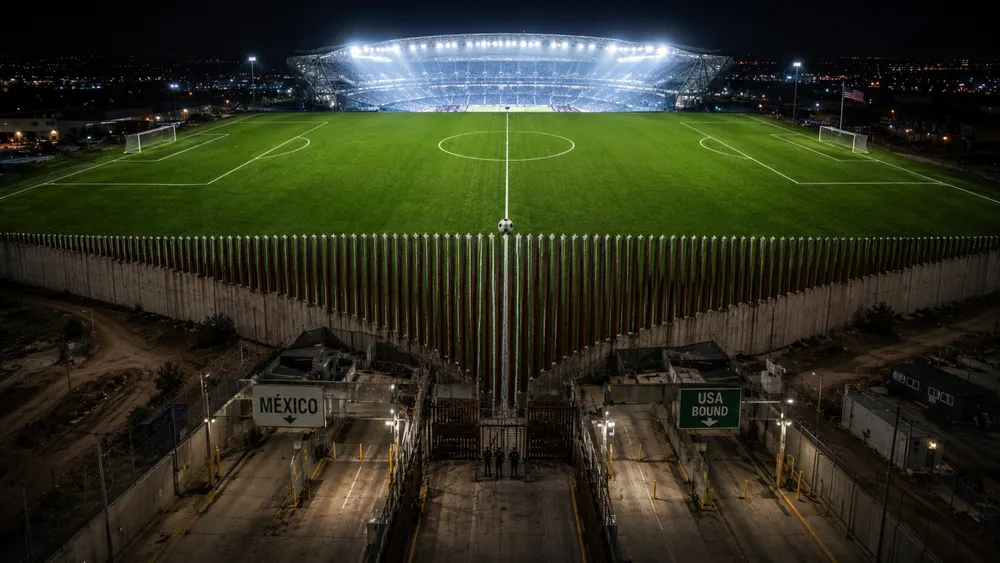
On Sunday (June 5, 2026) morning, a chartered aircraft landed at Tijuana’s Abelardo L. Rodriguez International Airport at 5am local time. On board were 26 players from Iran’s national football team, some support staff who had cleared American visa processing, and a number of managerial personnel who had not. The players had received their visas the previous Friday, ten days before their first match, after a process that had stretched across three months, two base camp relocations and what can only be described as institutional improvisation at the highest levels of international sport. Iran had originally been assigned a training base in Tucson, Arizona. When the security and visa situation proved unworkable, it moved to Antalya, Turkey, where it spent weeks preparing. Then Tijuana, a bus ride from the stadium where it will play on June 15. Iran takes on New Zealand that day in Inglewood, California. It plays Belgium on June 21 and finishes group play against Egypt in Seattle on June 26.
The United States and Iran have been at war since February 28, 2026. Ayatollah Ali Khamenei, Iran’s supreme leader, was killed in the joint US-Israeli strikes that opened the conflict. Iran’s sports minister Ahmad Donyamali said in March that it was ‘not possible’ for the national team to compete in a tournament hosted by the country that killed his country’s supreme leader. Iran’s football federation said ‘no one can exclude’ the team. The two positions coexisted for several weeks before institutional gravity pulled things toward participation.
The visa situation is where the politics of all this became most visible. Iran’s federation president, Mehdi Taj, was denied entry for the tournament draw in Washington in December because he is a former commander of the Islamic Revolutionary Guard Corps, which the United States designates as a terrorist organisation. Secretary of State Marco Rubio told lawmakers that the US would not allow anyone with ties to Iran’s military into the country for the tournament. Key administrative and managerial staff were refused entry even after the players were cleared in early June. Taj flew somewhere else. The players got on the Tijuana bus. The line the United States drew is not between Iran and not-Iran. It is between Iran-as-sport and Iran-as-state, and reading where that line falls tells you something that the diplomatic statements around this war do not.
Trump’s own handling of the question moved through several registers over the preceding months. In March he posted on Truth Social that ‘The Iran National Soccer Team is welcome to The World Cup, but I really don’t believe it is appropriate that they be there, for their own life and safety.’ Later he told Politico ‘I really don’t care.’ When FIFA president Infantino went to the White House for a meeting, Trump apparently reiterated that Iran was welcome. None of this resolved the question of what he actually wanted, but it did establish that he was not going to take action to exclude the team. Iran’s players responded to his Truth Social post with a statement on their own Instagram that the country which ‘merely carries the title of host yet lacks the ability to provide security’ was the one that should face exclusion.
There was a brief moment when it looked as though the question might be resolved by replacement. Paolo Zampolli, an Italian-American who serves as a US envoy for global relations, told the Financial Times that he had suggested to both Trump and FIFA president Infantino that Italy, who failed to qualify for the tournament for a third straight edition, should replace Iran. Italy’s sports minister Andrea Abodi rejected the idea, saying ‘you qualify on the pitch.’ The Italian economy minister called it ‘shameful.’ FIFA had already made its position clear: Infantino stood at the FIFA World Congress in Vancouver in May and said, with some force, ‘of course Iran will be participating at the FIFA World Cup 2026.’ The Italy episode is worth mentioning because it shows how far the disruption of the tournament was actually considered, and how completely it was foreclosed.
The reason it was foreclosed has more to do with commercial logic than with principle. Pulling Iran from the draw would have meant voiding group stage match contracts, managing broadcaster and sponsor claims, and handling the institutional embarrassment of a World Cup host excluding a qualified team from competition. Infantino attended Iran’s friendly against Costa Rica in Antalya in March and posted his support. He was protecting the product. The United States, having spent considerable effort winning co-hosting rights, was not in a position to blow up the tournament over a geopolitical situation that had not existed when those rights were awarded. American hegemony extends very far. It apparently does not extend to unilaterally pulling qualified nations from the World Cup when the commercial and institutional costs of doing so are high enough. Even hegemony has pricing.
June 1998 offers an imperfect comparison that keeps being made anyway. The United States and Iran played each other at the World Cup in Lyon, France, during a period of cautious diplomatic warming under President Khatami. Iranian players gave their American counterparts white flowers before the opening whistle. Iran won 2-1. The match was described at the time as the most politically meaningful sports fixture of the decade, and there was something genuine in the ceremony even if it was also choreographed. The 2026 encounter in Los Angeles carries none of that texture. There will be no flowers, no warming, no pre-match gesture toward reconciliation. The teams will play football. It is oddly possible that the 1998 match, staged during a ceasefire of sorts between the two countries’ foreign policies, carried more diplomatic weight than a 2026 match played while their militaries are actively engaged. War, it turns out, does not automatically make a football fixture more significant. It can also make it smaller, a routine sporting event that happens to involve two countries currently shooting at each other, squeezed in between other fixtures on the calendar.
The Iranian diaspora in Southern California sits inside all of this in ways that are genuinely complicated to describe. The community known informally as Tehrangeles numbers several hundred thousand people, many of whom left Iran after the 1979 revolution and built lives in Los Angeles. They left a country whose supreme leader has now been killed by the government of the country they live in, and whose national football team is taking a bus from Tijuana to play in their adopted city. They are not a uniform political bloc. Some have spent decades opposing the Islamic Republic and may find the sight of the national team’s badge uncomfortable regardless of the quality of the football. Some have family in Iran whose daily lives are affected by the war in ways that cannot be addressed by whether a game ends 1-0 or 2-1. Some are simply football supporters who will watch the match the way football supporters watch matches, which is to say with an investment in the result that briefly displaces everything else. The flags people carry on June 15 will say something, but what they say will depend on individual histories that no analysis of geopolitical structure can settle in advance.
If both Iran and the United States advance as second-placed finishers in their respective groups, they meet in Arlington, Texas on July 3. Nobody has moved the fixture. Neither government has formally requested that FIFA change the scheduling. The match would be played in an American stadium, in the middle of an active war, before a crowd whose political composition and emotional temperature it is genuinely difficult to predict. It would also be broadcast to hundreds of millions of people including in Iran, where football provides one of the few genuinely collective experiences that the state permits and does not fully control. A win for Iran in Arlington would register in Tehran in a way that is hard to measure but probably real. A loss would register differently. Whether either team gets there depends on group stage results that have not yet happened, and it is entirely possible that the fixture nobody moved will simply never occur because one side fails to qualify. But the fact that it exists in the bracket, unaddressed, is itself something.
The US Ambassador to Turkey marked the visa approvals with a statement that sports transcend borders. The formula is diplomatic shorthand for a more specific truth: sports cross certain borders, determined by commercial agreements and the calculus of what any given government is prepared to lose, and decline to cross others. The borders here are not transcended. Mehdi Taj is not in the country. The IRGC commanders who coordinate operations in Lebanon are not attending the draw. The players took a bus through San Ysidro because that crossing was available to them and not to their colleagues. Reading the geography of those decisions is more useful than the ambassador’s phrase. The line between who gets in and who does not is the clearest available map of where this war actually runs, which is not the same as where the bombs are falling.
This Analysis piece is free to read. Future Analysis pieces will be available to registered DiploPolis members first. Free registration takes 30 seconds. No credit card required.