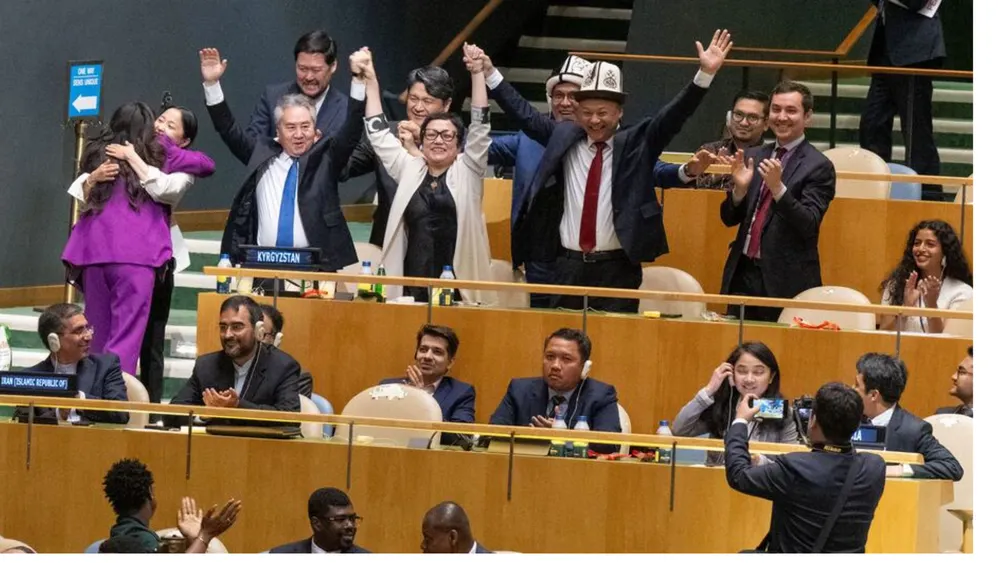
On June 3, Kyrgyzstan won a seat on the United Nations Security Council for the first time in its 34-year history as an independent state. Two weeks earlier, Russia's Deputy Foreign Minister Mikhail Galuzin filed a complaint about losing Central Asia's rare earths to Washington. Both things happened in the same fortnight. One is a celebration. The other is a tell.
Kyrgyzstan defeated the Philippines across four rounds of voting to take the Asia-Pacific seat for 2027 to 2028. President Sadyr Japarov had framed the campaign as a bid to give voice to countries that have never held a seat — landlocked, mountainous, specific in their security and climate challenges. The campaign worked. It is the first time Central Asia has had representation on the Council since Kazakhstan served in 2017 and 2018.
On May 20, Galuzin told Izvestia: 'We are concerned by the intensity with which Washington is pushing agreements on critical minerals and rare earth metals.' Then the line that gives the game away: 'This is not merely about economic competition, but about an attempt to push Russia out and create a Western-controlled infrastructure in the immediate vicinity of our borders.'
That is not a warning. It is an admission.
Russia considers Central Asia — Kazakhstan, Kyrgyzstan, Tajikistan, Turkmenistan and Uzbekistan — its sphere of interest. The five nations sit on deposits of rare earth metals, critical minerals and energy reserves that G7 nations want as a counterweight to China's dominance in global supply chains. Trump hosted all five Central Asian presidents at the White House in November, calling critical minerals a key priority. The EU has been pursuing its own agreements. Russia, watching both, filed a complaint — because complaining is what you do when you have run out of capacity to act.
The arithmetic of Central Asian allegiances has shifted visibly. Kazakhstan, Russia's closest partner in the region, pointedly refused to send troops to Ukraine and has been expanding trade routes that bypass Russian territory. Kyrgyzstan froze its participation in the Collective Security Treaty Organisation, Moscow's regional military alliance. The organisation Russia built to keep Central Asia in its orbit has become the clearest measure of how far the orbit has drifted. Meanwhile China has deepened its presence across all five nations — rail lines, cement plants, technology parks, financial institutions — while the US and EU now compete with Beijing for the very minerals that will power the clean energy transition. Central Asia is not watching this competition from outside. It is running it.
A sphere of interest requires the capacity to enforce it. Russia's army is in Ukraine. Its economy is under sanctions. Its energy leverage over Central Asia is diminishing as the region diversifies. The Central Asian states are watching all three great powers, calculating and playing each against the others as they have done for 30 years.
The five countries of Central Asia have a phrase for this. Multi-vector foreign policy. It means maintaining relationships with Russia, China, the US and the EU simultaneously, extracting what each has to offer while committing fully to none. It is a strategy born of geography and necessity. Landlocked, resource-rich and surrounded by powers that have historically treated them as objects rather than subjects, they have learned to make competition work for them.
Kyrgyzstan's Security Council seat is the most visible expression of that strategy this week. The seat does not give Bishkek a veto. It gives it a platform, a voice and two years of legitimacy at the table where the great powers who want its rare earths also argue about the rules of international order. Among the issues Kyrgyzstan will now help deliberate: Afghanistan, counterterrorism, water security and the transnational dynamics that define Central Asian life. The Council's most powerful members have spent decades treating these as peripheral concerns. Kyrgyzstan will have something to say about that.
Russia calls the region its backyard. The backyard just won a Security Council seat.