In the winter of 1884, representatives from fourteen European powers gathered in Berlin to divide a continent. No African was present. No African was consulted. The men in that room drew lines across a map they had never walked, splitting ethnic groups that had lived together for centuries, forcing traditional enemies into single states, severing ancient kingdoms from their own land. They called it the Scramble for Africa. History should call it what it was: the opening entry on a bill that the Global South is still paying and the West has never presented to itself.
The displacement crisis that Western governments call a refugee problem did not begin in Baghdad in 2003, or Kabul in 2001, or Tripoli in 2011. It did not begin with the Arab Spring or the War on Terror or the collapse of the Soviet Union. It began in the centuries of colonial extraction, arbitrary borders and deliberate state destruction that built Western wealth on Global South ruin. It ran through the Nakba of 1948 and the seventy-eight years of Palestinian dispossession that followed. It accumulated through Cold War proxy wars fought on other people's soil, through sanctions that killed children before the bombs arrived, through interventions that removed dictators and installed chaos. And it is compounded today by a climate crisis that the West created and the Global South is paying for in floods, droughts, failed harvests and forced movement.
The bill has never been properly presented. This is it.
Cartographers of Catastrophe
The Berlin Conference of 1884 to 1885 cut through 190 cultural groups. Ancient kingdoms were split apart. Traditional enemies were locked inside the same borders. Communities that shared language, custom and kinship were separated by lines that meant nothing to them and everything to their colonial administrators. A Nigerian newspaper at the time called it a robbery on so large a scale that it beggared description. That was 1885. The robbery has not stopped.
The arbitrary borders drawn across Africa, the Middle East and Asia by European powers in the nineteenth and twentieth centuries are not a historical curiosity. They are the foundation of nearly every contemporary conflict that produces the refugees the West now refuses. The tensions between Hutus and Tutsis that produced the Rwandan genocide were shaped by Belgian colonial classification systems that hardened fluid social categories into fixed racial identities. The conflict between Kurds and the states that contain them — Türkiye, Iraq, Iran, Syria — exists because the Sykes-Picot Agreement of 1916 divided the Middle East between Britain and France with no regard for the Kurdish people's existence as a distinct nation. The instability of the Democratic Republic of Congo, one of the world's largest producers of refugees, traces directly to Belgian colonialism — the state King Leopold II built on mass murder and forced labour.
This is not ancient history deployed as excuse. This is causation. States built on colonial violence, with borders drawn for colonial convenience, with economies designed for extraction rather than development, with institutions imposed rather than grown — these states are structurally more prone to the conflicts that produce displacement. The West built those structures. The West is surprised by the consequences.
Balfour Catastrophe and Its Unending Sequel
On November 2, 1917, British Foreign Secretary Arthur Balfour wrote a letter expressing His Majesty's Government's support for a Jewish homeland in Palestine. The letter was sixty-seven words long. Its consequences have lasted more than a century and show no sign of ending.
In 1917, Jewish people represented approximately six per cent of Palestine's population. The declaration offered that minority a national home while offering the Arab majority — described only as non-Jewish communities — civil and religious rights. Not political rights. Not national rights. Not the right to the land they had lived on for generations. A colonial power, governing a territory it had seized from the Ottoman Empire, promised that territory to a people who largely did not live there, while denying the political rights of the people who did.
Between 1947 and 1949, more than 750,000 Palestinians were expelled or fled their homes as the state of Israel was established. More than 400 Palestinian towns and villages were destroyed to prevent their return. The refugees and their descendants now number approximately 8.36 million, scattered across Gaza, the West Bank, Lebanon, Jordan, Syria and beyond, denied their internationally recognised legal right of return for seventy-eight years. The Palestinian displacement is not merely the world's longest-running refugee crisis. It is the world's most nakedly Western-manufactured refugee crisis — created by a British promise, sustained by American protection, compounded by decade after decade of Israeli settlement expansion that the West funds, arms and diplomatically shields.
The Nakba did not end in 1948. It is ongoing. More than 100,000 Palestinian homes have been demolished since 1948, excluding the ongoing wars in Gaza. The current war in Gaza has displaced the overwhelming majority of its 2.3 million people, many of them multiple times. The West that expresses humanitarian concern about this displacement is the same West that provided the weapons, the diplomatic cover and the Security Council vetoes that made it possible.
Proxy Wars and Their Refugees
The Cold War was not cold for the Global South. It was a series of wars fought on other people's territory, with other people's lives, in service of a superpower competition that had nothing to do with the interests of the people caught in the middle.
The United States overthrew Mohammed Mossadegh in Iran in 1953, restoring the Shah and setting in motion the chain of events that produced the 1979 revolution, the Iran-Iraq War, and the regional instability that has generated displacement across the Middle East ever since. It overthrew Jacobo Arbenz in Guatemala in 1954, beginning a cycle of military rule and civil war that produced hundreds of thousands of refugees whose descendants are still making the journey to the American border that the United States is now militarising against them. It backed the Khmer Rouge against the Vietnamese-aligned government in Cambodia in the 1970s. It funded the mujahideen in Afghanistan against the Soviet Union in the 1980s, arming and training the fighters who became the Taliban. Afghanistan has now produced one of the largest refugee crises in history — a third generation of Afghan children born in exile. By 2023, 6.4 million Afghan refugees were living in other countries and 3.2 million remained internally displaced within their country. Iran and Pakistan — both Global South nations — host the overwhelming majority. The West that launched the war resettled a fraction.
The United Kingdom's record is no cleaner. The partition of India in 1947 — conducted in haste by a departing empire with no regard for the consequences — produced approximately fourteen million displaced people in the space of a few months, the largest forced migration in human history. The violence that accompanied it killed hundreds of thousands. Britain had ruled India for two centuries. It left in seventy-three days after the partition plan was announced, with borders drawn by a lawyer who had never visited India, leaving communities to manage a catastrophe that took two years to execute and generations to absorb.
France's exit from Algeria left a legacy of violence and displacement that shaped North African politics for decades. Belgium's exit from the Congo left a state with no functioning institutions, no trained administrators, no infrastructure for self-governance — and a resource wealth that immediately became the prize for a series of proxy conflicts that have displaced millions. These were not natural disasters. They were the predictable consequences of deliberate colonial choices, made in European capitals, that the people of the Global South were left to survive.
War on Terror's Permanent Refugees
The 2003 invasion of Iraq produced no weapons of mass destruction. It produced four million displaced Iraqis — internally displaced within the country and externally as refugees in Jordan, Syria and beyond. The United States invaded on the basis of intelligence its own officials knew to be false, destroyed the Iraqi state, disbanded its army, unleashed a sectarian conflict that it did not understand and could not control, and then spent a decade managing the consequences while the displaced waited in camps and apartments in neighbouring countries for a stability that did not come. When the Islamic State emerged from the power vacuum the invasion had created, it produced a second wave of displacement that dwarfed the first.
Afghanistan was invaded in 2001 with the stated goal of destroying Al-Qaeda and removing the Taliban. Twenty years later, the United States withdrew, the Taliban returned to power within days, and the country reverted almost entirely to the conditions that had existed before the invasion. What had changed was the scale of destruction, the depth of dependency on foreign aid that instantly evaporated, and the number of people who had built their lives around an international presence that departed as rapidly as it had arrived.
Libya was not invaded in the same way. It was bombed into chaos under NATO's 2011 intervention, justified as a humanitarian mission to protect civilians, executed in a manner that removed the government and left nothing coherent in its place. The state collapsed. The country fractured into competing militias. Libya became, almost immediately, one of the primary transit routes for refugees from sub-Saharan Africa and the Middle East seeking to reach Europe — a route marked by drowning, enslavement and indefinite detention. The West that created the chaos then built border fences to keep out the people the chaos had produced.
Syria: more than 13 million displaced. The conflict that began in 2011 was shaped by Western-backed rebel groups, by weapons flows that the West supported and then lost control of, by a climate-driven drought that preceded the uprising and was itself a consequence of the emissions that Western industrialisation produced. The Syrian refugee crisis produced the European migration crisis of 2015, which produced the political backlash against refugees that empowered right-wing governments across the continent. The chain of causation runs directly from Western emissions to Syrian drought to Syrian war to Syrian displacement to European politics — and the West, at each step, treated the crisis as something that was happening to it rather than something it had helped to create.
Climate Surcharge
Every calculation about displacement must now include the climate. In 2022 alone, weather disasters triggered 32.6 million internal displacements globally, of which 98 per cent were caused by floods, storms, wildfires and droughts. Weather-related disasters forced a quarter billion people to flee their homes in the last decade, according to UNHCR.
Over 70 per cent of refugees and asylum-seekers come from countries that are among the most vulnerable to climate change. The Sahel is desertifying. Bangladesh floods with greater frequency and severity. Pacific island states are disappearing beneath rising seas. The Horn of Africa faces droughts of increasing length and intensity. These are not random disasters. They are the measurable consequences of greenhouse gas emissions that the industrialised West has been producing since the nineteenth century — the same period in which it was colonising the countries now facing the worst consequences.
The West promised in the 2015 Paris Agreement to limit warming and to provide climate finance to the most vulnerable nations. It has consistently failed to deliver the finance. It has consistently failed to meet its own emissions targets. Under President Trump, the United States — historically the world's top donor to UNHCR — slashed foreign aid and cut funding to the agencies managing the displacement crisis. The country most responsible for cumulative global emissions is now most aggressively withdrawing from the mechanisms designed to manage the consequences.
Presenting the Bill
The West did not create poverty. It organised it. It created the conditions — colonial extraction, imposed borders, destroyed institutions, proxy wars, climate destruction — in which poverty and displacement are the predictable outcomes. And then it built a system for managing the human consequences that is now collapsing under the weight of the crises it was never designed to resolve.
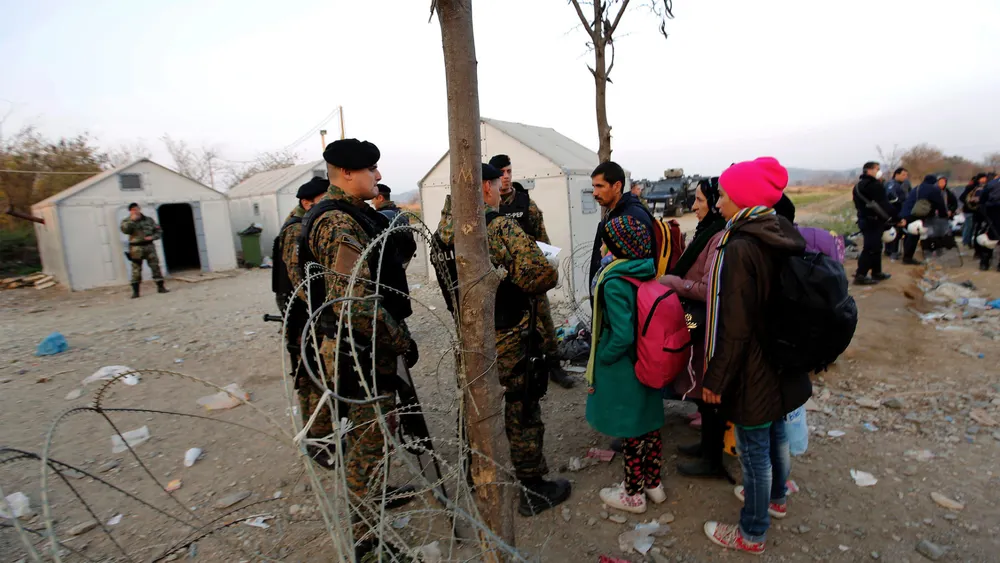
More than 117 million people around the world are forcibly displaced from their homes. The countries hosting the majority of them are not in the West. Türkiye, Pakistan, Iran, Uganda, Sudan, Colombia — these are the nations carrying the weight of a displacement crisis whose causes sit primarily in decisions made in Washington, London, Paris and Brussels. Jordan has been hosting Palestinian refugees since 1948. Pakistan has been hosting Afghan refugees for four decades. Lebanon hosts more refugees per capita than any country in the world, in a state already on the edge of collapse. The Global South did not create this crisis. It is managing it while the West lectures about border security and controlled migration.
That is the audacity at the centre of this story. The West that drew the borders, started the wars, backed the dictators, armed the militias, funded the groups that became the terrorists, abandoned the states it had promised to rebuild, produced the emissions that are drowning coastlines and desiccating farmlands — that West now presents itself as the victim of a migration crisis and demands that the Global South do more to stop people from coming.
The bill has been presented many times, in many forms, by many voices from the countries that are paying it. It has never been accepted. It has barely been acknowledged. What comes instead are border policies, detention centres, deals with authoritarian governments to stop the movement, and the occasional humanitarian gesture — a resettlement programme here, an aid package there — that addresses the symptom while carefully avoiding any reckoning with the cause.
The refugee the West made is not an abstraction. She is a woman from Gaza displaced seven times in eighteen months. He is an Afghan man whose family spent four decades in Pakistani camps waiting to return to a country that no longer exists in the form they left it. She is a Malian farmer whose land the Sahara has swallowed. He is a Syrian child who grew up in a Lebanese camp, stateless, waiting for a resolution that his parents were also waiting for.
These are the people on the bill. The West knows their names. It has photographed them extensively. It has written about them with considerable feeling. What it has not done is pay.
This Analysis piece is free to read. Future Analysis pieces will be available to registered DiploPolis members first. Free registration takes 30 seconds. No credit card required.