António Guterres visited Port-au-Prince on June 16. His convoy sped past a capital that no longer belongs to its government — gutted car dealerships, abandoned homes, concrete walls pockmarked with bullet holes. Graffiti on a crumbling wall read: 'Down with Viv Ansanm, long live the police.' Viv Ansanm is the gang federation that controls an estimated 70 to 90 per cent of Port-au-Prince. The state controls what is left. 'What I saw will not leave me,' Guterres said at the end of his visit. 'Each day is a fight to survive.'
He said something else. 'The biggest disgrace is indifference, the indifference of a world that has looked away.'
The world was in Switzerland last week. Vance was meeting Iranian officials. Trump was posting on Truth Social. Oil markets were tracking the MOU. The cameras were pointed at the Bürgenstock Resort. New UN statistics show Haiti has recorded 2,300 dead since January, 100 kidnapped and 1.5 million displaced. Among those kidnapped is James Boyard, cabinet director of the Defence Ministry, taken from one of the few areas of the capital still considered relatively safe. A country of nearly 12 million people has not had a president since Jovenel Moïse was shot dead in his bedroom in July 2021. It has had no elections since 2016 and no functioning parliament since 2019.
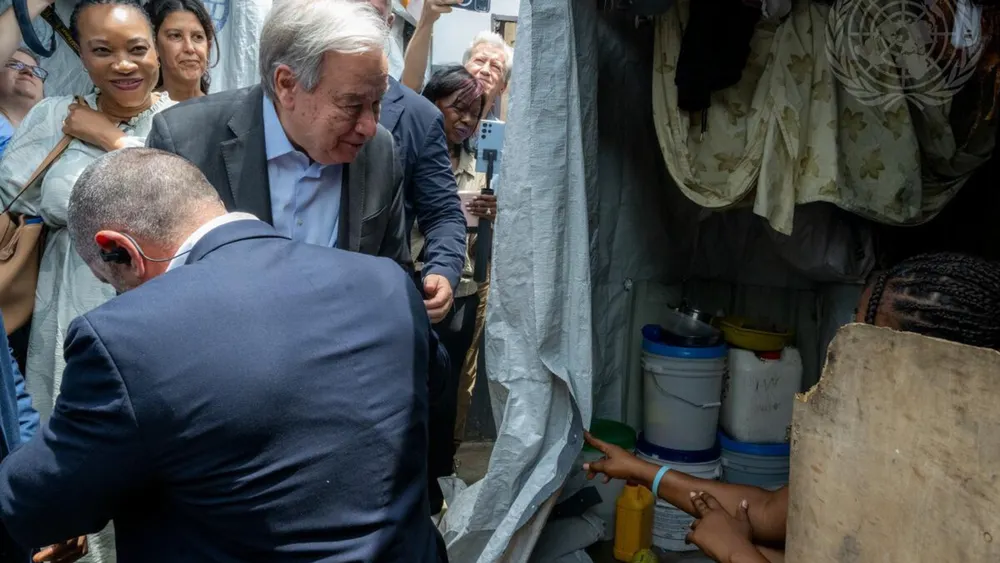
Guterres visited a makeshift shelter in a former school. He sat in a hot classroom with six women who told him they had no privacy even to shower. He listened to a man beat the metal siding of the building and shout: 'We want to go back home.' Clifford Lala is 31. He fled his community, Solino, when gangs overran it. He told Guterres his neighbourhood was not ready for him to return. 'These families did not ask for my sympathy,' Guterres said. 'They are waiting for action.'
The action on offer is the Gang Suppression Force — a UN Security Council-backed operation deploying Kenyan-led troops to take the fight directly to Viv Ansanm and the 25 other armed groups that between them have fractured the Haitian state. Fewer than 1,000 troops have deployed so far, from Jamaica, Chad, El Salvador and Guatemala. The force is underfunded, understaffed and not yet operational. Human Rights Watch, in a letter published the day before Guterres arrived, called for a full-fledged UN mission and said that even a fully staffed, fully resourced security operation would not be enough on its own. The gang-suppression force is a military response to a political collapse. Those are not the same problem.
Haiti's collapse is not a mystery. It is the accumulated result of every decision the international community made for it over three decades and then abandoned. The 2010 earthquake killed more than 200,000 people. Billions in international aid followed. Most of it did not reach the people it was promised to. Reconstruction was mismanaged. Debt accumulated. When the UN's own stabilisation mission departed in 2017 after 13 years, it left behind a cholera outbreak it had introduced, a political system no stronger than the one it found, and a gang ecosystem that had expanded to fill every space the state vacated. The gangs that control Port-au-Prince today were armed and empowered by the political elite that the international community recognised and worked with throughout those thirteen years.
Guterres called indifference the biggest disgrace. He is right. He is also the head of the institution that spent thirteen years in Haiti and left it in this condition. That is not a reason to look away again. It is a reason to look more honestly at what looking away actually costs.
Then Guterres left. The cameras followed him to the airport. The world went back to watching the Iran deal. Haiti is still there — twelve million people, no president, no parliament, no elections since 2016 and gangs controlling most of the capital. Clifford Lala is still at the shelter. Solino is not ready for him to go home.
SEO Title: What Guterres Saw: Haiti's 2,300 Dead and the Indifference of a World Watching Switzerland | DiploPolis
Meta Description: Guterres visited Port-au-Prince as gangs control 90% of the capital, 2,300 people have been killed this year and 1.5 million are displaced. He called indifference the biggest disgrace. Then he left.
Focus Keyword: Haiti gang violence Guterres UN 2026
Secondary Keywords: Haiti Viv Ansanm gang control Port-au-Prince · Guterres Haiti visit June 2026 · Haiti Gang Suppression Force · James Boyard kidnapped Haiti · Haiti no president elections 2026 · Haiti humanitarian crisis Global South
URL Slug: what-guterres-saw-haiti-gang-violence-2026
Tags: The Ledger, Haiti, United Nations, Global South, Gang Violence, Humanitarian Crisis, Accountability, António Guterres, Viv Ansanm, Americas
Schema: NewsArticle
Internal Links: Link to The Gaza Template or What Iran Won at first reference to Switzerland and the Iran deal — the contrast between what the world was watching and what it was ignoring is the spine of this piece, and both of those pieces documented what the world was watching. One internal link, placed precisely, earns its keep here without feeling mechanical.
300-Character Excerpt: Guterres visited Port-au-Prince as gangs control 90% of the capital and 2,300 Haitians have been killed this year. He called indifference the biggest disgrace. Then he left. The cameras followed him to the airport. Haiti is still there.
Social — Twitter/X Option One: 'The biggest disgrace is indifference, the indifference of a world that has looked away.' Guterres said this in Port-au-Prince. Then he left. New Ledger — diplopolis.com
Social — Twitter/X Option Two: 2,300 dead. 100 kidnapped. 1.5 million displaced. The world was in Switzerland watching the Iran deal. Haiti's cabinet minister was taken in broad daylight. Guterres visited, said what he saw would not leave him, and boarded his plane. New on DiploPolis — diplopolis.com
Social — LinkedIn: The world was watching Switzerland last week. Vance was meeting Iranian officials. Oil markets were tracking the MOU.
Haiti had 2,300 dead since January, 100 kidnapped, 1.5 million displaced and a cabinet minister abducted in broad daylight from one of the few safe areas left in Port-au-Prince.
Guterres visited on June 16. He called indifference the biggest disgrace. He is also the head of the institution that spent thirteen years in Haiti and left it in this condition.
New Ledger on DiploPolis: What Guterres Saw. Link in comments.