'It feels like God has opened the gates of hell,' said an employee at a pastry shop in Tunis. The refrigerators had stopped running. The cakes sat in the dark. He was describing what it had felt like to live and work in Tunisia since July 12, when the blackouts began in the middle of an exceptional heatwave that would push temperatures above 50 degrees Celsius and send 900 wildfires burning across the country in three days.
Between 150 and 200 people are reported dead since the power cuts began. The figures come from the Organisation of Young Doctors in Tunisia. The authorities have not confirmed or denied them. At least five deaths directly linked to the outages were reported by local media in the first days — among them a cancer patient whose home oxygen equipment stopped working when the power went out. Tunisia's state electricity company, STEG, has been implementing rolling blackouts to prevent total grid collapse. Residents described their power going off for six hours at a stretch. Others said longer. Some said they had stopped using the lift for fear of being trapped inside it.
The deaths are the product of three simultaneous failures. The first is structural: Tunisia's electricity grid is ageing, built for a climate that no longer exists, running at record demand during peak tourism and summer simultaneously. The second is climatic: the heatwave is not an anomaly but a trend — what climate scientists have been predicting for the North African littoral for decades, arriving now with regularity and force. The third is political: Tunisia's energy supply has been squeezed by the same disruption that killed six million people's food security across Somalia, Afghanistan and Sri Lanka — the closure of the Strait of Hormuz and the disruption of Gulf energy supply chains. Tunisia imports a substantial portion of its energy. The Iran war's energy bill is being paid in Tunis as it is being paid in Colombo and Mogadishu. In Tunisia it is being paid in the dark.
President Kais Saied appeared publicly after several days of silence to describe the pace of outages as 'not normal' and said those responsible must 'assume their responsibility.' He announced no specific measures. His presidency said it was 'monitoring the situation closely' and that a cabinet meeting had been held. He reportedly stressed the outages must 'end immediately.' The deaths are not normal. The president said so. Nothing changed.
The blackouts reached their peak in the same week Tunisia marked the fifth anniversary of the day Saied suspended parliament and assumed emergency powers. On July 25, 2021, Saied declared a national emergency and began to rule by decree. Tunisia had been the Arab Spring's only democratic success — the country that went from revolution to elected government, that wrote a constitution with broad civic participation, that showed that the Arab world's demand for dignity and self-governance could produce something durable. That experiment lasted ten years. In 2021, Saied ended it. The political debates that had filled Tunisia's airwaves after 2011 have given way to sports and entertainment shows. The octogenarian leader of the Ennahda movement, Rached Ghannouchi, has been detained. Journalists have been sentenced. Opposition figures have been imprisoned. Haifa Chebbi, the daughter of jailed opposition leader Ahmed Nejib Chebbi, posted a video saying prison conditions had become unbearable for her father, uncle and other detainees — in the same heat that was killing people in the street. Courts have handed down rulings that international human rights organisations describe as politically motivated.
The West's response to the coup was, initially, criticism. Then it was a gradual thaw from 2023, driven by the calculation that Tunisia's cooperation on migration — the human pipeline across the Mediterranean that European governments need to contain — was worth more than the democratic principle that Saied had violated. The same Morocco logic that DiploPolis described in the Ceuta piece: the state that controls migration has a veto over accountability. Tunisia learned this. Saied learned it faster.
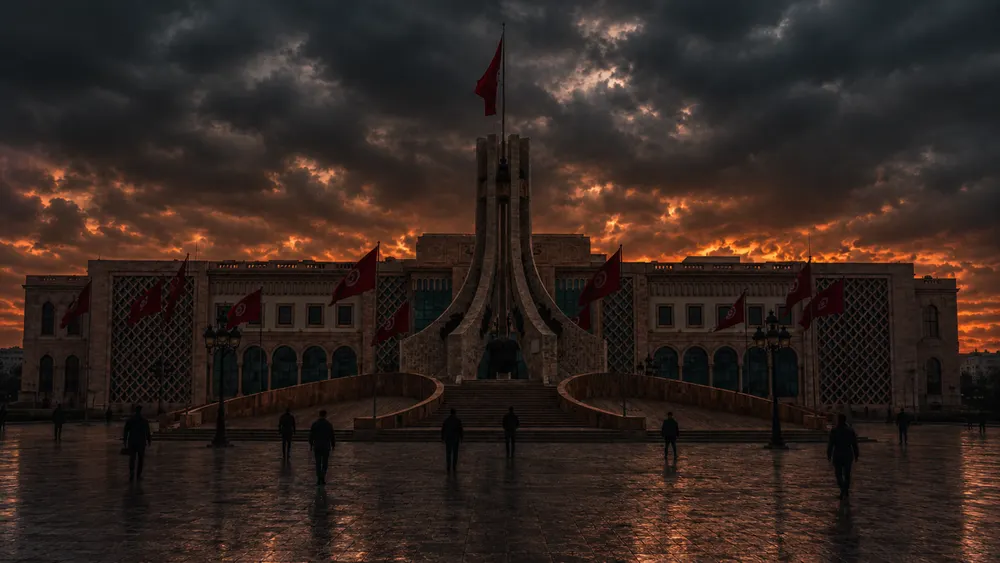
Thousands of Tunisians demonstrated in the capital on July 25 to mark five years since the power grab, directing their anger at Saied's inaction as the blackouts continued. Hamza Bouchrit, a poultry farm veterinarian, told Africanews that nearly 90 per cent of the chickens on his farm — between 150,000 and 200,000 — died when the generator overheated and stopped working during a prolonged cut. The power is reportedly returning to normal as temperatures fall. The coup is five years old. The West has normalised it. The people have not.
150 to 200 people are dead. The Organisation of Young Doctors counted them. The state has not confirmed or denied. The gates of hell, the pastry shop employee said, had been opened. He was describing a heatwave. He was also describing something that took five years to build.