

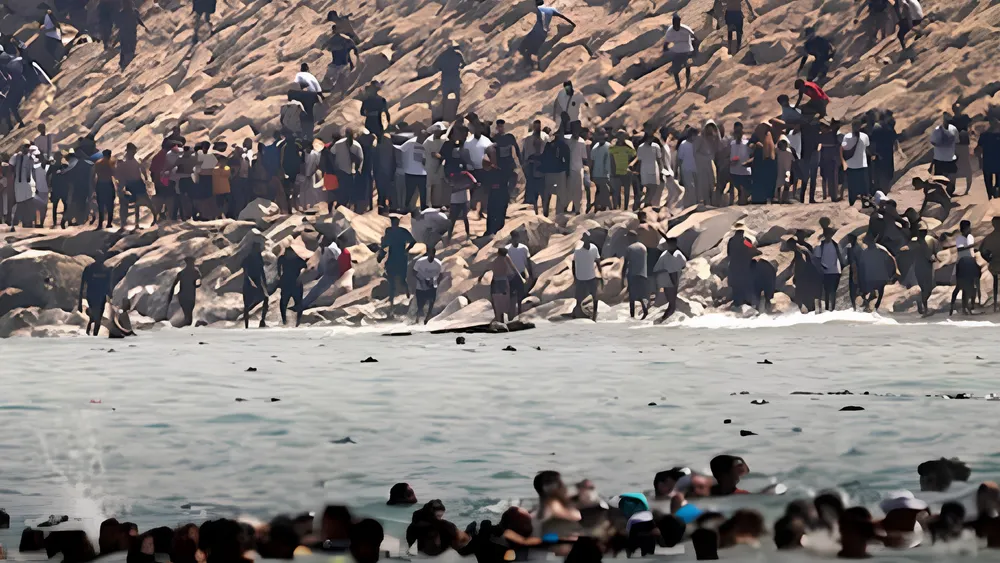
By Friday morning, an estimated 60,000 people had crossed from Morocco into Ceuta — the Spanish city of 84,000 on the North African coast. At least 72 died in the crossing. Spain's Interior Minister said 'almost all' had been returned to Morocco by Saturday and the situation had practically returned to normal. Ignacio Cembrero, a Spanish journalist who has covered migration in North Africa for decades, offered a more precise description of how the crossing happened. Morocco's security forces, which routinely deploy along the border in depth and stop crossings as a matter of standard procedure, had been 'sitting on their hands' since Wednesday. Ceuta's borders are among the most surveilled in the world. 60,000 people crossed them in three days. The fences did not fail. The people who operate the other side of them did not deploy.
This is not a border crisis. It is a diplomatic instrument that happens to require human beings to function.
Morocco has used it before. In May 2021, approximately 8,000 people crossed into Ceuta in a matter of days following a diplomatic dispute between Rabat and Madrid over Spain's hospitalisation of the leader of the Polisario Front. Morocco's security forces sat on their hands that time too. Spain's Defence Minister accused Morocco of 'blackmail.' The crossing ended when Spain adjusted its position. Ceuta is one of Morocco's most consistent pieces of leverage — not because Morocco lacks the ability to prevent crossings, but because it retains the ability to allow them. The ability to open a border is as much a tool of state power as the ability to close one.
The question is what the leverage was for this time. In the weeks before the crossing, Spain's Supreme Court had ruled that migrants intercepted at sea while attempting to reach Ceuta and Melilla could no longer be automatically returned to Morocco — a legal constraint that gave Morocco additional room to calculate the consequences of loosening border controls. Spain's recent foreign policy record provides the wider context, even if the causal link is unconfirmed. Spain refused to let a US-flagged cargo ship carrying weapons for Israel dock at Algeciras in 2024. It called the US-Israel war on Iran illegal under international law. Its prime minister said it was a sovereign country that does not take part in illegal wars. In June, Pete Hegseth placed the Rota naval base under a six-month review and called Spanish allies 'shameful' for declining to support the war. Iran placed the Spanish prime minister in an orange prison uniform on its Hamshahri kill list. Al Jazeera, covering the crossing, reported directly that some observers said Morocco may have orchestrated the incident under encouragement from Washington and Israel, both of which had openly criticised Spain. This has not been confirmed. What has been confirmed is that Morocco's security forces did not deploy, that Morocco has a documented history of using the Ceuta border as a pressure instrument, and that Spain is the European government most visibly at odds with Washington and Jerusalem on the war.
Trump did not wait to see what the evidence said. On Friday, he called the Ceuta crossing 'an invasion of a country' and told his cabinet at Camp David that the same thing would happen to the United States 'if the Republicans don't get elected, except worse, much bigger.' The US State Department raised its travel advisory for Ceuta to Level 3. Whatever caused the crossing, its domestic political uses in Washington were immediate, specific and entirely predictable.
The EU's response has been to call an emergency meeting about migration. 22 of 27 member states issued a joint letter calling for 'coordinated action and the strengthening of external borders.' Italy called for Spain's suspension from the Schengen zone. France quintupled police at its Spanish border. The emergency meeting is not about Morocco's decision to sit on its hands. It is not about whether a state actor may have deliberately opened a border to exert diplomatic pressure. It is about migration — which is to say, it accepts the premise that Spain's failure to control its border is the problem, rather than Morocco's deliberate failure to control the other side of it.
Karel Lannoo, CEO of the Centre for European Policy Studies, told Al Jazeera: 'There has been a concerted action by countries which are basically enemies to Europe to try to undermine European unity in one of the areas where Europe's unity is one of the weakest, migration, and where it's the easiest to exploit European disunity.' The 22 states who signed the emergency letter are meeting to discuss stronger fences. The stronger fence, in this case, is not on Spain's side of the border. Morocco already has the fence. It chose not to use it for three days.
Spain said no to the war. It said no to the weapons ship. It said no to the illegal strikes. 72 people died crossing the water into Ceuta. The EU is meeting Tuesday about Europe's borders. Morocco is, as of Saturday, a reliable partner again — Spanish Interior Minister Fernando Grande-Marlaska said so himself. The hands have been picked up from where they were sitting. The instrument has been returned to its case.


