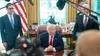
On Friday morning, Donald Trump announced on Truth Social that he was entering the White House Situation Room to make a 'final determination' on a memorandum of understanding to extend the ceasefire with Iran and reopen the Strait of Hormuz. He listed what he required. Iran must never possess a nuclear weapon. The Strait must be immediately open with no tolls. The naval blockade in the Gulf of Oman would be lifted. The terms were clear. The moment was final.
The meeting lasted two hours. Trump made no determination. The White House issued a statement saying the president would only make a deal good for America and satisfying his red lines. The Situation Room emptied. The war continued. The word final had done its work and meant nothing.
By Saturday, the picture was complete. Trump had sent the deal back to Iran with tougher terms. Officials said he pushed for harder language on Iran's nuclear commitments and the reopening of the Strait. Tehran said it may take days to respond. Iran's chief negotiator Mohammad Bagher Ghalibaf, re-elected as parliament speaker, said his country would achieve its rights not through dialogue but with missiles and would judge Washington by its actions rather than its words.
This is the pattern the Trump administration has established for three months. The ceasefire of April 8 was announced by the United States Secretary of State before Iran had said a word. It was violated within hours. The Doha talks of May 26 were held while Washington bombed southern Iran and called it self-defence. Oman was threatened with destruction for exploring arrangements for the Strait. And now a Situation Room meeting billed as a final determination that determined nothing, followed by tougher demands that Iran must now absorb and respond to, probably within days, possibly within a week, possibly longer.
Iranian state media pushed back immediately after Trump's Friday morning Truth Social post. The Strait of Hormuz toll-free clause does not appear in the text of the agreement, Fars News Agency reported, citing informed sources. The draft contains no reference to Iran dismantling or destroying its nuclear materials. The two sides are not describing the same document. They are not describing the same negotiation. A deal reached under these conditions is not an agreement between parties. It is terms presented to a country that has been bombed for three months and told to sign.
The deal under discussion would extend the ceasefire by 60 days while new talks began on Iran's nuclear programme. Among the first issues to be negotiated during that period would be what happens to Iran's highly enriched uranium. Trump has said Iran would not receive sanctions relief in exchange for giving up that uranium. Iran has said there are no negotiations on its nuclear programme underway. Both cannot be describing the same deal. They are not.
Final is a word the Trump administration uses the way it uses ceasefire, as a description of intent rather than outcome. Trump has made final determinations before. He said Iran was negotiating on fumes at his cabinet meeting last Tuesday. He entered the Situation Room on Friday prepared to decide. He emerged two hours later having decided nothing. He then sent tougher demands. A senior US official told Axios that Iran's negotiators were literally in caves and not using email. There will be a deal, the official added. The imminence of it, we will see. The war goes into its fourth month with the same architecture it had in its first — a ceasefire in name, strikes in practice, demands on one side and refusals on the other, and a Situation Room that produces statements rather than decisions.
Trump did not make a final determination on Friday. He made another demand. In this war those have always been the same thing.