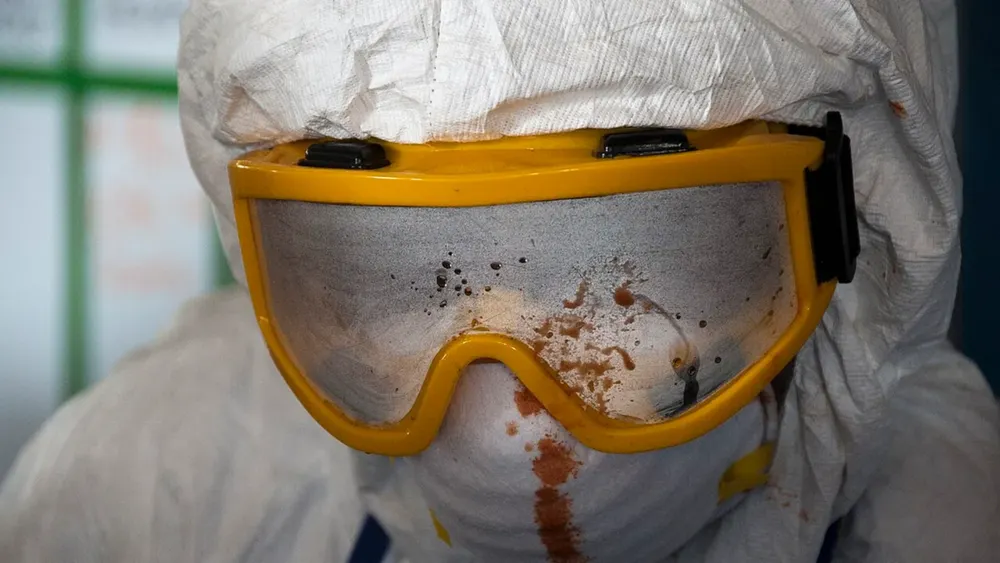
Vanisa Anifa was six months old. She died of Ebola in Bunia, in eastern Democratic Republic of the Congo, and was buried on June 19 at the Bigo Cemetery. She appears in the photographs as a small bundle, wrapped in cloth, carried by relatives through a graveyard filling faster than anyone anticipated. She is one of 277 people confirmed dead in an outbreak declared on May 15. The outbreak has now produced 1,094 confirmed cases in 38 days. France confirmed its first imported case yesterday — a doctor who had been in the DRC on a humanitarian mission. The virus has left Africa.
The figures require a moment. This is the third largest Ebola outbreak in recorded history, surpassed only by the 2014 to 2016 West Africa outbreak that killed more than 11,000 people across multiple countries. It is also, by the WHO's own assessment, the fastest-spreading first month of any Ebola outbreak ever recorded. The 2014 outbreak took 78 days to reach 250 deaths. This one took 37. The causative agent is the Bundibugyo strain of the virus — the rarest of the major Ebola types, last seen in 2012, and covered by no approved vaccine and no approved treatment. Both existing Ebola vaccines target the Zaire strain. Neither works for Bundibugyo. Health workers in a conflict zone, treating patients in a disease with a 25 per cent case fatality rate, have no pharmacological tools and no ability to vaccinate the exposed.
Dr Abdirahman Mahamud, Director of Health Emergency Alert and Response Operations at the WHO, returned last week from a month in the DRC. He said six words that carry everything: 'The outbreak is moving faster than us.'
It is moving faster in part because it was not caught in time. Officials do not know when the outbreak started. They do not know who patient zero is. Virus circulating in the community months before the May 15 declaration is the prevailing hypothesis — which means the outbreak was almost certainly present in February and March, the precise months when the surveillance infrastructure designed to detect it was being defunded. The International Rescue Committee confirmed that the Trump administration's cuts in March 2025 prompted a reduction in disease surveillance systems in the epicentre. Before those cuts, the IRC had funded outbreak preparedness activities across eastern DRC — hand-washing stations, isolation facilities, contact tracing networks, community health worker training. That funding ended in March 2025. 'Everything stalled while the outbreak continued,' a former USAID official told CNN. A year later, almost everyone on the USAID team that managed the previous DRC Ebola outbreak has been fired.
The US withdrew from the WHO in January 2025. The WHO, deprived of its largest donor — which historically contributed 15 per cent of its total budget and 25 per cent of its health emergency programme — cut its own budget by $1 billion, a 21 per cent reduction. Its 10 major programme divisions have been consolidated to three. The agency that is supposed to coordinate the global response to exactly this kind of outbreak is running on a budget cut by the country that triggered this outbreak's delayed detection by defunding the surveillance system that would have found it first.
Contact tracing is the core instrument available when no vaccine exists. Only 55 per cent of exposed contacts have been located and monitored. More than 35,000 people who came into contact with confirmed cases remain untraced. The gap exists partly because Allied Democratic Force fighters, an armed group affiliated with Islamic State, have cut off access to entire villages in Ituri Province, where the outbreak is worst. Partly because treatment centres have been attacked and burned by communities that distrust health authorities — on May 23, 18 suspected patients escaped a treatment centre in Mongbwalu after residents attacked and set it alight. Partly because people are avoiding hospitals, choosing to die at home rather than enter facilities they associate with isolation and death. 'Everyday life,' the International Organisation for Migration said, 'has become fraught with risk.'
Three million children are in the outbreak zone. Two million displaced people — including 320,000 refugees — live in areas of active risk. Uganda has confirmed local transmission in Kampala, its capital. Germany received a medically evacuated American case earlier this month. France confirmed its case yesterday. The outbreak that began in a remote province of eastern DRC has now reached four countries and two continents.
The global health architecture built after 2014 was designed for precisely this scenario — a fast-moving haemorrhagic fever in a conflict zone with a resistant community and limited state capacity. The surveillance systems that would have detected it earlier were cut in March 2025. The agency that managed the previous outbreak's response has been effectively dissolved. The international body that coordinates global emergency response had its budget slashed. The country that provided the backbone of all three announced it was leaving.
Vanisa Anifa was six months old. The outbreak was moving faster than the people trying to stop it before she was born.