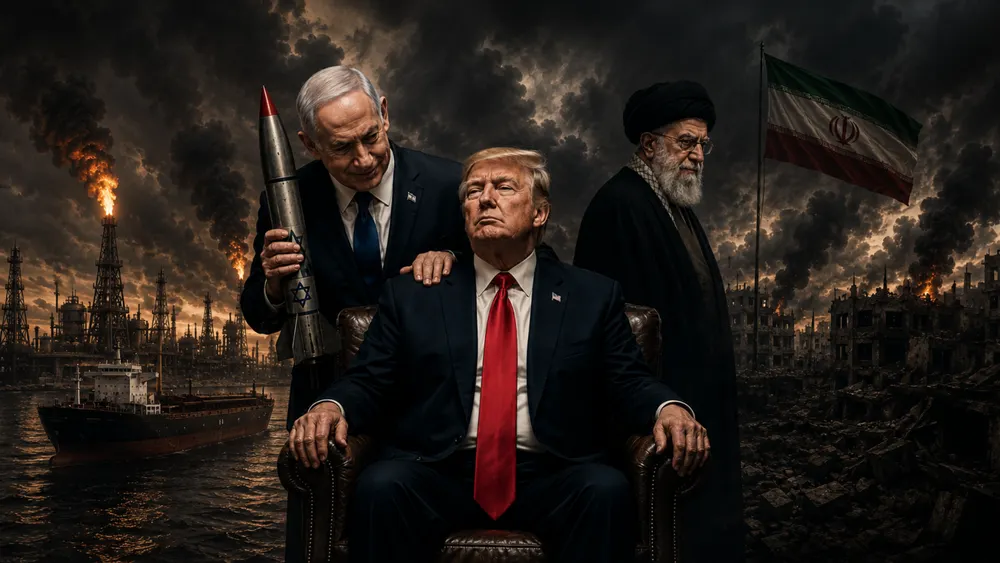
On June 15, 2026, the day the United States announced a peace deal with Iran, Israel's National Security Minister Itamar Ben Gvir walked into a Knesset faction meeting and made a demand. He wanted Israeli soldiers to continue, in his own words, "the vital activity of demolishing homes, eliminating Hezbollah terrorists, and distancing residents from their homes" in southern Lebanon. The same day, Defence Minister Israel Katz issued a formal statement: the Israel Defence Forces would remain in their security zones in Lebanon, Syria and Gaza "without any time limit." Finance Minister Bezalel Smotrich said Israel must not accept the ceasefire at all.
Hours earlier, Donald Trump had posted his announcement on Truth Social. "Ships of the World, start your engines. Let the oil flow!" he wrote, authorising the reopening of the Strait of Hormuz and the removal of the US naval blockade simultaneously. Iran's Deputy Foreign Minister Kazem Gharibabadi, quoted by Iranian state media on Telegram, described the same agreement as a victory in the face of foreign aggression.
Three Israeli cabinet ministers rejected, qualified or demanded the reversal of a deal on the same day those two statements were made. The deal they were rejecting was signed by the United States. Israel was not at the table. Israel signed nothing.
This is not the first time this sequence has played out. The pattern has a name and a documented record. Call it the Gaza Template.
What Happened Last Time
The template has been applied three times in eighteen months, and each iteration has followed the same structure.
On November 27, 2024, a US and France-brokered ceasefire took effect between Israel and Lebanon. Under its terms, Israel was required to withdraw its forces from southern Lebanon within 60 days and Hezbollah was to remain north of the Litani River. UN experts documented that Israel continued to strike Lebanese territory almost daily throughout the ceasefire period and kept its forces at five positions inside Lebanon in direct violation of the deal's terms, with the UN describing Israel's occupation of those positions as blatantly contradicting the agreement. The ceasefire was set to expire on March 2, 2026. When it did, fighting resumed within days.
On January 19, 2025, a Gaza ceasefire took effect following an agreement sealed on January 15. Trump announced it as a historic achievement. The deal had three phases: a six-week first phase covering hostage releases and a phased Israeli withdrawal, followed by negotiations on harder questions. The ceasefire lasted 57 days. On March 18, 2025, Israel renewed its campaign with a fresh bombardment of Gaza, killing more than 400 people on the first day. The stated reason was Hamas non-compliance with hostage release terms. The framework that was supposed to produce a permanent settlement produced a two-month pause followed by a resumption of fighting that continued through the summer and autumn of 2025.
By June 2026, a second Gaza ceasefire — announced in October 2025 — was technically in effect, though low-level operations and violations continued throughout the Iran war period.
The pattern extends beyond ceasefires to the institutional architecture Trump builds around them. In January 2026, as the second Gaza ceasefire took hold, Trump announced the Board of Peace to oversee Gaza's reconstruction and governance, appointing himself chairman and describing it as potentially the most consequential international body in history. Members included former British Prime Minister Tony Blair (in his personal capacity), Jared Kushner, Secretary of State Marco Rubio and the World Bank president" to "Members included former British Prime Minister Tony Blair, Jared Kushner, Secretary of State Marco Rubio, Special Envoy Steve Witkoff and World Bank President Ajay Banga. There were no Palestinians on the Board. France, Germany, the United Kingdom, Norway, Sweden and Spain declined invitations to join. As of June 2026, Gaza's reconstruction has stalled. The Iran war diverted international attention and donor funding. An official from an aid organisation operating in the territory described current measures as "a Band-Aid." The World Bank estimates reconstruction will cost 53 billion dollars. Trump has not published the Board's resolutions on its official website. The Board has held one formal meeting.
The pattern across all three ceasefires and the institutional framework around them is consistent: a US announcement, a short initial compliance period, Israeli military actions the US does not publicly contest, and an eventual collapse or stall attributed to circumstances beyond Washington's control.
What the Ministers Are Saying
Ben Gvir's statement is the most precise. He does not object to the Iran deal on strategic grounds. He objects to it as a constraint on Israeli military activity. He wants houses demolished. He wants Hezbollah fighters eliminated. He wants residents distanced from their homes. He says the security of Israeli citizens stands above all other considerations and that Israel is "not bound by agreements that put an end to its ability to defend itself."
Katz's statement is the most consequential. The Defence Minister controls the IDF. His position is not a party-political objection — it is a policy statement. He says the IDF will remain in its security zones in Lebanon, Syria and Gaza without time limit. He says those zones will be cleared of residents. He says all infrastructure, above and below ground, including houses in villages along the contact line, will be destroyed. He issued this statement on the same day the United States announced a deal that reportedly includes a ceasefire in Lebanon.
Netanyahu's position sits between endorsement and qualification. He says he saved Israel from annihilation. He says he supports the deal. He also says Israel retains its freedom of operation in Lebanon. Those two positions are not compatible if the deal's terms are taken seriously. Netanyahu has found a way to say yes to Washington and yes to his coalition simultaneously. That is the same calculation he made in November 2024 and January 2025. It produced the same result both times.
Hezbollah and the Missing Party
On June 4, eleven days before the US-Iran deal was announced, Israel and Lebanon agreed to a new ceasefire framework in Washington. Hezbollah rejected it the same day. Naim Qassem, Hezbollah's leader, called the negotiations "absurd, humiliating and insulting" and said the terms fulfilled "the enemy's objectives." His objection was specific: the ceasefire required Hezbollah to cease attacks and withdraw its fighters from parts of southern Lebanon while making no reciprocal demand on Israeli forces. Hezbollah told the Lebanese president it would not accept any ceasefire that did not begin with the withdrawal of Israeli forces from south Lebanon. "We have given no commitment to anyone," Qassem said. Iran's Revolutionary Guard commander Esmail Qaani stated that Israel must return to its pre-war positions as a first condition. Iran's Foreign Minister Abbas Araghchi had said in April that "the US must choose — ceasefire or continued war via Israel. It cannot have both."
The June 15 deal supersedes the June 4 framework and reportedly includes Lebanon in its ceasefire terms. But Hezbollah's stated condition has not been addressed. Defence Minister Katz confirmed this on June 15: the IDF will remain in its security zones in southern Lebanon without time limit. The houses will be demolished. The residents will be distanced. Hezbollah demanded Israeli withdrawal as the precondition for any ceasefire acceptance. Israeli forces are not withdrawing. Hezbollah was not at the table on June 15 any more than it was on June 4. The deal was announced. The condition Hezbollah set remains unmet.
The Structural Problem
The US-Iran deal has a 60-day negotiating window during which the parties are supposed to resolve the hard questions: enrichment levels, sanctions, Iran's stockpile of highly enriched uranium. During that window, the ceasefire is supposed to hold across all fronts including Lebanon. But the ceasefire's primary threat does not come from Tehran.
Mojtaba Khamenei assumed the role of Supreme Leader on March 8, 2026, nine days after the US-Israeli strikes killed his father. He has not appeared publicly since the war began. His approval was required before Iran could sign. He gave it. Iran's Foreign Minister had already said, before the deal was announced, that Israel's attack on Beirut on June 14 proved that Washington lacked the will or ability to fulfil its commitments. The ministerial statements of June 15 suggest he was making an accurate prediction, not a diplomatic complaint.
The United States has no enforcement mechanism over Israel that it is willing to use. It funds the Israeli military. It supplies the weapons. It provides the diplomatic cover at the UN Security Council. Withholding any of these is not a serious option within the current American political configuration. Trump posted on Truth Social on June 14 asking Israel not to blow the deal. Israel continued operations in Beirut regardless. The post was the full extent of American pressure.
The Template Applied
The Gaza Template works as follows. Washington announces a deal and claims a diplomatic victory. Israel accepts in principle while reserving the right to continue operations it deems necessary for its security. The operations continue. The other party to the deal points to continuing operations as evidence of bad faith. The deal's text is contested before it is implemented. Each side accuses the other of violations. The 60-day clock runs down. A second phase is announced or the deal collapses. A new escalation provides the next reset. The Board of Peace holds another meeting.
The ceasefire in Lebanon has already been contested before implementation. The June 4 framework was rejected by Hezbollah within hours. The June 15 deal was rejected by three Israeli cabinet ministers within hours. Israel says it retains freedom of operation in Lebanon. Hezbollah says Israeli withdrawal is the precondition for any ceasefire acceptance. The deal says the ceasefire includes Lebanon. None of these positions are compatible.
What Changes and What Does Not
The deal does change things. The Strait of Hormuz — through which roughly 20 percent of the world's oil passes — is set to reopen, though Trump confirmed on Sunday that the waterway must first be cleared of mines before shipping resumes. The US naval blockade on Iranian ports is lifted simultaneously. Sanctions on Iranian oil and petrochemicals are suspended. Twenty-four billion dollars in frozen Iranian assets are to be released during the 60-day negotiating period. For the import-dependent economies of South Asia, East Africa and Southeast Asia — the countries that absorbed the cost of a war they did not choose — those are real and significant changes.
What does not change is the military architecture that produced the war. Iran retains its nuclear programme, its missiles and its proxies. Israel retains its positions in Lebanon, Syria and Gaza. The Palestinian question is unaddressed. The Board of Peace has held one formal meeting. Hezbollah's weapons are intact. The structural conflict between Israeli military presence and Iranian-backed armed groups across the region continues.
In January 2025, Trump announced a historic Gaza ceasefire. It lasted 57 days. In November 2024, the US brokered a Lebanon ceasefire. UN experts documented near-daily Israeli violations throughout its life before it expired. In January 2026, Trump announced the Board of Peace. Gaza's reconstruction has stalled. In June 2026, Trump announced a historic Iran deal. Three Israeli cabinet ministers rejected it on the day of the announcement while demanding the continuation of the military activity the deal was supposed to stop. Hezbollah, the armed group that controls the territory where the ceasefire is most immediately contested, was not party to the agreement and has not accepted its terms.
The template does not guarantee failure. But it carries a record. And the record shows that American ceasefire announcements in this region have a consistent lifespan: approximately 60 days, contested throughout, collapsed when the harder questions arrive.
"Ships of the World, start your engines. Let the oil flow!" Trump wrote on Sunday evening. By Monday morning, Israel's Defence Minister had announced the IDF would stay in Lebanon without time limit. The Strait will need to be cleared of mines before the oil can flow at all.
This Analysis piece is free to read. Future Analysis pieces will be available to registered DiploPolis members first. Free registration takes 30 seconds. No credit card required.