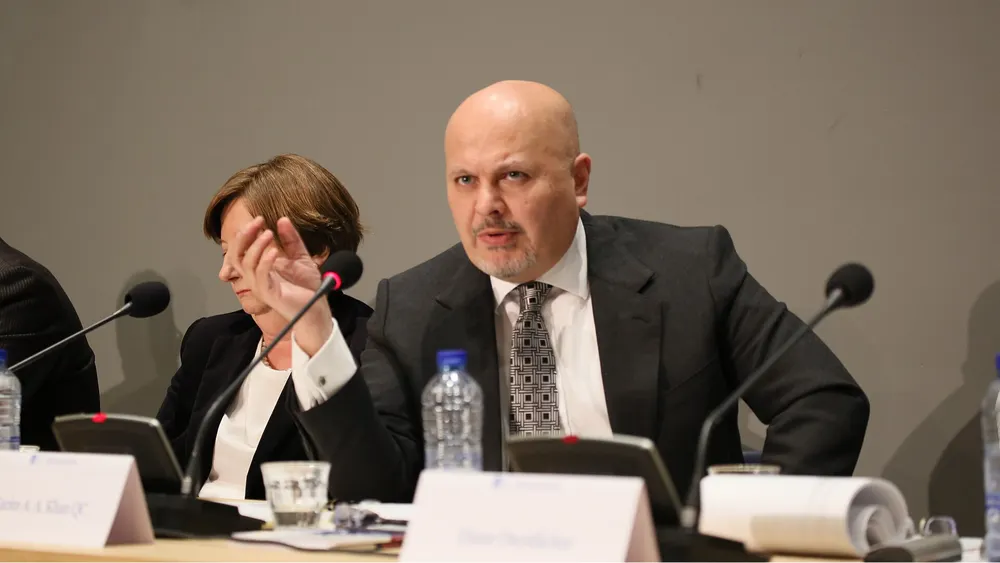
At four in the afternoon on July 24, 2026, Päivi Kaukoranta, president of the International Criminal Court's Assembly of States Parties, read aloud the result of a closed-door vote at UN Headquarters in New York. The Assembly had decided, by a majority of 82 of its 125 member states, that prosecutor Karim Khan had committed serious misconduct and a serious breach of duty, and had voted to remove him from office. Thirteen states voted against removal. Fifteen abstained. Khan had been elected to serve a nine-year term in 2021. He was four years into it. No sitting ICC prosecutor had ever been removed. The announcement asked, formally, for the dignity and privacy of all those involved.
Hours later, Israel's ambassador to the United Nations, Danny Danon, released a statement. 'Karim Khan believed that by launching a political witch hunt against Israel and issuing a politically motivated arrest warrant against Prime Minister Netanyahu, the world would ignore the grave sexual misconduct allegations against him,' Danon said. 'He was wrong.'
The Netanyahu arrest warrant, issued by Khan in November 2024, remains active and unexecuted in The Hague. The man who issued it has been removed. The man named in it has not been touched.
The International Criminal Court has spent twenty-four years building a record of seven convictions and thirty-four current cases. It has issued warrants for Vladimir Putin and Benjamin Netanyahu. It cannot arrest either of them. On July 24, it removed the only prosecutor it has ever had who tried to hold a Western ally's prime minister to account. That removal may have been justified. It may have been political. The specific facts of this case make it impossible to be certain of either, and the impossibility itself is the story.
The Entanglement
The misconduct allegations against Khan are real and serious. The Associated Press reported in 2024 that a female aide had accused him of coercive and non-consensual sexual behaviour over approximately a year, occurring at the ICC office, at Khan's home and during work trips. Khan categorically and consistently denied everything. Two court employees to whom the alleged victim had confided reported the misconduct to the court's independent watchdog in May 2024. That was weeks before Khan formally sought arrest warrants against Netanyahu, his then-defence minister Yoav Gallant and three Hamas leaders.
In the days before the Assembly vote, Khan's accuser appeared in a public interview with CNN's Christiane Amanpour — the first time she had spoken publicly about the allegations. The interview changed the political context of the vote. The Assembly had been scheduled to act regardless, but the public disclosure meant the vote took place in full view of the allegation rather than as a closed proceeding on a confidential matter.
The ICC requested an external investigation by the UN Office of Internal Oversight Services in November 2024. In May 2025, Khan announced a leave of absence pending its conclusion. His deputy prosecutors assumed leadership of the Office of the Prosecutor. In March 2026, a panel of three judges submitted its findings to the Assembly's oversight body. The panel had examined the full evidential record. Tayab Ali, leading Khan's legal team, stated publicly that the panel had unanimously determined that the OIOS findings 'did not establish misconduct or breach of duty by Mr Khan under the relevant legal framework.'
The Assembly voted to remove him anyway.
The Bureau of the Assembly, working from the OIOS report, the judicial panel's conclusions, the underlying evidence and written submissions, voted by a qualified majority in June 2026 to refer the matter to the full Assembly and suspend Khan immediately. On July 24, the Assembly voted 82 to remove him. Kaukoranta specifically stated, in response to Khan's legal team, that the Assembly had 'fully respected Khan's due process' and that 'the investigation did find evidence supporting the misconduct allegations.' Whether the Bureau and the Assembly reached a different conclusion from the judicial panel by weighing the evidence differently, or whether considerations other than the evidence shaped their calculus, the proceedings were closed. The question cannot be answered from outside.
What can be said is that the proceedings concluded in an environment in which the United States government had sanctioned Khan personally, sanctioned nine other ICC officials including judges and deputy prosecutors, and made its political objection to the Netanyahu warrant explicit and public. In August 2025, the UN General Assembly president described the American sanctions as 'a flagrant attack on judicial independence'. The UK's Bar Standards Board separately upheld a suspension of Khan's professional registration. Iva Vukusic, a researcher at Utrecht University who had been following the proceedings, told the AP that political considerations had been 'folded into' the process, particularly because it was 'the first time a prosecutor has pursued warrants against a Western ally.'
The entanglement that Vukusic identified is not a conspiracy theory. It is a description of how a disciplinary process, legitimate in its origins, becomes impossible to separate from its political environment when that environment has been deliberately saturated with hostility by the world's most powerful government. The allegations against Khan may be true. A judicial panel concluded they were not established under the relevant legal framework. The Assembly removed him regardless. All of these things can be simultaneously true, and together they produce an outcome whose legitimacy is permanently contested.
What the Court Inherits
The ICC's Office of the Prosecutor is now run by its two deputies. One of them, Mame Mandiaye Niang, is under American sanctions. The other, Nazhat Shameem Khan, is not yet sanctioned but leads an office that has operated for more than a year under the shadow of American financial and travel restrictions on its senior staff. The court must elect a new chief prosecutor. The process for doing so will take months. During those months, the court's two most consequential open investigations, Gaza and Ukraine, will proceed under officials whose personal bank accounts and travel have been subjected to US government restriction specifically because of the work they are doing.
The court that cannot make arrests without state support has now lost its most senior official while seven of its judges and multiple prosecutors remain sanctioned by the most powerful state that refused to join it. The relationship between those two facts is not subtle.
In twenty-four years, the ICC has convicted seven individuals. Every one of them was African or from a country without the protection of a major power's political support. The court has opened investigations in Afghanistan, Palestine, Ukraine and elsewhere. It has issued warrants for Putin, Netanyahu and senior American-allied officials. It has collected none of them. It has convicted militia commanders from the Central African Republic and the Democratic Republic of Congo. The pattern of who is collected and who is not is not a product of judicial neutrality. It is a product of power.
The UN Secretary-General's office affirmed on July 13 — eleven days before the Assembly vote — that the ICC remains 'a critical cog' in global justice efforts. That affirmation came as calls to abolish the court were already circulating. The vote to remove Khan has not helped the argument for its survival. Khan's defenders will say the removal was political. His critics will say the warrant for Netanyahu was political. The court sits in the middle of both arguments, unable to enforce either judgment.
The Netanyahu arrest warrant was issued under Article 27 of the Rome Statute, which affirms that official capacity, including head of government, provides no immunity. That provision was the founding promise of the post-Nuremberg legal order — the specific commitment that power would not exempt itself from accountability. The warrant sits in The Hague. Netanyahu continues to govern. He attended a Knesset session this week. He appeared at a memorial ceremony. He has not been arrested and will not be.
The man who issued the warrant has now been removed from the office that issued it. His deputy, who now holds that office, is sanctioned by a government that imposed those sanctions specifically to constrain the court's work. The Assembly that voted to remove Khan included states that voted for South Africa's genocide case in The Hague, states that marched at the UN for Palestinian rights, states that issued communiqués denouncing Israel's conduct in Gaza. Eighty-two of them voted to remove the prosecutor who charged Netanyahu with war crimes.
Whether they voted to enforce procedural integrity or to relieve political pressure, or some combination of both, the result is identical: the court's most consequential prosecution has lost its author. Israel's ambassador celebrated. It would be too convenient to say that his celebration proves the removal was political. It would be equally convenient to say that the judicial panel's unanimous clearing of Khan proves it was not. The truth of what happened in the Bureau's deliberations will not emerge from public record.
What has emerged is this: the ICC cannot reach Netanyahu. It cannot enforce its warrant. It cannot compel compliance from states that ignore its orders. It has now removed the prosecutor who was most associated with the attempt to reach him, under a process that a judicial panel concluded did not establish the legal basis for removal, in an environment saturated with political pressure from a government explicitly opposed to that prosecution. The court has seven convictions, thirty-four cases and no chief prosecutor. Its deputy is sanctioned. Its warrant is unexecuted.
That is not the court failing. It is the court revealing, again, what it has always been: an institution whose reach extends as far as the political will of its members allows. That will was tested by its most consequential case. On July 24, 2026, it was found, again, to be insufficient.
This Analysis piece is free to read. Future Analysis pieces will be available to registered DiploPolis members first. Free registration takes 30 seconds. No credit card required.
Find this piece interesting?
Dispatches by DiploPolis delivers sharp analysis and pointed commentary on power, politics, diplomacy, and world affairs — directly to your inbox.
No neutrality. No noise. Just argument.