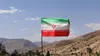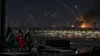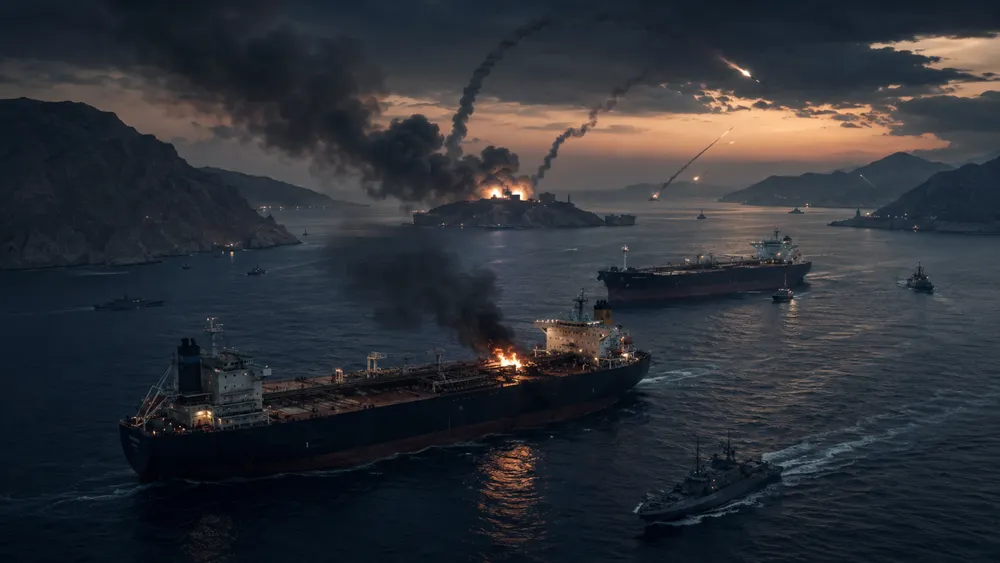
On August 30, US forces struck Iranian rocket launchers on a small island in the Strait of Hormuz. Tehran retaliated by launching missiles at US military targets in Jordan. On August 31, a tanker was struck by three unknown projectiles seventeen nautical miles east of Khasab, Oman. Jordan's armed forces said it shot down eight missiles entering its airspace. At noon ET on September 1, CENTCOM announced that US forces had begun striking Islamic Revolutionary Guard Corps targets in Iran — air defence sites, radar systems, maritime assets and facilities, mine-laying capabilities and communications sites. For the first time in the conflict, US forces struck two Iranian government tankers directly under what officials described as a 'tanker for tanker' policy. Iran reported at least 18 killed, four of them at a wedding ceremony in a coastal town, a claim CENTCOM denied. Iran's foreign minister said Tehran had targeted US assets in Bahrain, Jordan, Kuwait and Iraq. Saudi Arabia said Iran had struck a Saudi tanker in Hormuz and killed crew members.
The Islamabad Memorandum, signed at Versailles on June 17, 2026, lasted 75 days.
The war that paused on June 17 resumed on August 30 at a higher escalation level than the one at which it paused. The MOU did not hold the conflict at the point where the ceasefire found it. It held it for 75 days, during which Iran restructured its military, accelerated its weapons output and appointed a hardline IRGC veteran to head its supreme security council — and the war resumed with the United States implementing a policy it had not previously used: striking the other side's commercial vessels in direct retaliation for the other side's attacks on commercial vessels. The tanker for tanker precedent is new. The conflict it governs has been running since February 28.
What the Pause Was Worth
The Islamabad Memorandum was presented, at Versailles, as the beginning of a resolution. The G7 applauded it at Évian. Bessent described it as 'a historic step toward sustainable peace.' Iran's foreign minister described it as the end of the war, not a ceasefire — and said that since the US had violated it within 48 hours of signing, there was nothing to extend. Both readings were, in different ways, accurate: it was historic in the sense that it temporarily halted the most intensive American air campaign since Iraq in 2003, and it was not a ceasefire in the sense that the conditions that produced the war remained entirely unresolved.
DiploPolis tracked what Iran did with the 75 days in August: the IRGC was given greater authority over the regular military; military appointments shifted toward hardliners with experience in previous conflicts; missile and drone production was accelerated; Mohsen Rezaei, a former IRGC commander, was named head of Iran's Supreme National Security Council. The Wall Street Journal reported that Iran's hardline leadership treated the MOU as a tactical pause and possibly as a US-Israeli ploy to ease pressure on the global economy while buying time for a larger operation. Whether or not that reading was accurate, the 75 days of pause produced, on Iran's side, a more consolidated IRGC and a more hardline political leadership. On the American side, the 75 days produced sanctions packages that China refused to join, a Hormuz mine-clearing operation and a further degradation of the Patriot interceptor stockpile that the Ukrainian government had been refused access to in July.
The MOU's 60-day clock was supposed to produce a nuclear deal. The clock expired on August 17 without one. The 75 days of the pause — from Versailles to the resumption of fighting — produced no settled question. Iran's enrichment programme remains intact. The Hormuz arrangement with Oman was never completed. The Lebanon provisions that were the first clause of the MOU and the structural flaw the DiploPolis Lebanon Trap piece identified in June were never resolved. The Islamabad Memorandum produced a pause. The pause produced preparation. The preparation produced escalation.
The Escalation the Pause Made Possible
The specific character of the resumed fighting is worth noting because it differs from the pre-MOU conflict in one documented way: the tanker for tanker policy. Throughout the first phase of the war — from February 28 to the June 17 ceasefire — the US struck Iranian military targets, infrastructure, naval vessels and missile sites. It did not formally adopt a policy of striking Iranian commercial tankers as direct retaliation for Iranian attacks on commercial shipping. The September 1 strikes changed that. CENTCOM struck two Iranian government tankers. Trump described the strikes as 'a very heavy attack' that 'took out all of the new equipment they tried to build along the Strait of Hormuz.' He threatened a 'much bigger attack' if Iran retaliated again.
The escalation ladder has moved. Each phase of the conflict has introduced weapons, targets or policies that the previous phase had not. The initial strikes on February 28 produced Iranian naval mining of the Strait. The mining produced US mine-clearing operations. The mine-clearing produced Iranian attacks on vessels transiting the cleared corridor. The vessel attacks produced the tanker for tanker policy. Each step has formalised a precedent that then governs the next phase. The tanker for tanker policy will govern the next round of negotiations, if there are negotiations, as a baseline that did not exist before the MOU.
NPR reported that a supertanker had caught fire over the weekend after striking two naval mines in the Strait — a detail that contradicted the US military's claim that it had cleared mines from the international shipping routes. CENTCOM had announced on August 25 that underwater drones had identified over 100 suspected mines and private contractors had dealt with them. The mines that stopped the supertanker were not in the cleared corridor. The Strait of Hormuz is not a contained waterway. Its geography resists the administrative logic that 'cleared' and 'safe' are the same condition.
Putin and Pezeshkian met on September 1 and reaffirmed the Moscow-Tehran alliance. Putin expressed support for Iran's position in the conflict. Pezeshkian thanked Putin and said Tehran remained ready for diplomacy. Qatar said it was making efforts to restart negotiations. The diplomatic track and the military track are running simultaneously, as they have been since February 28, producing no conclusion on either. The latest round of diplomacy that Qatar is attempting will have to account for the tanker for tanker policy, the Saudi tanker Iran struck, the IRGC command restructuring and the 75 days the MOU provided without resolving the war's underlying causes.
What Comes After the Pause
The Islamabad Memorandum's architects presented it as the foundation for a negotiated resolution. Its actual function was to hold the conflict at a particular level while both sides prepared for what came next. Iran prepared by restructuring its military. The US prepared by sanctioning 60 entities in multiple countries, clearing Hormuz mines and attempting to build an economic coalition that China declined to join. Neither preparation produced a resolution. Both produced the conditions for the resumed conflict.
The GlobalSecurity.org daily report for September 2 described the Strait as 'a two-sided kinetic theater again.' The language is military and precise. The Strait of Hormuz is not a diplomatic problem. It is a physical waterway through which 20 per cent of the world's oil passes, contested by two militaries implementing opposing policies about who controls it. The MOU's provision on Hormuz — which committed both parties to 60 days of negotiations about its reopening — produced, after 75 days, a tanker for tanker policy and a resumed naval confrontation in the disputed waters.
Trump called Iran a 'failed nation' on August 31. Iran's IRGC said the US was 'defeated on the battlefield' and resorting to economic pressure as a result. These are the public positions of two governments that fought a 75-day ceasefire and emerged from it with the same objectives they entered with. The MOU produced a pause. The pause produced what pauses between unresolved conflicts produce. The Ceasefire That Wasn't — DiploPolis's characterisation from June — has become the War That Resumed. The MOU's legacy is not what it resolved. It is what it deferred while Iran restructured its IRGC and the US ran out of Patriot interceptors.
This Analysis piece is free to read. Future Analysis pieces will be available to registered DiploPolis members first. Free registration takes 30 seconds. No credit card required.
Find this piece interesting?
Dispatches by DiploPolis delivers sharp analysis and pointed commentary on power, politics, diplomacy, and world affairs — directly to your inbox.
No neutrality. No noise. Just argument.