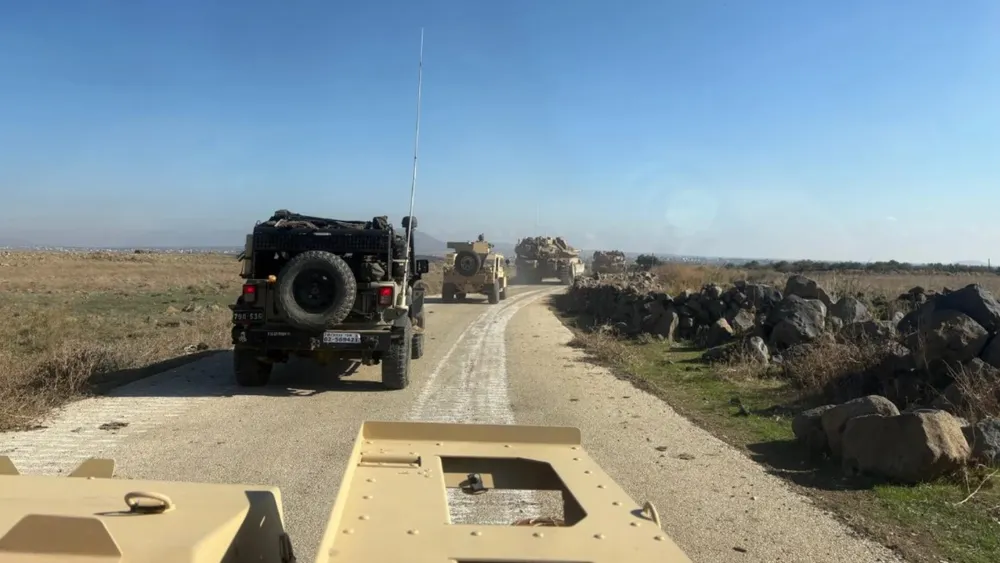
The Israeli army was preparing a nighttime strike on a group of men in southern Syria when the soldiers noticed the long curls dangling from the temples of their targets. They held their fire. These were not Syrian militants attempting to breach Israel's border. They were religious Jews who had slipped into Syrian territory and were making their way back.
The episode, first reported by Israel's Kan public broadcaster and confirmed to the Associated Press by the Israel Defence Forces, is the clearest image of what the Israeli settler movement has become. Soldiers in a theatre of active military operations, tasked with securing an occupied buffer zone, nearly engaged Jewish civilians because the operational environment no longer permits reliable distinction between an armed infiltration and a religious one. The settlers who caused the confusion are members of a group called the Pioneers of Bashan, and they are being described, across Israeli and international media, as fringe.
Lebanese Deputy Prime Minister Tarek Mitri has a response to that. Writing on X this week about attempts by a parallel settler group — Uri Tzafon — to enter Lebanon, Mitri noted that both groups are being called fringe and that the movement to settle the West Bank 'in its early days was a small group that faced some obstacles and difficulties.' It was called fringe. It was Gush Emunim. His observation applies with equal force to both groups.
What the Pioneers of Bashan Are
The group was founded in April 2025, led by Amos Azaria, a computer science professor at Ariel University in the West Bank. Its name comes from the biblical region of Bashan, which encompasses what is now southwestern Syria — the governorates of Quneitra, Deraa and Suweida. Members number in the dozens. Their objective is to establish Jewish settlements inside Syrian territory currently held by the Israeli military. They have been crossing from Israel into Syria every few days in recent weeks.
On August 18, 2025, the group held a cornerstone-laying ceremony beyond the Syrian border for a settlement they called 'Neve HaBashan.' Some participants planted an Israeli flag. The IDF detained a number of them and transferred them to police. Channel 12 has reported that no indictments have since been filed.
On July 5, 2026, a video on the group's social media showed teenage members seated on the ground with their arms linked together as soldiers tried to separate them. A second video showed soldiers shoving activists and zip-tying their hands. An earlier video, from April, showed several dozen activists waving Israeli flags and chanting on the roof of a house on the outskirts of the Syrian village of Hader in Quneitra province, with Israeli soldiers watching on.
The IDF has described the border crossings as a 'serious criminal offence that endangers civilians and Israeli military forces'. It says it detains civilians caught crossing and hands them to police, expecting 'law enforcement authorities to bring those involved to justice.'
Amos Azaria has explained the group's strategic aims without ambiguity. 'The entire Daraa district,' he said, 'must be cleared of the enemies seeking our destruction and instead be filled with Jewish settlement.' Azaria also said the group aims to establish a 'humanitarian corridor' from Israel to the Druze enclave of Suweida by depopulating adjacent Sunni-majority areas. The language of humanitarian purpose and the language of ethnic displacement are being used interchangeably.
The Government They Have
The word fringe implies distance from the political mainstream. The Pioneers of Bashan do not have that distance.
In April 2026, the Israeli cabinet passed legislation to facilitate the relocation of approximately 3,000 settler families to the Golan Heights by 2030. This is not the policy of a government hostile to the Pioneers of Bashan's ambitions. It is the adjacent policy — the legal, official, government-endorsed version of the same territorial project. The settler families moving to the Golan will be one side of the Syrian buffer zone. The Pioneers of Bashan want to be on the other.
The group's social media accounts document meetings it has held with cabinet ministers Amichay Eliyahu of Otzma Yehudit, Ben-Gvir's party, and Shlomo Karhi of Likud. 'We have support from friends in the government and many members of the Knesset,' Azaria has said. This week, Defence Minister Israel Katz ordered the end of an administrative restraining order on a detained settler extremist, a gesture whose timing was noted by Israeli civil society groups monitoring settler violence.
The IDF's insistence that it takes firm action against unauthorised crossings sits alongside the fact that no indictments have been filed against a group that has staged repeated illegal incursions into occupied foreign territory, nearly been shot by Israeli soldiers who could not identify them as civilians, and laid foundation stones on Syrian soil. The criminal justice system's response to the Pioneers of Bashan's activities, as of July 2026, is a consistent pattern of detention, release and repetition.
There is also a parallel group operating in Lebanon. 'Uri Tzafon' — meaning 'Awaken, O North' — has staged incursions into southern Lebanon with a similar aim. Israel militarily occupies approximately 570 to 600 square kilometres of Lebanese territory. Settler activists have been crossing into it. The army removes them. They return.
The Template and the Timeline
The West Bank was not settled by government decree. It was settled by Gush Emunim.
Gush Emunim was founded in 1974 as a religious-nationalist movement dedicated to Jewish settlement across the biblical Land of Israel. In its early years it was precisely what Mitri described — a small group, measured in hundreds, that repeatedly attempted to establish illegal outposts and was repeatedly removed by Israeli military and civilian authorities. The government of Israel, at various points, opposed its activities, detained its members, demolished its structures and declared its settlements unauthorised.
Today there are approximately 700,000 Israeli settlers in the West Bank and East Jerusalem, living in settlements that successive Israeli governments built, funded, connected to Israeli infrastructure and defended with Israeli military force. The process took five decades. It began with a fringe group that the army kept removing from hilltops.
The relevance of this history to southern Syria is not an inference. It is what Lebanese Deputy Prime Minister Tarek Mitri explicitly named this week, noting that the West Bank settlement enterprise 'in its early days was a small group that faced some obstacles and difficulties.' Mitri's point is structural: the question is not whether a group is currently small. The question is what the Israeli state does when the group's activities begin to align with the direction the state is already moving.
The direction the Israeli state is moving in Syria has been documented since December 2024, when Israeli forces occupied 350 square kilometres of Syrian territory within 48 hours of Assad's fall and declared the 1974 disengagement agreement invalid. Israel has since built nine military bases in the buffer zone, a tenth reportedly under construction. Its forces have conducted regular raids, arrested young men at checkpoints, demolished homes and reportedly sprayed agricultural land with chemicals. Human Rights Watch published a report in April 2026 documenting Israeli war crimes in the occupied Syrian Golan. The New Arab published an analysis in February asking whether Israel was imposing a 'West Bank-style occupation' on southern Syria.
The answer to that question, as of July 2026, is: the architecture is in place. The settler movement is arriving. The cabinet has legislated for 3,000 families. The military is removing unauthorised civilians from unauthorised outposts and filing no charges. The government has ministers who meet with the pioneers.
The word 'fringe' describes the current size of a group. It says nothing about the direction the group is moving, whether the institutional environment will harden against it or accommodate it, and whether the state whose military is the only thing standing between the group's ambitions and their realisation has the political will to maintain that position permanently. In the West Bank, the answer to all three questions took five decades to become clear.
In Syria, the timeline appears to be compressed. The military occupation is fourteen months old. The settler incursions began within weeks of it. The cabinet passed legislation for Golan settlements within four months. The Pioneers of Bashan laid their first foundation stone within a year of being founded.
Gush Emunim waited three years before its first foundation stone at Sebastia in 1974. The Israeli government removed them. They went back. Eventually the government did not remove them. The rest is the map of the West Bank.
The Question Nobody Is Asking Loudly Enough
The international response to the Pioneers of Bashan's activities has been the Syrian government condemning Israeli military presence and calling for withdrawal, the Lebanese government focusing on Israeli military withdrawal from Lebanon, and periodic statements from UN agencies documenting abuses. The Pioneers of Bashan themselves are so clearly unauthorised that they do not require a formal international response — they are, after all, being removed by the Israeli army.
The question that requires a response is not whether the Israeli army is removing them. It is whether removal, unaccompanied by prosecution, unaccompanied by the cabinet reversing its own settlement legislation, unaccompanied by any signal that the Israeli government's territorial ambitions in Syria differ in kind from those of a group it calls fringe — whether that removal means anything.
Mitri's Gush Emunim warning suggests the answer. The IDF removed Gush Emunim from Sebastia in 1974. It removed them from Kadum in 1975. It removed them repeatedly across the following years. The removals produced photographs and statements and diplomatic reassurances. They did not produce a different outcome. What produced a different outcome was the Israeli government, over time, deciding that the settlers' vision of the territory and the government's vision were compatible enough to merge.
Finance Minister Smotrich has declared territorial ambitions in Syria on the record. Netanyahu endorsed the Greater Israel vision on Israeli television in August 2025. The cabinet approved Golan settlement legislation in April 2026. Cabinet ministers have met with the Pioneers of Bashan. No member of the group has been charged with a crime.
The nighttime almost-strike tells the story more plainly than any ministerial statement. Israeli soldiers in a military occupation of Syrian territory nearly fired on Jewish settlers because the operational environment has evolved to a point where the distinction between civilian and security threat requires identifying a religious man's sidelocks. The army is managing a situation the government has created. Whether the army will manage it indefinitely, or whether the government will eventually arrive at the conclusion it arrived at in the West Bank, is the only question that matters.
Gush Emunim was a small group that faced obstacles and difficulties. The obstacles were real. The difficulties were genuine. The settlements are still there.
This Analysis piece is free to read. Future Analysis pieces will be available to registered DiploPolis members first. Free registration takes 30 seconds. No credit card required.
Find this piece interesting?
Dispatches by DiploPolis delivers sharp analysis and pointed commentary on power, politics, diplomacy, and world affairs — directly to your inbox.
No neutrality. No noise. Just argument.